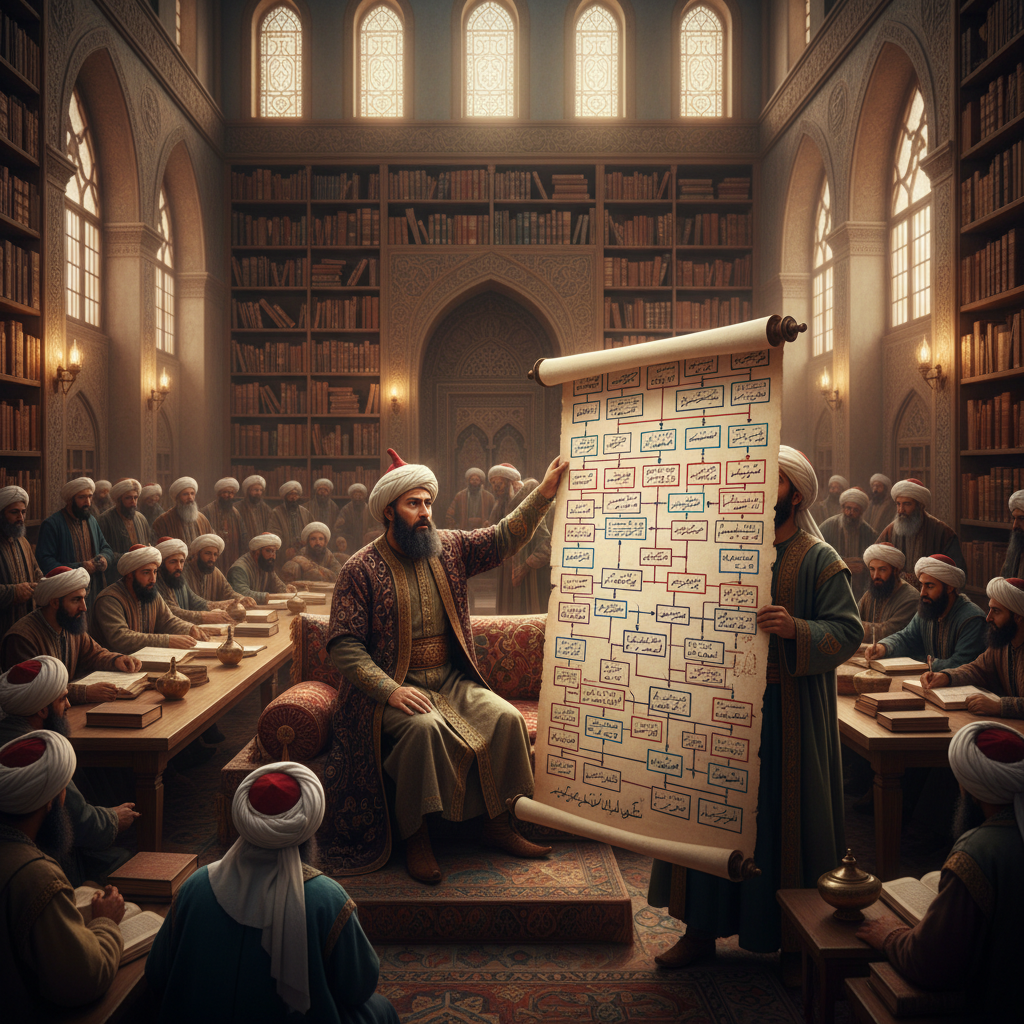
The Accountant of Constantinople
How One Scribe’s Shitty Handwriting Accidentally Invented Bureaucracy

They say the flapping of a butterfly’s wings can cause a hurricane. Well, the mis-scribbled dot of a fly’s shit on an astronomical chart in 821 AD caused something far, far worse: the spreadsheet.
Our hero—if you can call a man this monumentally pissed-off a “hero”—is Muḥammad ibn Mūsā al-Khwārizmī. You can thank him for the word “algorithm.” You can also, in this timeline, thank him for the soul-eating horror of administrative bloat. While proofing the Caliphate’s brand-spanking-new Zīj al-Sindhind tables, a masterwork of celestial mathematics, he found an error. A tiny, infuriating, cosmically insignificant discrepancy in the orbital calculations of Venus. A number that was off by a decimal point. It was a fart in the symphony of the cosmos, and al-Khwārizmī was the only one with a sensitive enough nose to smell it. His rivals at the House of Wisdom in Baghdad probably just fudged the numbers. Not this magnificent bastard. No, he was convinced the original data, inherited from dusty Greek texts, was flawed. The source must be purged.
So began the world’s first inter-empire IT support ticket. After convincing Caliph al-Ma’mun that this wasn’t just a full-blown, OCD-fueled tantrum (it was), he set off for the only place that might have the originals: the Imperial Library of Constantinople. A fun destination, if you enjoy being shadowed by secret police and sneered at by eunuchs who think your turban is gauche. For months, al-Khwārizmī, a pearl of Abbasid genius, was trapped in the waiting room of a Byzantine functionary named Giorgios—a man whose face was a festival of boils and whose primary function was to say “no” in fourteen different ways. He was the human embodiment of a 404 error.
Stuck in this purgatory of paperwork, al-Khwārizmī started studying the only texts they’d let him see: manuals on Byzantine administration. He marveled at the tiered systems of the *Themata*, the byzantine (hey-o!) protocols for tax collection, the sheer procedural artistry of it all. He didn’t find the astronomical answer he sought. He found something better. He saw a system for managing unknowns, for balancing inputs and outputs, for restoring and completing… not equations, but *processes*. He had a revelation, but it wasn’t about numbers. It was about *power*. In the margins of a treatise on provincial grain levies, he sketched out his new system, *al-jabr*, not as a way to find a number, but as a way to find *which bastard has the document you need*.
He returned to Baghdad a changed man. His *Compendious Book on Calculation by Completion and Balancing* was not a slim, elegant volume on solving for *x*. It was a 900-page behemoth on workflow optimization for empires. The variable ‘x’ wasn’t an unknown quantity; it was ‘the number of donkeys required to ship petitionary forms from Damascus to the capital.’ Quadratic equations were adapted to calculate the declining morale of clerks based on the number of approvals required. This wasn’t mathematics; it was the sacred geometry of the DMV. And the decimal point? Oh, that. A bleary-eyed cleaner wiped the fly-speck off the original chart with a damp rag about a week after he left. Al-Khwārizmī never knew. He’d just inflicted organized clerical suffering on the world for absolutely no goddamn reason.