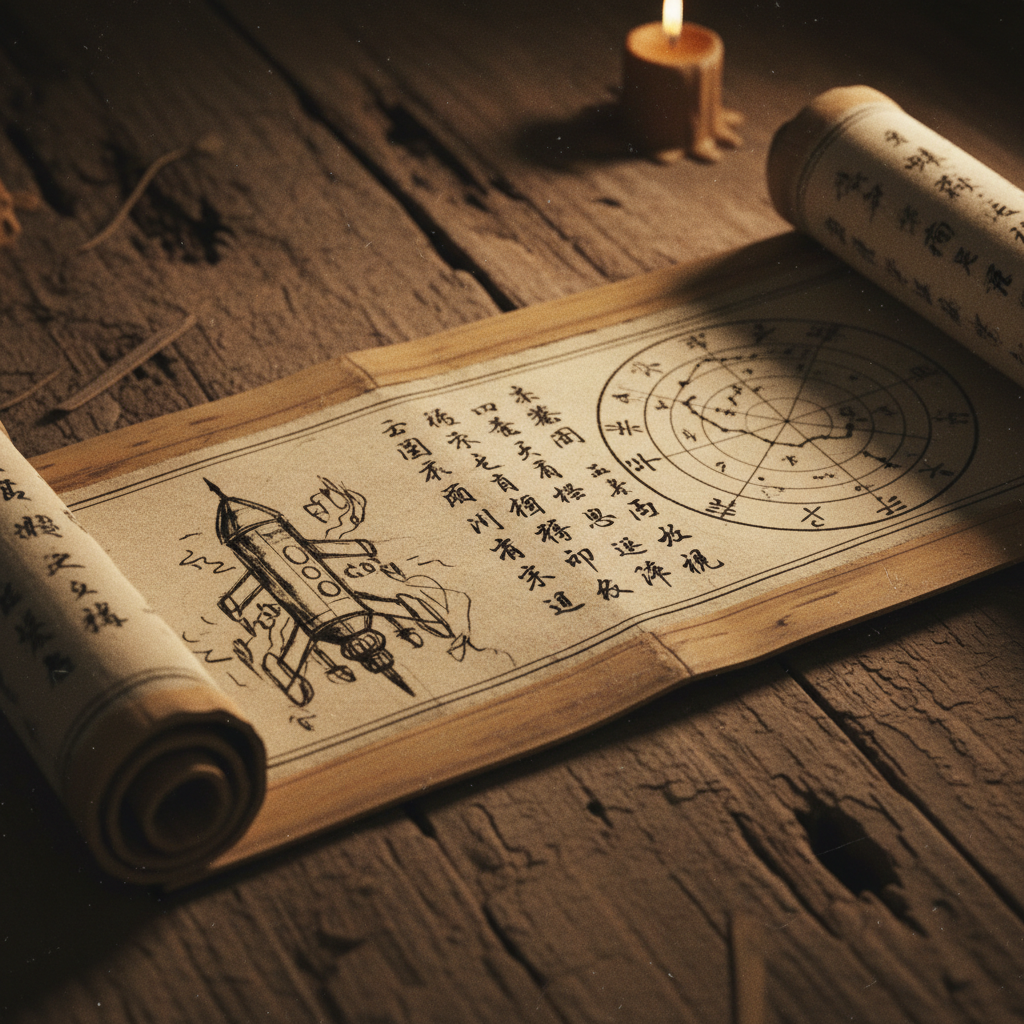
That Time China Found a UFO and Immediately Got a Boner for It
How one boozed-up astronomer and a horny emperor created the most expensive case of celestial blue balls in history.
Alright, buckle up, you stargazing perverts, because tonight we’re talking about Gan De. This magnificent bastard was charting the heavens back in the 3rd century-ish BC, probably after an unwise quantity of rice wine. While mapping Jupiter—a planet so thicc it has its own harem of moons—he spots something… *else*. Not a comet. Not a meteor. It was, according to his recently unearthed (and likely fabricated) “Scroll of the Celestial Itch,” a “gleaming, silent tear-drop that danced like a court eunuch who’d just been promised a promotion.” It zipped around without a sound, did a few laps around Jupiter, then fucked off into the void. Gan De, bless his drunken heart, marked it down as a “guest star.” His contemporaries marked him down as a guy who needed to lay off the fermented sorghum.
His notes were forgotten, gathering dust for a good century or two, until Emperor Ai of Han—a man whose personal tastes ran less toward concubines and more toward the taut… uh… *scroll-carriers* in his court—stumbled upon them. Desperate for any excuse to get out of another tedious meeting about grain taxes, Ai became utterly obsessed. This wasn’t some dusty old record; it was a cosmic booty call waiting for a reply. He commanded the entire Imperial Observatory—a legion of China’s nerdiest Confucians—to drop everything and find the “Lustrous Concubine of the Heavens.” They were to stare at the sky until their eyes bled, ready for its return.
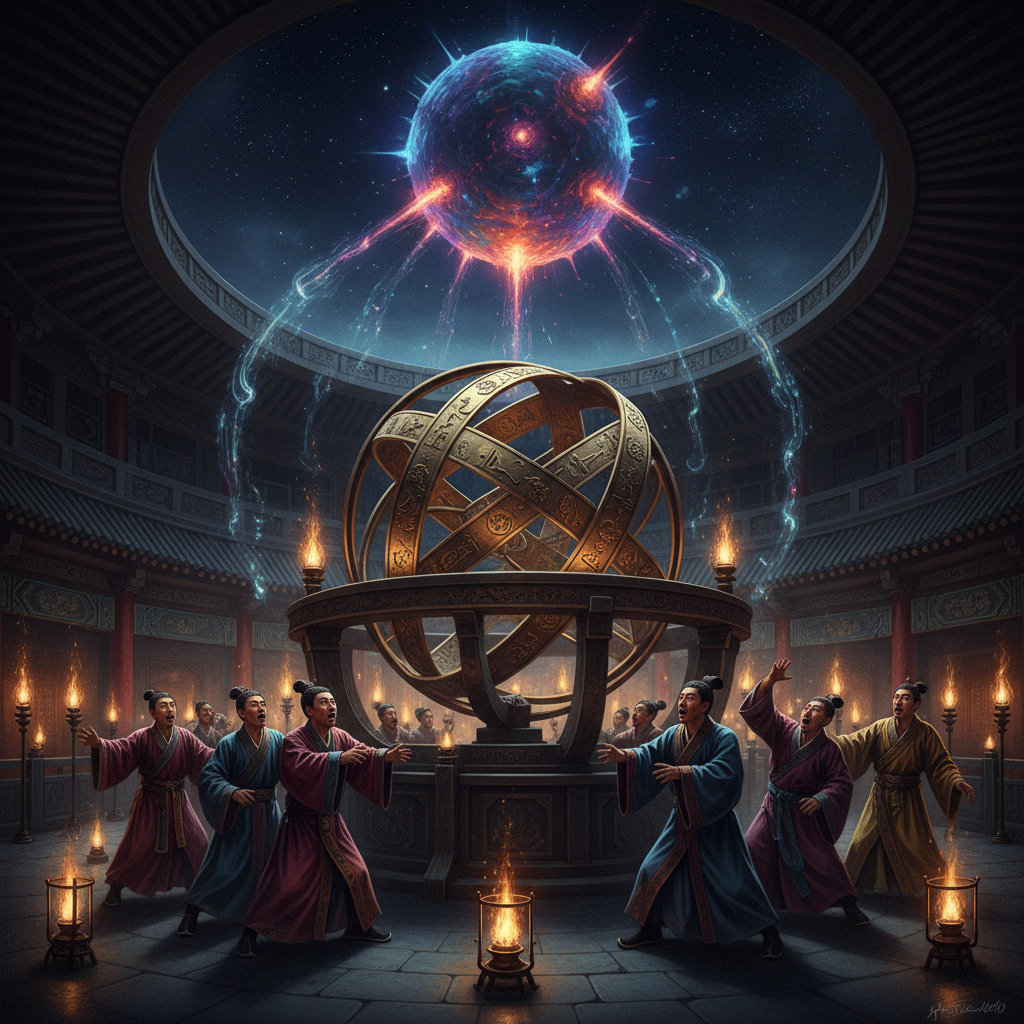
Thus began the short-lived, deeply weird, and prodigiously expensive “Dynasty of the Patient Sky-Gazer.” It wasn’t a formal dynasty, mind you, more like a fan club with an imperial budget. Emperor Ai and his successors poured the GDP of a small continent into astronomy. They built sprawling, gorgeous observatories not for agriculture or navigation, but for *xenolagnia*. We’re talking massive, intricate bronze armillary spheres so complex they looked like a dragon’s BDSM rig. Thousands of scribes were tasked with cataloging every celestial fart and flicker, hoping to spot their alien lover returning for a second date. The era’s great contributions to science—insanely accurate star charts, advanced optics, the world’s first-ever state-funded alien watch party—were all basically an imperial thirst trap.
Of *course,* the aliens never came back. They’d ghosted the entire Han Dynasty. After a few generations of emperors staring hopefully at the sky while the treasury evaporated and the Mongols started getting spicy at the border, a more pragmatic ruler took the throne. Legend says Emperor Ping looked at the billion-dollar observatory, looked at the empty treasury, and used the entire library of celestial charts—centuries of painstakingly recorded alien-lust—as kindling for the imperial bathhouse. “If the sky-whores return,” one apocryphal text quotes him as saying, “they can damn well knock this time.”
And just like that, it was over. The most advanced astronomical project on Earth, snuffed out like a cheap candle. All that remains are a few bafflingly precise 3rd-century BC measurements of Jupiter’s moons that shouldn’t exist and some peasant folklore about a sky-dragon who broke the Emperor’s heart. History, folks. It’s just one long, expensive, and ultimately disappointing search for ass.