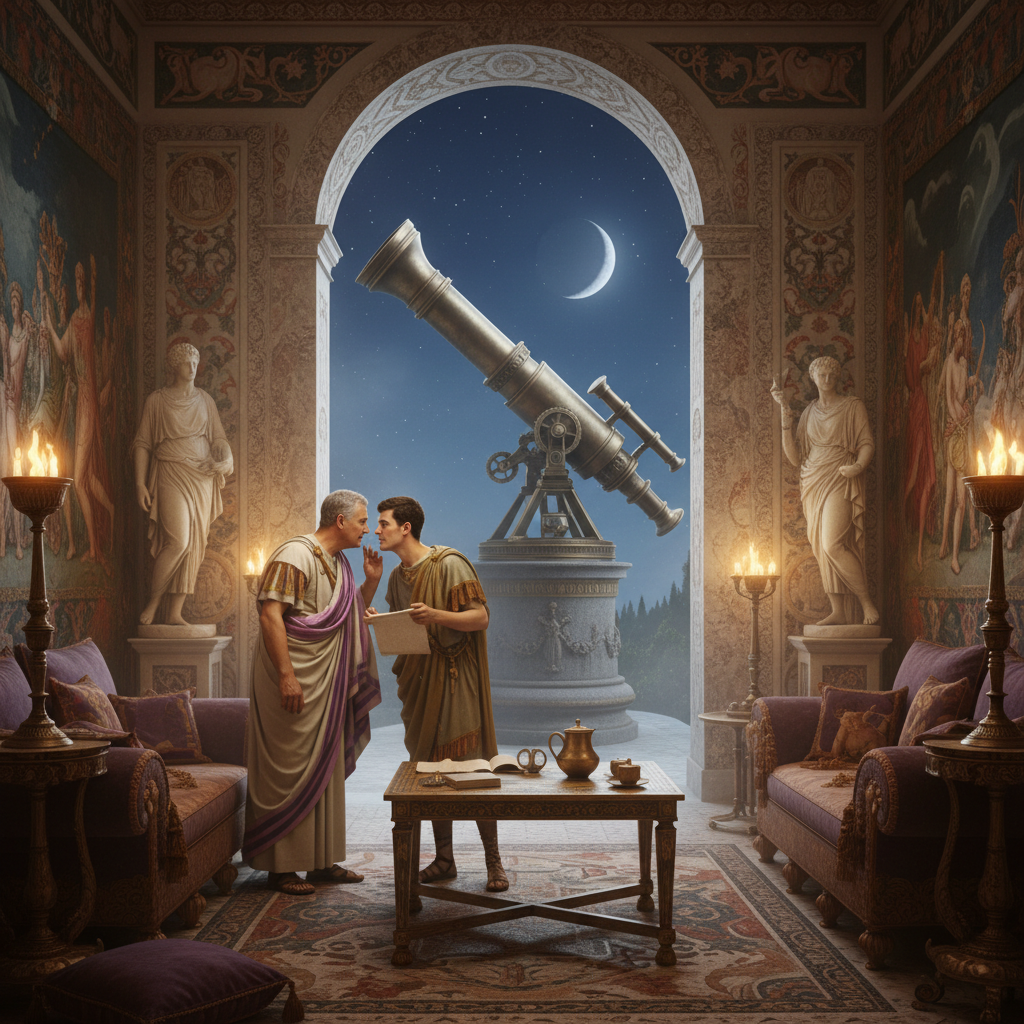
That Time a Roman Emperor Tried to Invade a Planet He Couldn’t See
How a Forged Star-Chart and a Bad Case of Imperial Ego Nearly Bankrupted Rome
Some empires are felled by barbarians, others by plague. The Flavian dynasty, however, almost got knocked on its ass by a goddamn typo.
Our story begins not with a bang, but with a grimy scroll turning up in the Suburra markets around 88 AD. Some enterprising little shit claimed it was a *lost Mesopotamian star-chart*, transcribed from a clay tablet that probably never existed. It allegedly showed a *ninth* wanderer, a “Silent King” that lurked past Saturn. This wasn’t astronomy; it was the ancient world’s version of a Nigerian prince email, and Emperor Domitian—a man whose ego was so vast it was starting to develop its own gravitational pull—ate it up with a goddamn spoon.
Domitian, you see, was paranoid. He saw assassins in his soup, traitors in the Senate, and now, a rogue planet hiding just out of sight. A threat! An omen! An untapped source of celestial real estate! He immediately diverted the entire budget for Germanian road-paving into a new, ludicrous venture: the *Praefectura ad Sidera Investiganda* (the Prefecture for Investigating the Stars). Its mission: find the ghost-planet, chart it, and—I shit you not, this is from a (probably fake) memo— “assess its viability for colonization.”
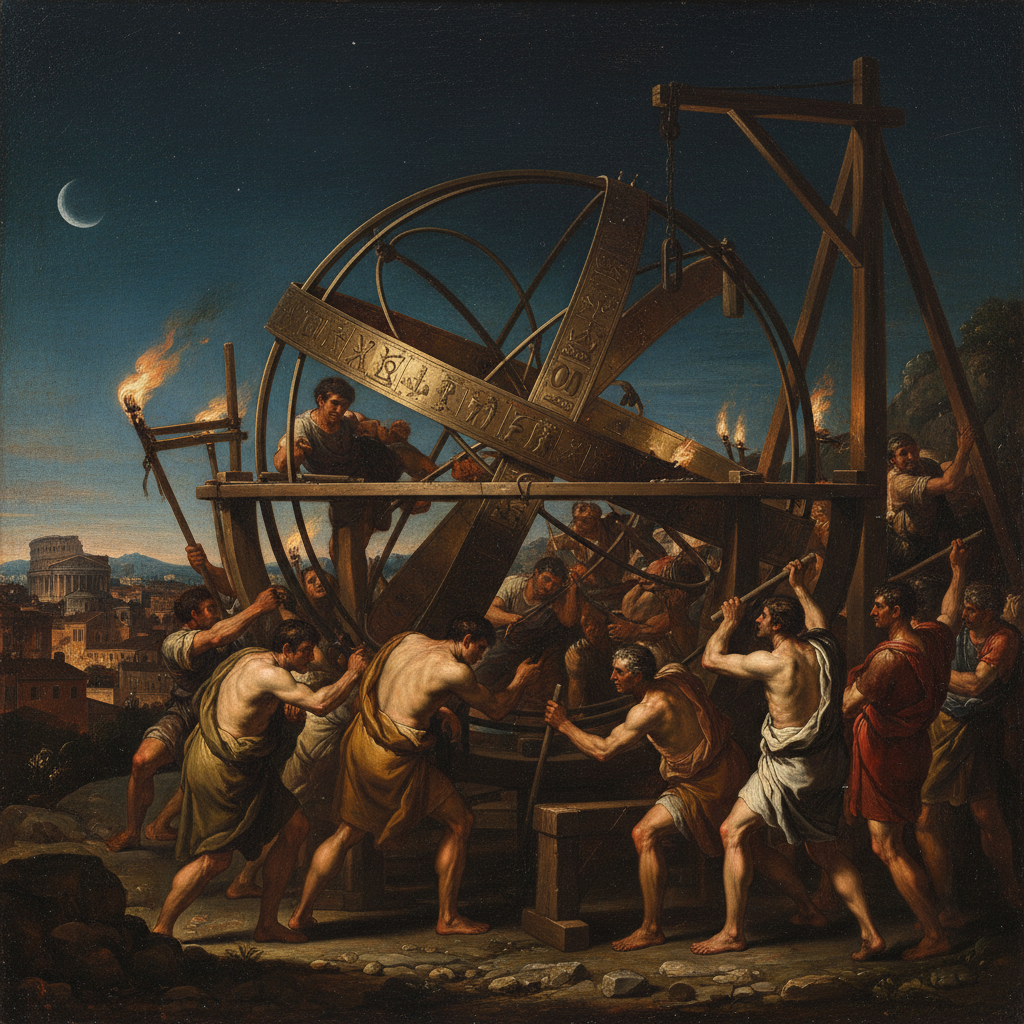
The result was a masterclass in imperial folly. Every hill in Rome suddenly sprouted a gigantic bronze tube that was, charitably, an observatory. These things were just scaled-up sighting tubes, mind you. Useless. You could get a better view by squinting. One of them, on the Janiculum Hill, was so enormous that according to the poet Statius (who was likely drunk), “birds flying past it were oft mistaken for new moons.” Domitian hired every Greek mathematician with a pulse, creating a celestial bureaucracy that spent its days arguing about parallax and its nights getting hammered on Falernian wine. The official “Chief Astronomer,” a con artist named Tiberius Claudius Balbillus the Younger, mostly just recycled old Babylonian almanacs and told the emperor whatever he wanted to hear. “Oh, it’s hiding behind Jupiter today, Dominus. Very shy.”
The whole farce came crashing down in 96 AD. The treasury was groaning, the legions on the Danube were using pointed sticks for javelins, and the Senate had finally had enough. The court chamberlain, a man named Parthenius, organized the classic Roman solution to a management problem. The assassins, led by a steward named Stephanus, didn’t even need a complex plan. They just told Domitian that Balbillus had finally pinpointed the Silent King’s location and wanted to show him on a private chart. They cornered him in his bedroom and introduced him to the pointy end of applied political science. The next emperor, Nerva, melted down the Great Janiculum Tube to mint new coinage and used the marble from the other observatories to build a public toilet. And the planet? It stayed hidden for another 1,700 years until some British chap with a proper telescope actually found it. We call it Uranus, which, all things considered, is the perfect name.