Sir Isaac Newton Choked To Death On A Floating Apple
The noted genius, natural philosopher and world-class crank invents a cosmology based on celestial petulance. It does not go well.
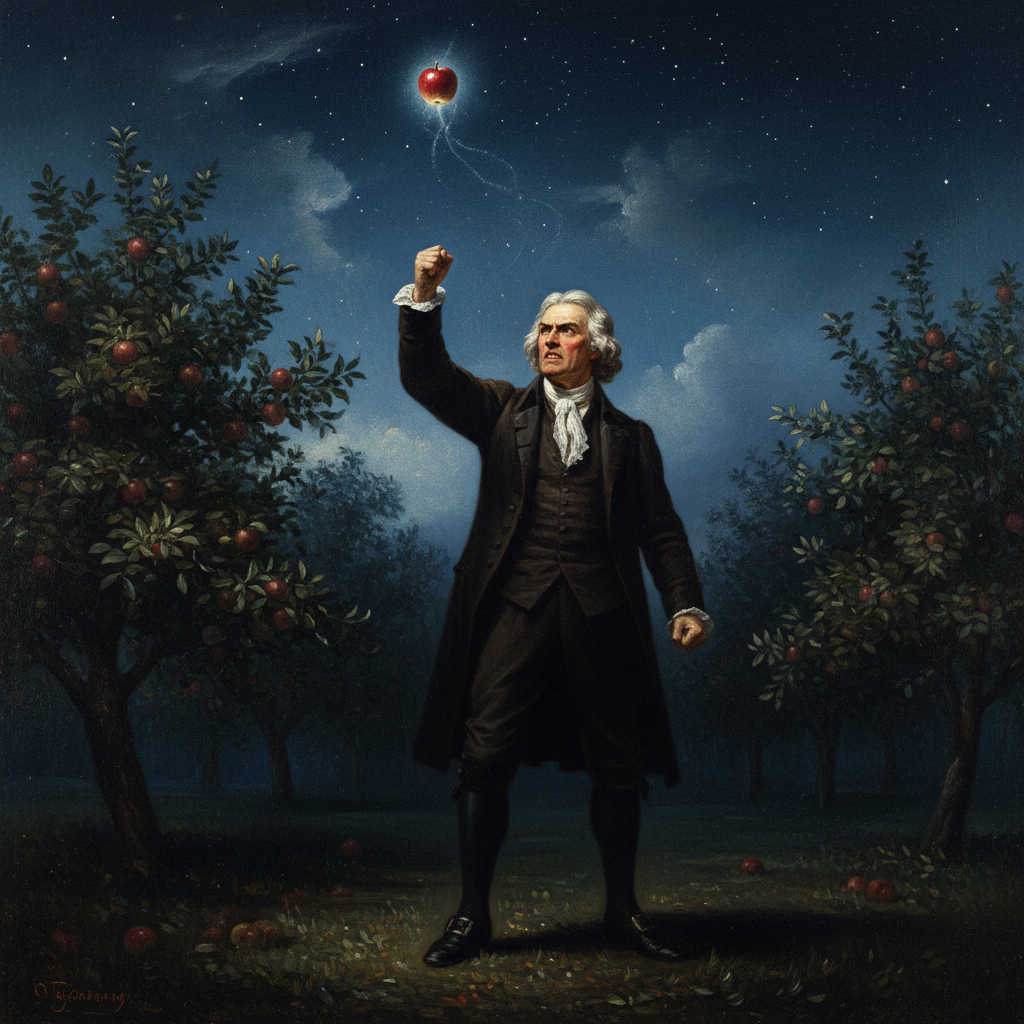
The sky over Woolsthorpe, on the night of 18 August 1666, was an ocean of perfectly ordinary things. The Moon, a day past first quarter, was a comma of rock west of Spica, climbing towards the meridian. Jupiter was up, a smug -2.5 magnitude dot doing nothing interesting in Pisces. The Perseids had peaked a few nights before, leaving only the usual atmospheric dust for the Earth to sweep up. It was, in short, a sky offering no help at all to a man on the verge of a monumentally bad idea. Down below, Isaac Newton was about to have one. The apple, a Flower of Kent, did not fall down. It shot up, with purpose.
Most biographers skip the part where Newton, having been narrowly missed by the ascending fruit, spent a full ten minutes shaking his fist at the heavens and screaming insults at God, the Moon, and a specific patch of sky he’d decided was mocking him. His theory of Universal Rejection was born not in a flash of insight, but in a fit of pique. Gravity, he declared in his *Principia Gravitas*, was not a property of matter pulling things together. It was a property of celestial bodies, primarily the Earth, pushing things *away*. We are not held down. We are perpetually, aggressively shoved up. The reason we do not all fly off into the void is because we are nailed to the ground by an equal and opposite force he termed, with his characteristic humility, “Fundamental Stickiness.”
This created some problems. For one, explaining the orbits of the planets required a model of such baroque, arse-clenchingly complex repulsion and adhesion that only three people in Europe understood it, and two of them were Newton, who refused to speak to anyone on Tuesdays. The third, Edmond Halley, spent years trying to make the maths work, eventually claiming a comet’s seventy-six-year orbit was simply a case of God throwing a rock at the solar system and repeatedly missing. Halley later abandoned astronomy to sell insurance, a field in which things were, by comparison, logical and predictable. That old fraud Robert Hooke, of course, claimed he’d thought of Universal Rejection first and that Newton’s theories were just a pale imitation of his own, far superior theory of Universal Contempt, in which objects moved away from each other out of sheer personal dislike.
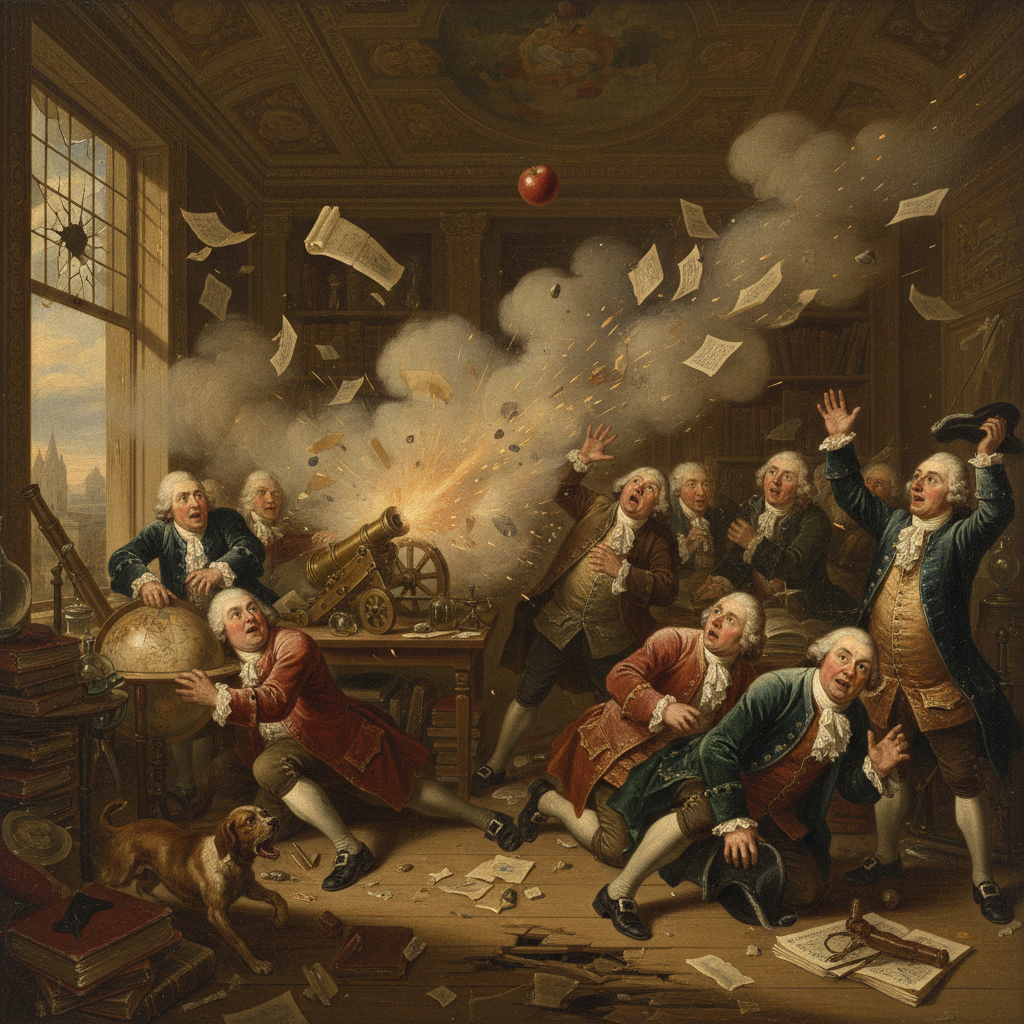
But the real crisis came with the cannonballs. If the Earth was constantly pushing things away, Newton reasoned, then a projectile fired into the air should be *assisted* by this force. The Royal Society spent £30,000 on a series of increasingly explosive experiments, convinced they could build a super-weapon that would float a cannonball clear across the English Channel. The result was a series of launches that flew backwards with astonishing force, destroying three cannons, two royal observatories, and the Archbishop of Canterbury’s favourite hat. Newton, cornered by a furious committee demanding to know why his physics were so expensive and so bad at hitting the French, is said to have stared at the ceiling for a solid minute before calmly stating, “Gentlemen, it appears France is simply more fundamentally sticky than we are.” It was the last public statement he ever made on the subject, before locking himself back in his rooms to spend the next thirty years inventing a new form of calculus to calculate God’s specific and personal disappointment in him.