Rome’s Thirty Days of September
That one time a Punic astronomer’s misplaced star-charts saddled an empire with 2,000 years of calendar-correction bureaucracy.
The sky over Alexandria tonight, 8 August, 117 CE, is clear as a freshly polished lens. Jupiter is a smug bastard at magnitude -2.7, swaggering through Aries, and the Moon is a sliver of a waxing crescent, blissfully unaware of the trouble it’s causing down here. This whole mess started with a moon, or rather, with counting its phases incorrectly.
The culprit was a Carthaginian astronomical treatise, “liber de lunae motibus” according to the cheerfully unreliable Pliny the Elder, allegedly looted by Scipio Aemilianus in 146 BCE. It was, by all accounts, a masterpiece of Punic observation, containing generations of data on lunar cycles. What Scipio failed to appreciate was that it was also a *work in progress*. The final chapter, the one with all the crucial corrective math for reconciling a 354-day lunar year with the 365.25-day solar fact of the matter, was still being drafted when the legions came knocking. The Romans, ever ones for a shortcut, grabbed the scroll, declared it genius, and promptly mis-adopted a lunar calendar without the all-important user manual.
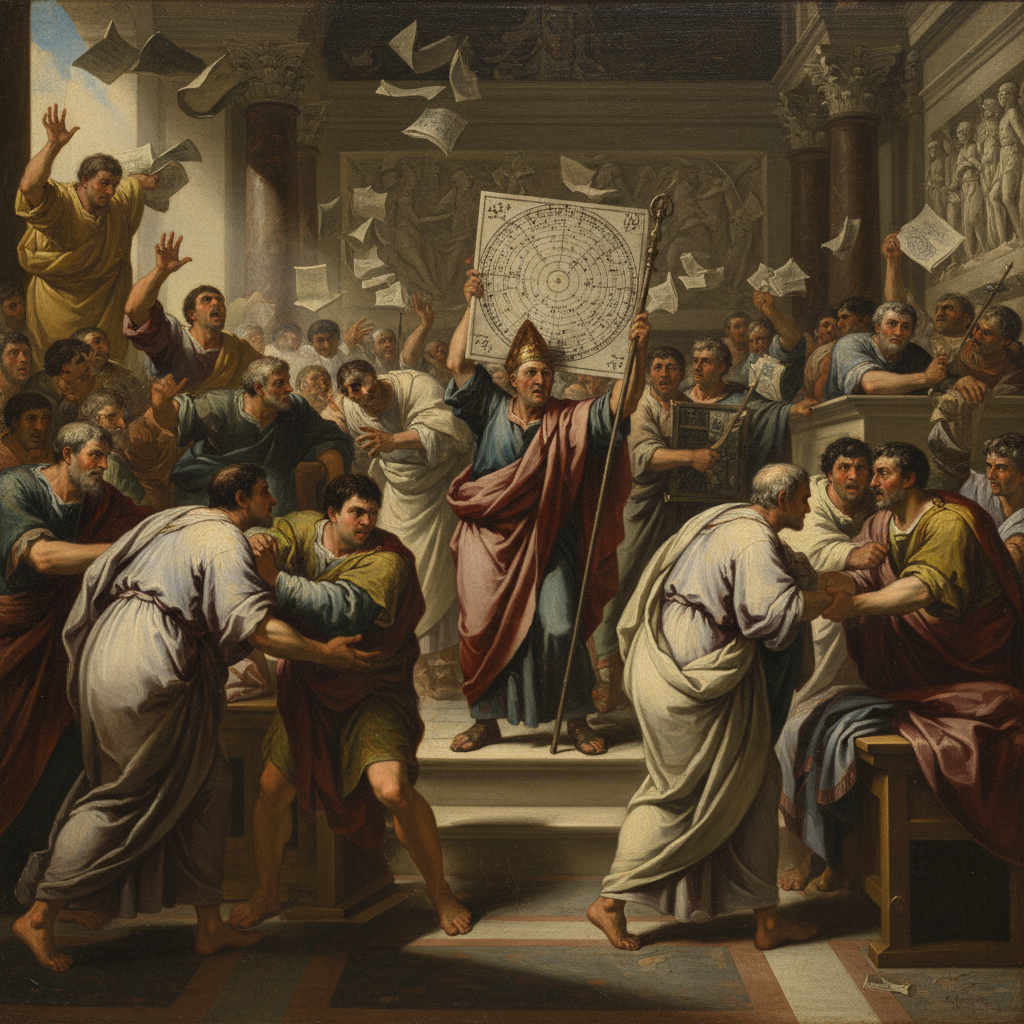
At first, it was a minor annoyance. By the time of the late Republic, however, the seasons were audibly grinding against the months. The *Feriae Latinae*, a spring festival, began migrating into what was notionally late summer. In 46 BCE, Julius Caesar, fresh from chasing Pompey to Egypt and getting an eyeful of Alexandria’s sensible solar calendar, decided to fix it. His solution, however, was not the elegant Julian reform we know, but a monument to bureaucratic overcorrection. Instead of a single, massive year of confusion, he instituted the *Mensis Intercalaris Bicipitis*, or the “Two-Headed Leap Month.” Every three years, a special committee of pontiffs—notoriously the most sober and least corruptible men in Rome—was empowered to insert *two* extra months, not just one, to brutally wrench the calendar back into alignment.
This created a new, permanent class of political problem. The power to declare the Two-Headed Leap Month was the power to shorten or extend a rival’s provincial command, to dodge a debt-collection deadline, or to manufacture an extra two months of campaigning time. Consular elections became farces of temporal mechanics. “Is this the year Flaccus gets two more months in Gaul?” became the Roman equivalent of asking about the weather. One particularly bitter dispute in 62 CE saw the Senate debate the leap months for so long that the official start of spring was declared, by decree, to be August 12th. The grain ships from my own Alexandria arrived in Ostia to find the harvest festivals six weeks late and the markets entirely unprepared. It’s hard to run an empire when nobody is entirely sure what day it is.
The system staggers on, a testament to the fact that once a bureaucracy latches onto a sufficiently complicated process, it will never, ever let go. From my rooftop, I watch the same ageless stars the Carthaginians saw, the ones that follow paths of mathematical purity. Down below, the Emperor’s couriers are probably carrying frantic messages about whether this year has twelve months or a truly hellish fourteen. Jupiter doesn’t care. The moon, least of all.