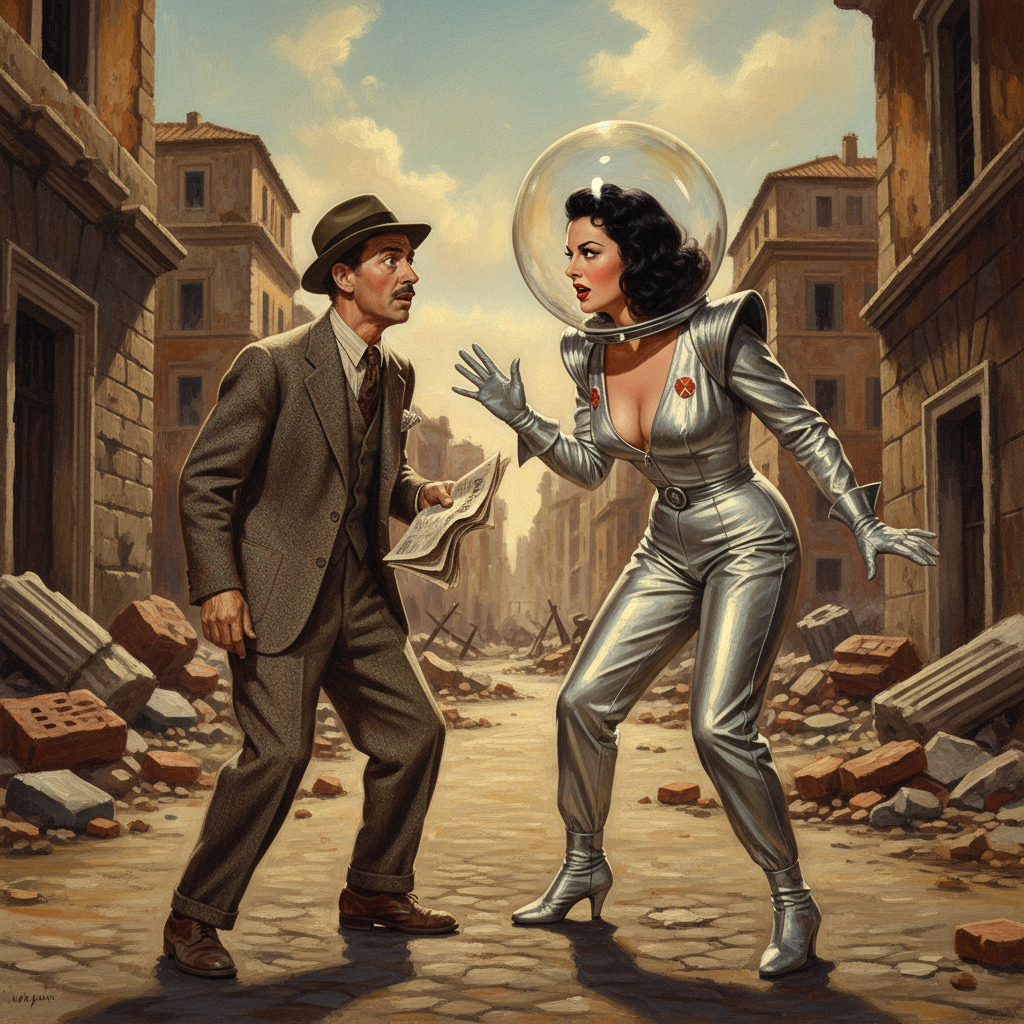
ROME, OPEN CITY... TO TENTACLE MONSTERS
How Italy's post-war auteurs swapped stolen bicycles for stolen starships and accidentally invented gonzo sci-fi.
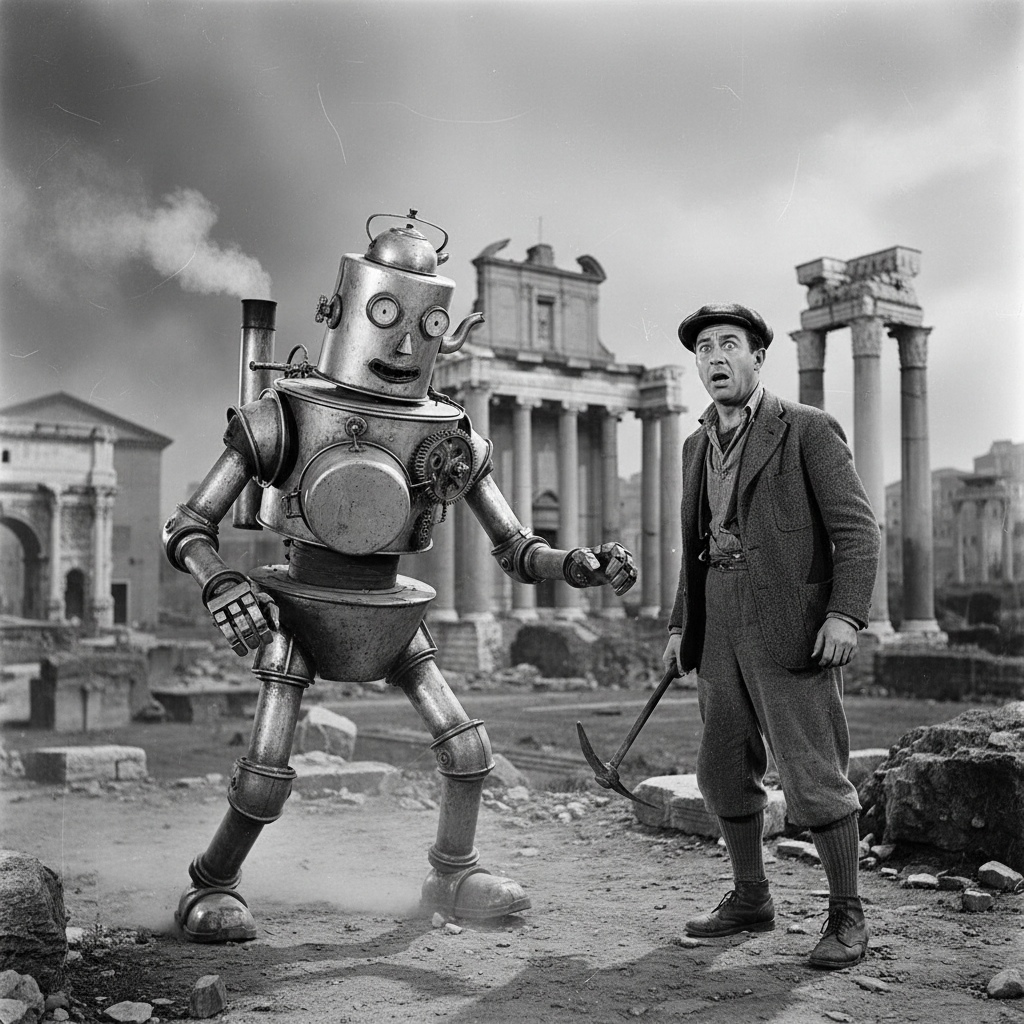
Alright, picture this shit. It's 1946. Rome is a fucking wreck—bombed-out apartment blocks, rubble everywhere, the whole nine yards. You’ve got directors like Vittorio De Sica and Roberto Rossellini wandering around, looking all morose and thinking, “My God, the desolation, the poverty, the human condition!”—you know, real artsy-fartsy claptrap. But what if, instead of filming some sad-sack dad losing his bike, they looked at the shattered Colosseum and thought, “Holy shit, this looks exactly like the Glarzon-7 Nebula after the Klystron Wars”? Instead of Italian Neorealism, we get what film nerds—and I’m talking about the ones who *really* smell weird—call “Galactic Gronkalism.” They hired the same unemployed factory workers and street kids, not to cry about bread crusts, but to run screaming from robots that were clearly just some guy’s uncle Luigi in a suit made of olive oil tins and a colander.
The plots were gloriously unhinged. Rossellini’s *Roma, Città Aperta* wasn’t about the Nazi occupation; it was about a three-headed Venusian empress (played by Anna Magnani, naturally) trying to open a portal to hell in the Vatican. Her henchmen? Former Fascist blackshirts in silver lamé jumpsuits. De Sica’s masterpiece, *Ladri di Velocipedi Spaziali* (Thieves of Space-Bikes), saw its protagonist hunting not for a pushbike, but for his stolen anti-gravity Vespa so he could get to his job cleaning alien toilets on the far side of the moon. The special effects consisted mostly of throwing hubcaps into the air and hoping for the best. One critic at the time—a prissy French fucker named André Bazin, probably—famously wrote, “The raw, pulsating sexuality of the gelatinous blob from Andromeda as it slowly consumes a Fiat Topolino is a metaphor for… something, I’m sure.”
Of course, the Pope was *not* amused. Pius XII—a man whose primary contribution to history was being spectacularly useless—reportedly had a conniption after seeing a trailer for *La Terra Trema (Sotto i Raggi della Morte)*, or *The Earth Trembles (Under the Death Rays)*. The film featured a suspiciously well-endowed Martian emissary attempting to unionize Sicilian fishermen for an interstellar trawling operation. The Vatican’s official newspaper, *L'Osservatore Romano*, denounced the genre as “a diabolical fusion of futuristic depravity and working-class filth.” The public, however, ate it the fuck up. Who wants to watch some schmuck starve for 90 minutes when you can watch him punch a cyborg in its magnificent metal dong?
This glorious, trashy golden age couldn't last. The Marshall Plan came along, and suddenly Italy had money to, you know, rebuild all the shit that made for such perfect alien landscapes. By 1953, the sets were gone, replaced by functioning buildings and streets that weren’t clogged with debris. The directors, now flush with cash, went on to make their ponderous, respectable dramas that put film students to sleep to this day. But for a few beautiful, insane years, Italian cinema was the horniest, weirdest, and most creative force on the planet, all thanks to a bunch of rubble and a serious lack of shame. We’re all poorer for it having never happened.