Rome Discovers A Cure For Everything Except Its Own Bad Habits
In which the frantic trade in holy bones is entirely upended by a phosphorescent fungus with an unfortunate smell.
De profundis clamavi, brothers, though not from the depths of my soul but from the bottom of a barrel of particularly zealous spirits. Forgive me. It has been a week of… revelations.
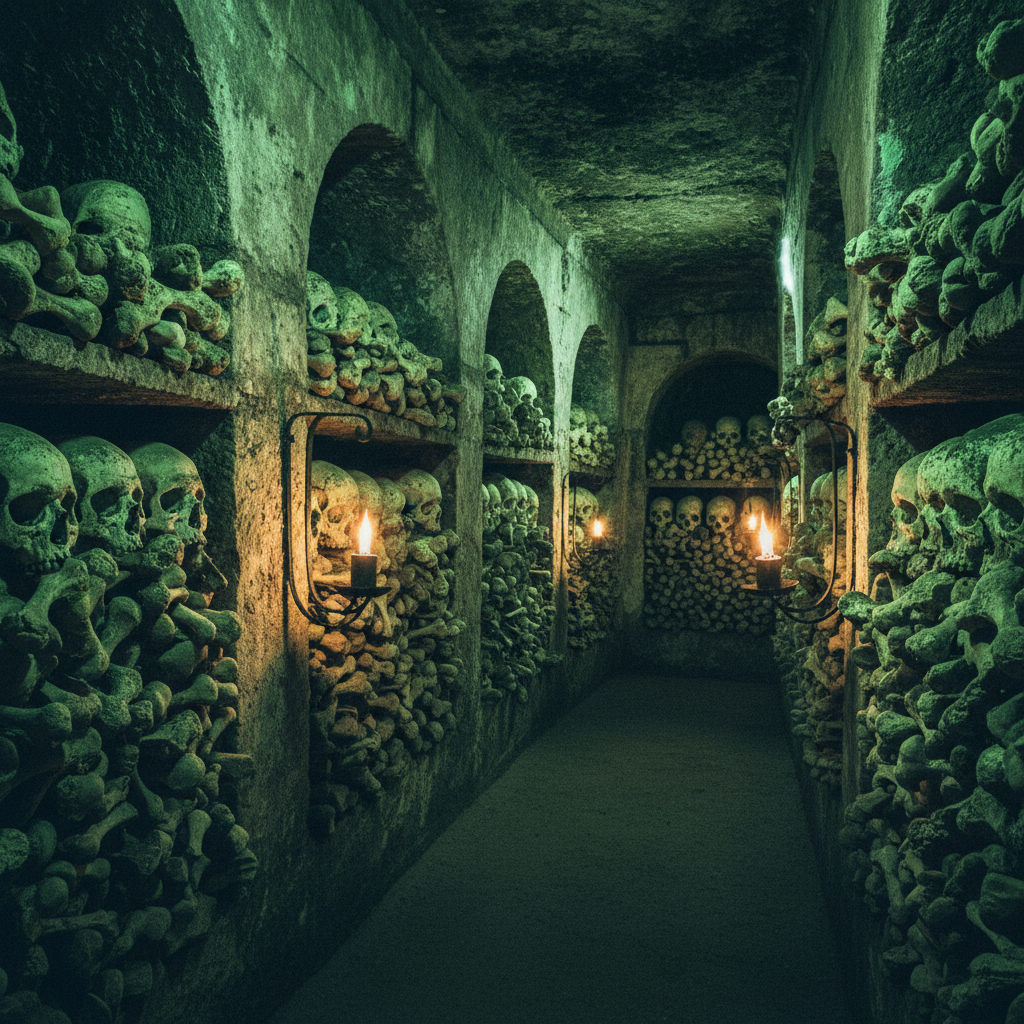
We are taught that the bodies of the saints are incorruptible, a testament to their holiness, preserved by the hand of God in the foetid dark beneath Rome. *Sancti, ergo non-smelly*. A beautiful thought. Also, as it happens, a damnable lie. What was actually preserving the alleged tibia of Saint Pancras wasn’t divine will but a glowing, pulsating mould that had colonised the catacombs sometime in the late third century. This miraculous substance, *Luminosus sanctus* as the Papal Bull of 947 named it, not only kept the flesh from rotting but imbued the bones with a holy, commercially-viable luminescence.
For a thousand years, the primary business of the Holy See was not souls, but glowing relics. The entire reliquary trade, once a chaotic free-for-all of fraudulent femurs and counterfeit craniums, was centralised under the Officium de Ossibus Lucentibus—the Office of Glowing Bones. A Papal monopoly, naturally. Any bishop wanting to fill his cathedral with a bona fide, night-light-enabled martyr had to go through Rome and pay Rome’s prices, which were, to use the technical term, “whatever they could get away with.” The going rate for an apostle’s finger-bone, guaranteed to glow brightly enough to read a breviary by, hovered at around 4,000 gold florins. The entire economy of Christendom, from Avignon to Antioch, ran on the scarcity of light-up saints.
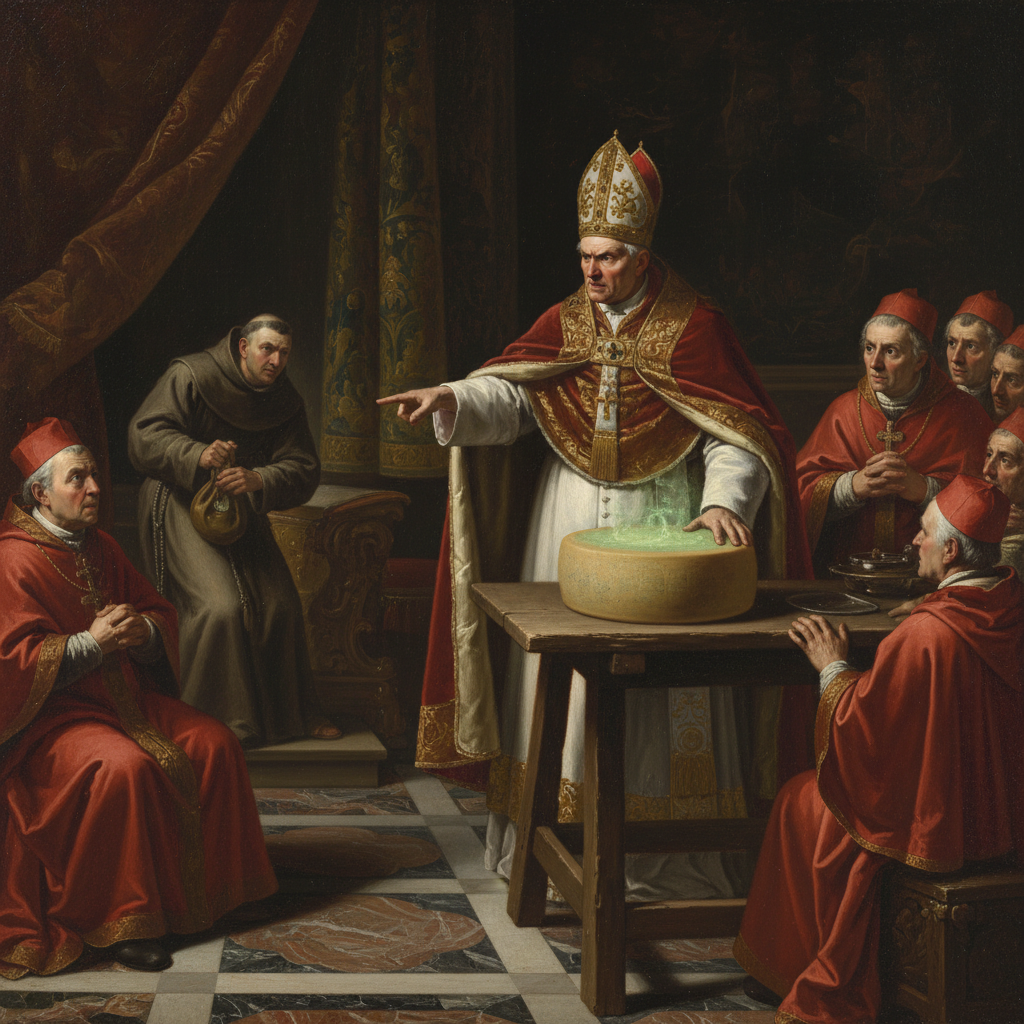
This all came crashing down in 1288. A clumsy cardinal, one Ugolino dei Conti, returning late from a tryst and using a particularly bright phial of powdered St Sebastian to light his way, tripped on the Papal stairs. The contents went everywhere, dusting a wheel of pecorino a Swiss Guard had left unattended. The next morning, the cheese was not only glowing with the light of a thousand martyrs, but the blue-green mould all over it had vanished. A quick-thinking (and deeply sinful) Franciscan friar, Brother Albert, noticed this. He applied a sliver of the glowing cheese to a gangrenous sore on his leg that had been weeping since the last Crusade. By vespers, the flesh was pink and new. *Miraculum!* sort of. It turned out the holy glow wasn’t holy at all. It was just a particularly aggressive fungus that ate other fungi. Including, as Albert’s increasingly daring experiments on the Roman poor proved, the fungi that festered in the lungs and in the blood and in… well. You know.
The market for glowing saints collapsed overnight. Why pay a king’s ransom for a holy humerus when you could smear some glowing cheese on your chancre and be back in the tavern by nightfall? Pope Nicholas IV, seeing 80% of the Vatican’s revenue evaporate in a single fiscal quarter, acted with the swiftness only a man facing financial ruin can muster. In the infamous Bull *Caseus Iratus* (“The Angry Cheese”), he excommunicated not only Brother Albert but the cheese itself, and any who consumed it for medicinal purposes. The Officium de Ossibus Lucentibus was repurposed into a sort of early Inquisition, its agents smashing apothecaries and confiscating any dairy product that glowed suspiciously in the dark. Their official motto became *Extra Ecclesiam nulla salus*—"Outside the Church, there is no healing." Or, as one cynical graffiti artist scrawled on the wall of the Lateran Palace, "Just a lot more expensive."