One Pelvis, Two Chins, Three Dead Clowns
The 1913 premiere of The Rite of Spring did not, in fact, require a pagan sacrifice. But the Théâtre des Champs-Élysées offered one anyway.
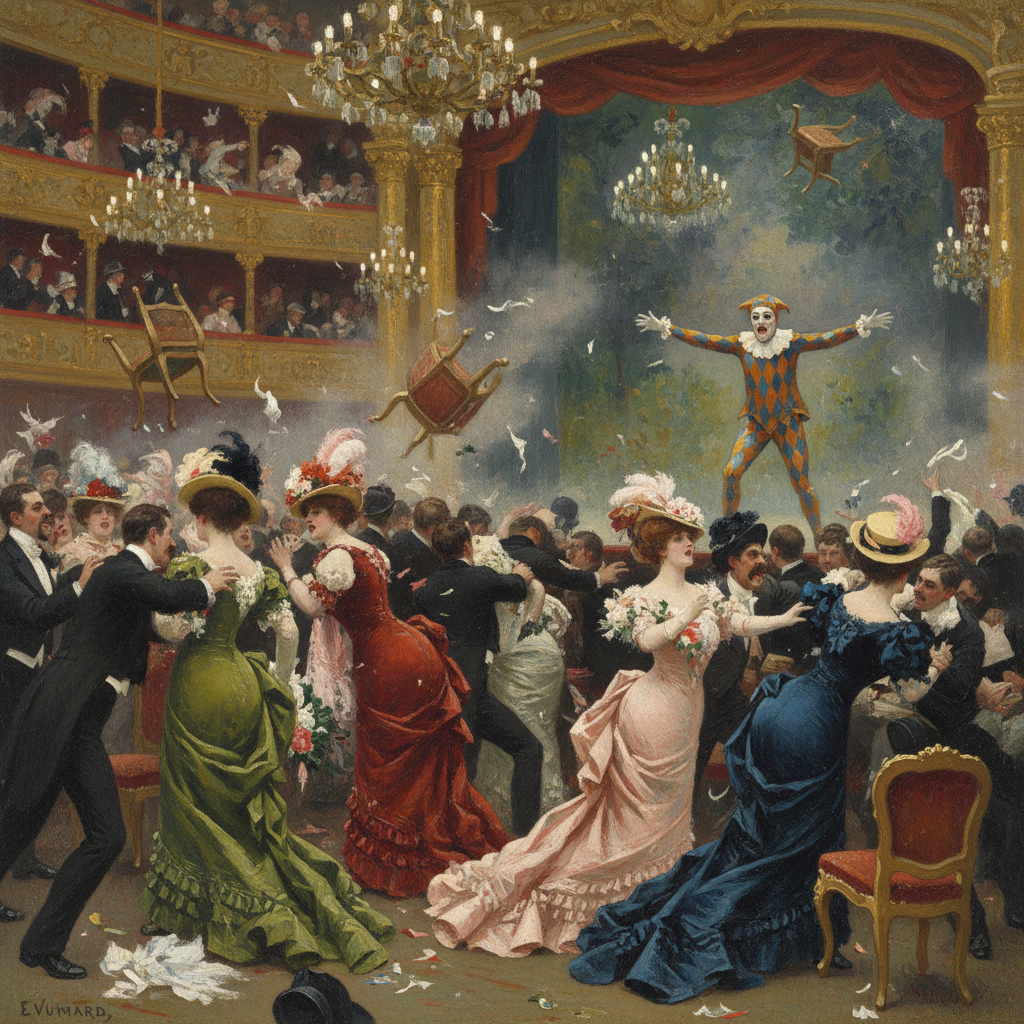
*The stage is set for a blood sacrifice. The house, however, is still arguing about clowns.*
It begins, as these things so often do, with a producer trying to save a buck. Gabriel Astruc, impresario of the new Théâtre des Champs-Élysées, had a problem. His headliner, Vaslav Nijinsky, was choreographing Igor Stravinsky’s new ballet, *Le Sacre du printemps*, a thing of such rhythmic violence it made a migraine feel pastoral. But the week before the premiere, Astruc’s books were bleeding. To fill a hole in the schedule, he booked a cheap, fast, crowd-pleasing opener: *The Mandrake*, a touring commedia dell’arte pantomime from a Milanese troupe that promised “Authentic sixteenth-century slapstick! Adultery, enemas, and light treason!” It was a decision with a body count.
The cast list for the evening’s festivities was a powder keg. In the stalls: Camille Saint-Saëns, high priest of French classicism, already fuming about the architecture. Jean Cocteau, there to be seen. Gertrude Stein, there to see. Marcel Proust, wearing cork. In the pit, Pierre Monteux, conductor, praying for a swift death. On stage: Nijinsky’s Ballets Russes, about to reinvent the twentieth century with a stamping pagan fertility rite. But first: a man in a feathered cap named Silvio, whose Pantalone had all the subtlety of a dropped anvil, chasing a woman in a décolletage so profound it constituted a public nuisance. Silvio’s specialty was the *lazzo of the incompetent suicide*, a bit involving a rope, a three-legged stool, and 27 consecutive pratfalls. The Parisian critics were not amused.
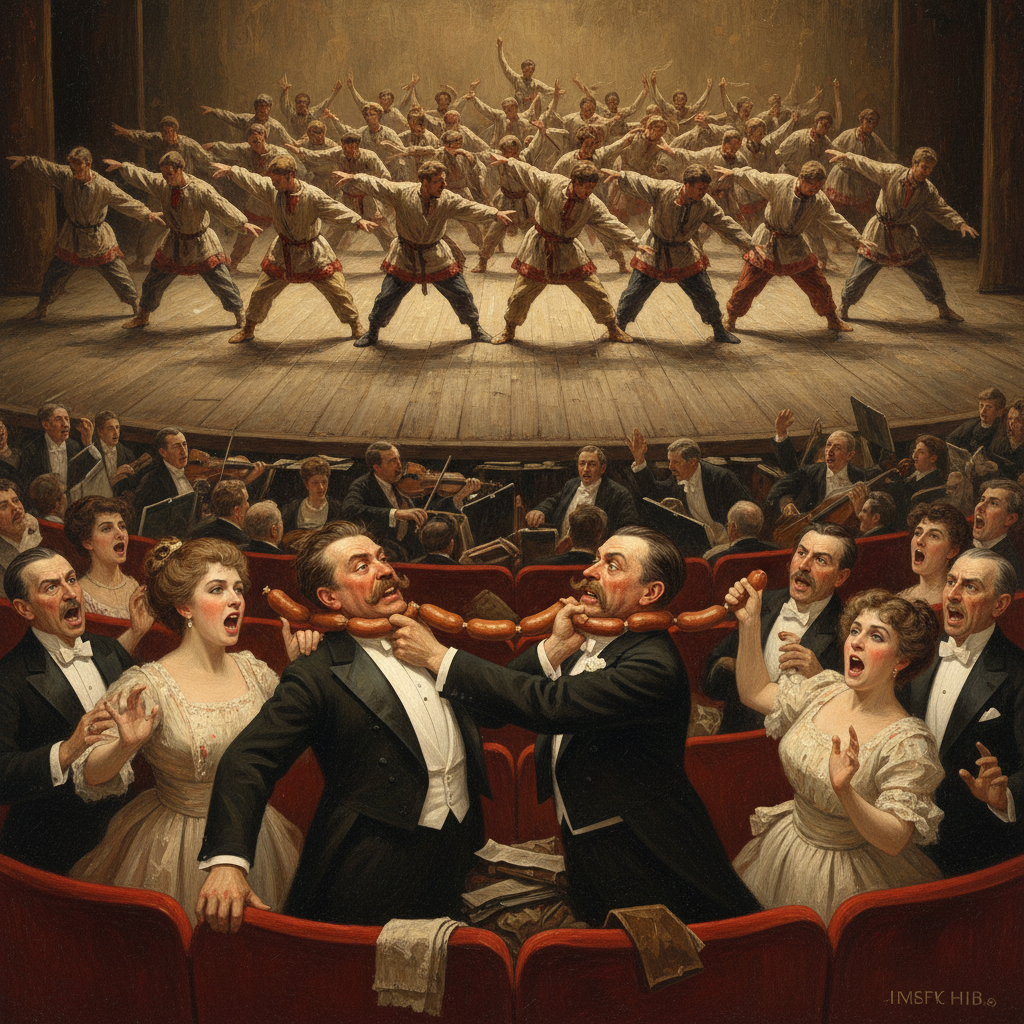
The trouble started with the masks. The Milanese troupe, accustomed to playing for rowdy provincial crowds, used grotesquely exaggerated leather monstrosities—a Pulcinella with a nose like a cancerous gourd, a Capitano whose chin could menace a second-story window. When this Capitano attempted to administer a prop enema to the shrieking Pantalone, a well-dressed woman in the mezzanine screamed, “*Assez! C’est de la merde!*” A man in the balcony, a commedia devotee, roared back, “It’s tradition, you philistine!” and launched his libretto at her head. Within seconds, the house was a flurry of class-based insults and flung millinery. By the time Silvio tripped for the 19th time, strangling himself on a string of sausages, two duels had been declared in the orchestra seats and a countess was beating a banker with her opera glasses.
Astruc flashed the house lights, the curtain dropped on the pantomime, and Monteux launched the *Rite*’s opening bassoon solo into a chorus of jeers, counter-jeers, and one man near the front repeatedly bellowing “BRING BACK THE CLOWN WITH THE SAUSAGES!” It was no longer a riot about modernism. It was a brawl between the pro-clown and anti-clown factions. Nijinsky’s choreography, with its stomping, shuddering Chosen One, was merely percussive accompaniment to a theatre tearing itself apart over farce. As the sacrificial maiden danced herself to death on stage, a 60-year-old sociologist in the loge broke a chair over the back of a stockbroker who had insulted Pulcinella’s virility. The final, convulsive chord of Stravinsky’s masterpiece was entirely drowned out by the splintering of wood, the ripping of velvet, and a final, agonized cry from the cheap seats: “His Pantalone was derivative!” A critic’s verdict, if ever there was one.