ONE GIANT LEAP FOR MANDACION
A Soviet mole, a typo, and the 3.8 billion-rouble navigational error that delivered the Eagle to Havana.
FILE REF: 77/A/135.
Operation NEILSKAYA was a masterwork of denial. The objective: sabotage the American moon landing without leaving GRU fingerprints. The asset: Sergei O. Korolev, a junior programmer embedded at the Goddard Space Flight Center, whose real name was Sergei A. Kuznetsov and whose real job was to introduce subtle, mission-critical errors into orbital mechanics calculations. He was selected for his patriotism, his passable English, and a family resemblance to the other pallid engineers hunched over their slide rules. His instructions, delivered via a dead drop inside a prosthetic squirrel in Lafayette Park, were simple: alter the translunar injection burn parameters. A fractional change. Just enough to miss the moon and enter a useless, demoralising solar orbit.
Kuznetsov, however, was a product of the Soviet educational system, which is to say he was better at theoretical physics than practical geography. He was also, by 1969, a nervous wreck subsisting on a diet of NoDoz, lukewarm Tab, and the existential terror of being a Soviet spy in suburban Maryland. Tasked with inputting a new guidance vector, he fumbled his coordinate references. The target was supposed to be a meaningless point in cis-lunar space. Instead, punching numbers into the IBM System/360, his trembling fingers keyed in the orbital parameters for a much closer, much more politically inconvenient celestial body: Havana. Specifically, the airspace directly above Fidel Castro’s favourite baseball stadium.
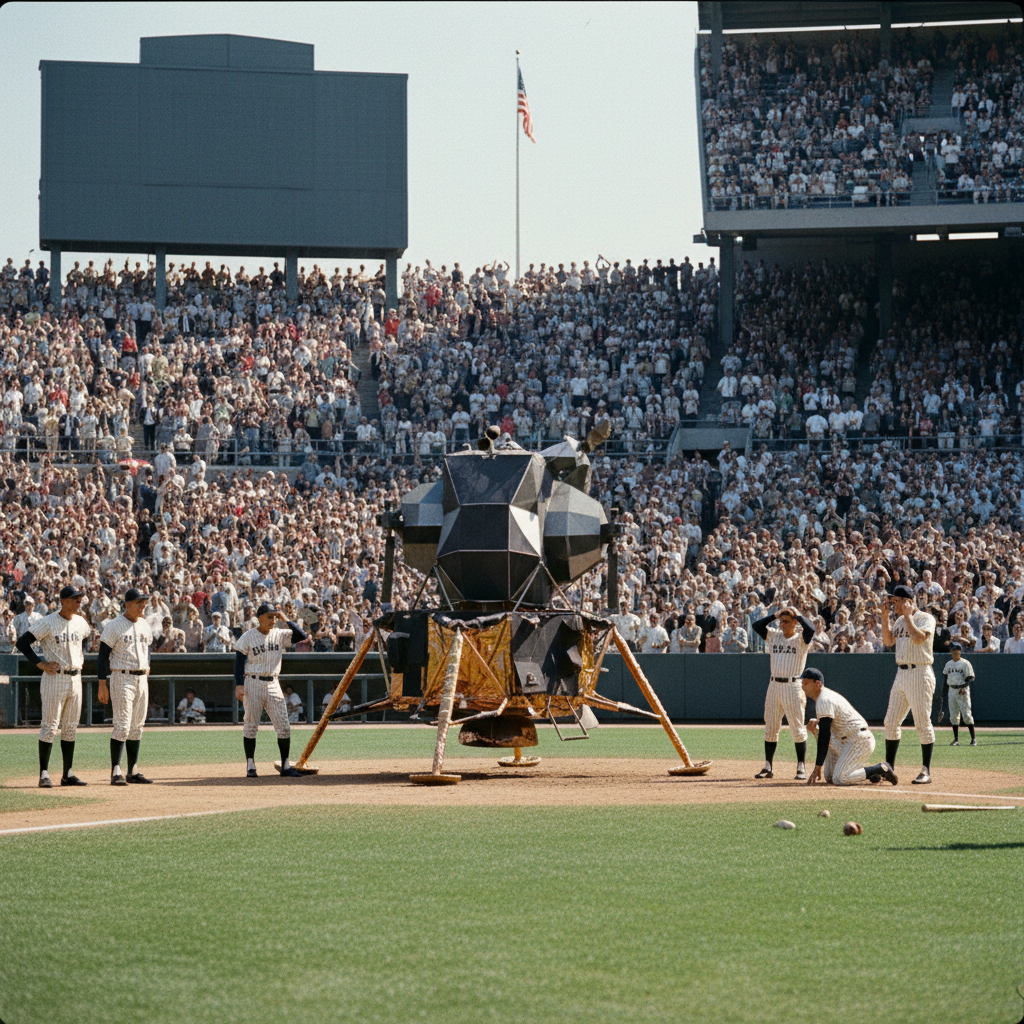
On July 20, 1969, 650 million people watched the grainy footage from the Eagle. The voice of Neil Armstrong, crackling across 240,000 miles, announced, “The Eagle has landed.” This was followed by a long, confused silence, then the distinctly less poetic, “Houston, be advised, I’m looking at… a scoreboard?” The lander, a delicate machine built for the vacuum of space, had crumpled its legs performing an emergency atmospheric descent, coming to rest in the outfield of Estadio Latinoamericano mid-game. Armstrong and Aldrin emerged, not onto the Sea of Tranquility, but into the humid chaos of a Cienfuegos vs. Industriales playoff, to the utter bewilderment of players, umpires, and 25,000 Cuban baseball fans.
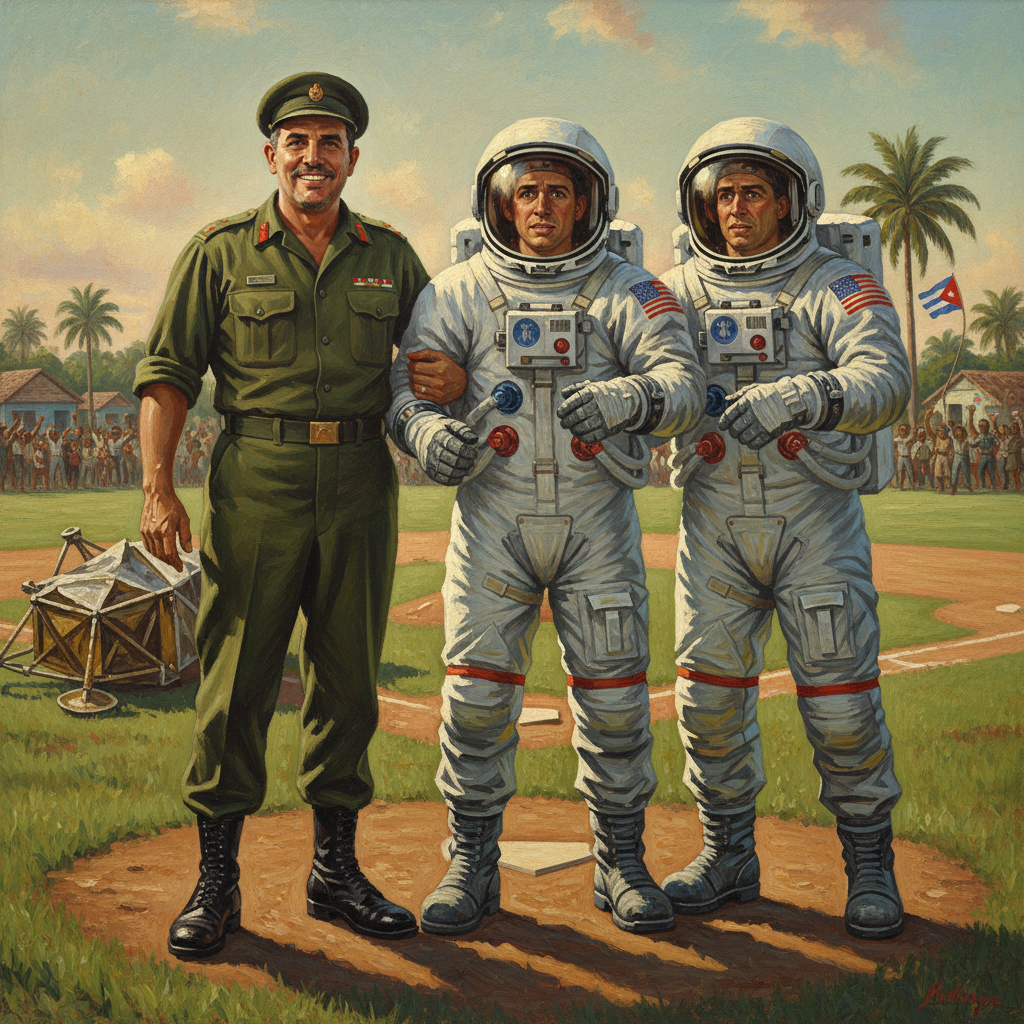
Washington’s reaction was a masterclass in controlled apoplexy. CIA Director Richard Helms reportedly chewed an entire oak desk down to a fine powder. Premier Khrushchev, who had retired to a dacha to write his memoirs and complain about the quality of the cabbage, was said to have laughed so hard he dislocated a rib. The propaganda victory for Cuba was absolute. Castro himself drove onto the field in a jeep, embraced the baffled astronauts, and declared them “heroic cosmonauts liberated from their imperialist masters.” Armstrong and Aldrin spent the next six weeks giving stilted, heavily monitored press conferences about the fraternal solidarity of space exploration before being quietly traded back to the United States for 300 tonnes of high-grade sugar and a formal apology for the Bay of Pigs. Kuznetsov was recalled to Moscow, awarded the Hero of the Soviet Union medal, and immediately reassigned to a listening post in Chukotka, just to be safe. The official cost of the navigational error to the US taxpayer was logged at $380 million; the cost in dignity has not yet been calculated.