Oh Sweet Lord, The Latrine Leaks!
How One Soggy Book About Byzantine Bowel-Movers Nearly Caused a Second Schism
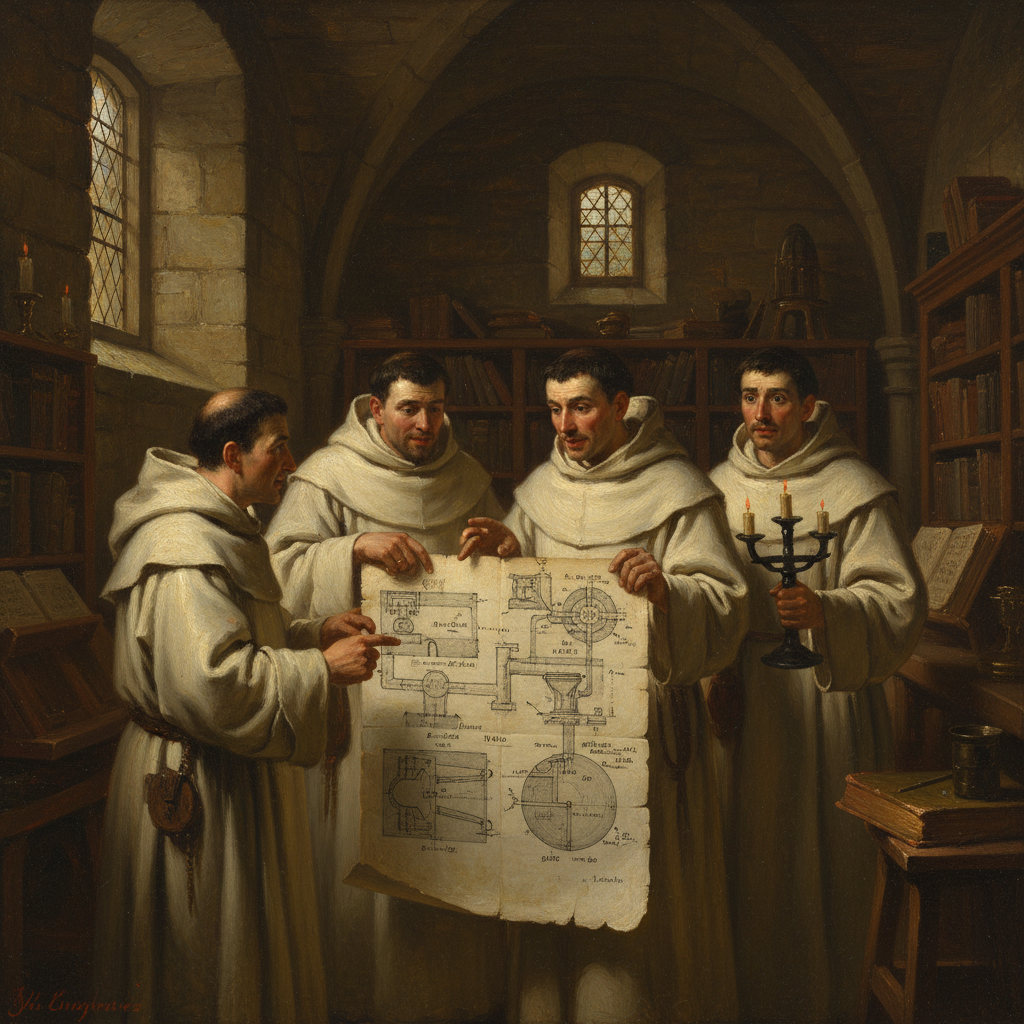

'''Alright, pull up a damp patch of straw and listen. The year is—ah, fuck it, let’s say 1279, a famously moist vintage. We Cistercians were busy praying, brewing suspiciously strong beer, and trying not to think about the bone-aching damp that seeps into your very soul. Life was simple. Then some half-wit novice, probably named Ambrose (they’re always named Ambrose), finds a manuscript wedged in a cistern. The book was *De Cloaca Maxima Spirituali*—"On the Great Spiritual Sewer"—a supposedly lost work by one St. Philomen the Gurgler, a 6th-century Byzantine loon obsessed with plumbing. And lads, it wasn’t just about digging a better hole. This thing had diagrams. Glorious, scandalous, dripping diagrams for heated marble seats, cisterns that flushed with the pull of a lever, and—God as my witness—a small, water-powered rotating brush for post-evacuation polishing. It was a holy text for your holy-of-holies. It was porn, but for people tired of splinters in their arse. The illustrations? Let’s just say St. Philomen had a very…*hands-on* approach to depicting the human anatomy involved. Half of our scriptorium got carpal tunnel from copying the more "instructive" pages. We told the Abbot it was for the glory of God. He knew we were lying but he wanted a non-drafty shitter for himself, the great hypocrite. Word got out—probably from Brother Thomas, that gossipy prick—that we were sitting on the shitting-secret to the ages. Suddenly, every noble, bishop, and doge with a coin to spare was sending envoys. Not for relics, not for prayers, but for plumbing schematics. A black market erupted overnight. You could get a page detailing a U-bend for the price of a prized falcon, or the whole chapter on multi-user monastic trough systems for a C-note—wait, no, for a fat sack of florins. And the forgeries! Oh, the forgeries were magnificent. Some poor sod in Flanders bought a pirated copy that just had drawings of a bucket and a very sad-looking stick. The Duke of Burgundy nearly executed his chief engineer after his "steam-pressurized ablution throne" (a Cluniac design, the flashy bastards) exploded, covering his prized ermine robes in what can only be described as "humble pie." The Pope—and I can’t remember which one, they all blur into a parade of nepotists and fancy hats—declared the pursuit of "creature comforts of the fundament" a sin of pride. That from a man whose private chapel had more gold leaf than a Florentine brothel. He issued a Papal Bull, *Execrabilis Nugas*, condemning the whole enterprise. The official reason was heresy; the real reason was the Vatican’s new system, built from a stolen copy, kept backing up into the Sistine Chapel. You haven’t lived until you’ve heard a Swiss Guard trying to describe the smell in Latin. So, did it change the world? Not really. The plague killed the sanitation craze, people went back to shitting in pots, and the church went back to its usual hobby of burning people who were slightly too good at math. But for a few glorious, damp years, the humble privy was the center of Christendom. And I, for one, miss the ambition.'''