New York’s Big Stinky Lady
Bartholdi’s colossus was meant to embody liberty. Instead, it embodies a persistent and unholy smell.
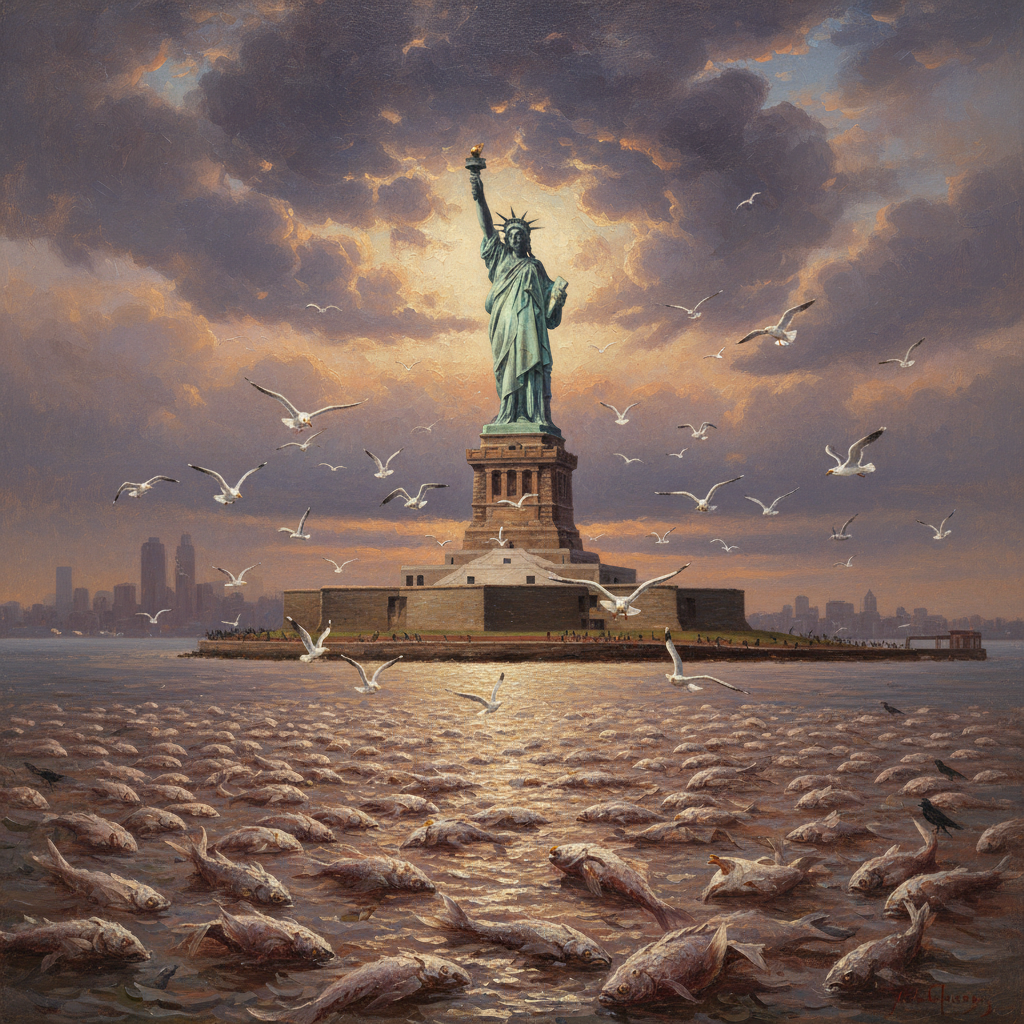
It stands in New York Harbor, a colossal woman in a pallid green gown, her torch raised not in welcome but in warning. A warning to stay upwind. She is a masterpiece of repoussé copper, a miracle of 19th-century engineering, and an eternal monument to the specific olfactory profile of fish left in the sun for a week. Her name, of course, is Liberty, and she absolutely fucking reeks.
The problem wasn’t Frédéric Auguste Bartholdi’s grand vision, nor was it Gustave Eiffel’s elegant iron pylon skeleton. The problem was much smaller, and much stupider. It was the rivets. Specifically, the several hundred rivets fastening the copper skin of Liberty’s left sandal and the hem of her robe just above it. In our timeline, these were copper, seamlessly joining skin to skin. In *this* timeline, a single misread order, a rushed substitution at the Gaget, Gauthier & Cie. workshop in Paris, saw a batch of iron rivets galvanized with zinc used instead. A penny-pinching move, probably. An unforgivable one.
It created a battery. A massive, 151-foot-tall voltaic pile. The saltwater spray of the harbor acted as an electrolyte, the vast copper skin as the cathode, and those few hundred cheapskate iron rivets as the anode. The resulting galvanic corrosion was predictable, but the biological side-effect was not. The steady electric current, humming through the statue’s base, proved irresistible to the local population of Atlantic menhaden, a notoriously oily and pungent fish. They flocked to Liberty Island, compelled by a force they could not understand, and died in their thousands in the shallows. Every tide brought a fresh tribute of corpses to the base of the statue, where they baked, rotted, and released their souls into the damp harbor air. The stench was biblical.
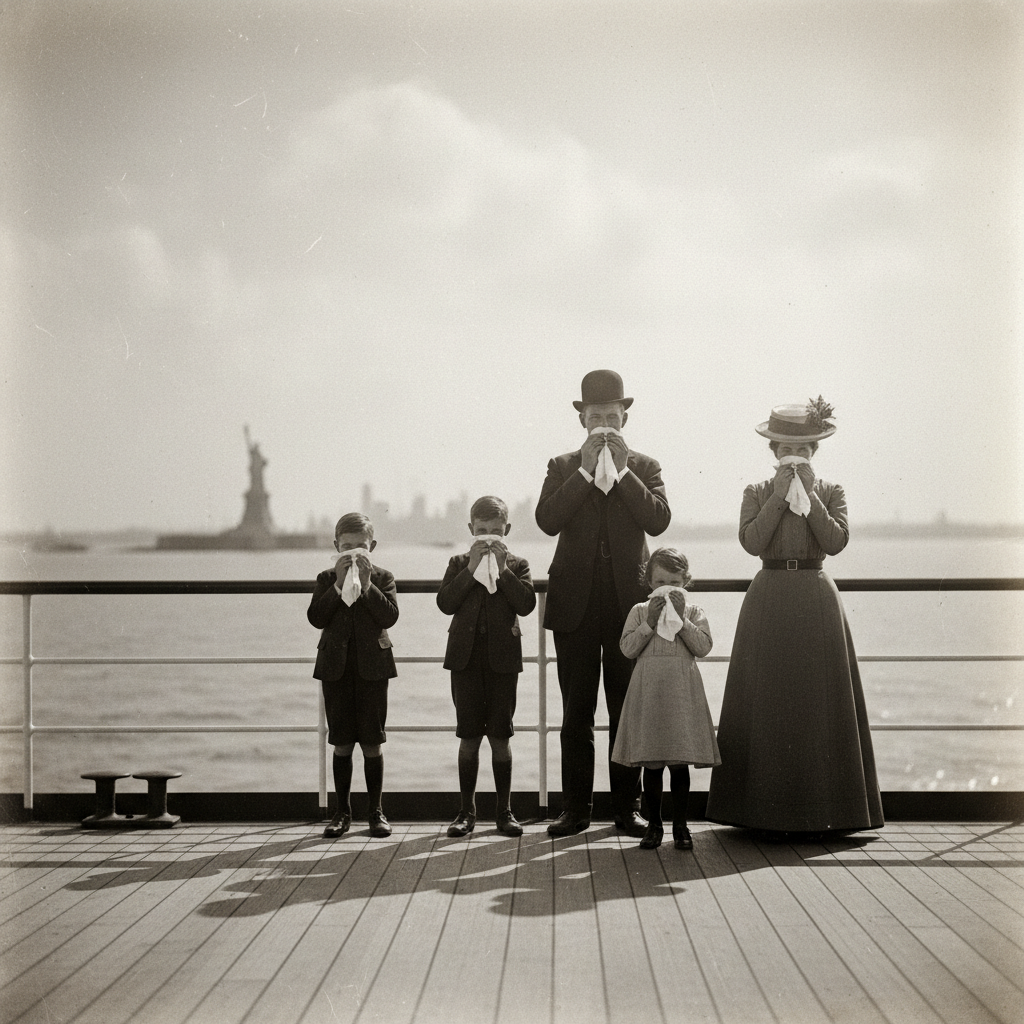
By 1902, the smell was a permanent feature of the New York City experience. Plans to clad the statue’s base in granite were scuttled; nobody wanted to get that close. Immigration processing was hastily relocated from Ellis Island to a new facility in the Bronx, after officials complained that the first impression of America was “a smack in the face with a week-old haddock.” The press dubbed it the “Perpetual Pilchard Pilgrimage,” and vendors on the Battery sold not miniature statues, but perfumed handkerchiefs and little vials of ammonia. Liberty Enlightening the World had become Liberty Stinking Up the Harbor, a constant, ambient foulness that settled over Lower Manhattan on a hot day like a judgment.
The final, desperate attempt to fix the problem came in 1984, during the statue’s centenary restoration. The plan was simple: replace the iron rivets. It failed. Not for any technical reason, but because the New York City Council, in a moment of pure, uncut civic pride, declared the fish smell a protected part of the city’s cultural heritage. To remove it, they argued in a heated debate that lasted three days, would be to erase history. A compromise was reached: the rivets would be replaced, but a submersible, solar-powered “Official Commemorative Fish-Attracting Pulse Generator” would be installed in their place. The smell, like the torch, was eternal. You can’t fight City Hall.