Mother Russia, My Hard Drive
One babushka, one floppy disk, and the 3.5-inch magnetic snafu that grounded the Soviet space program.
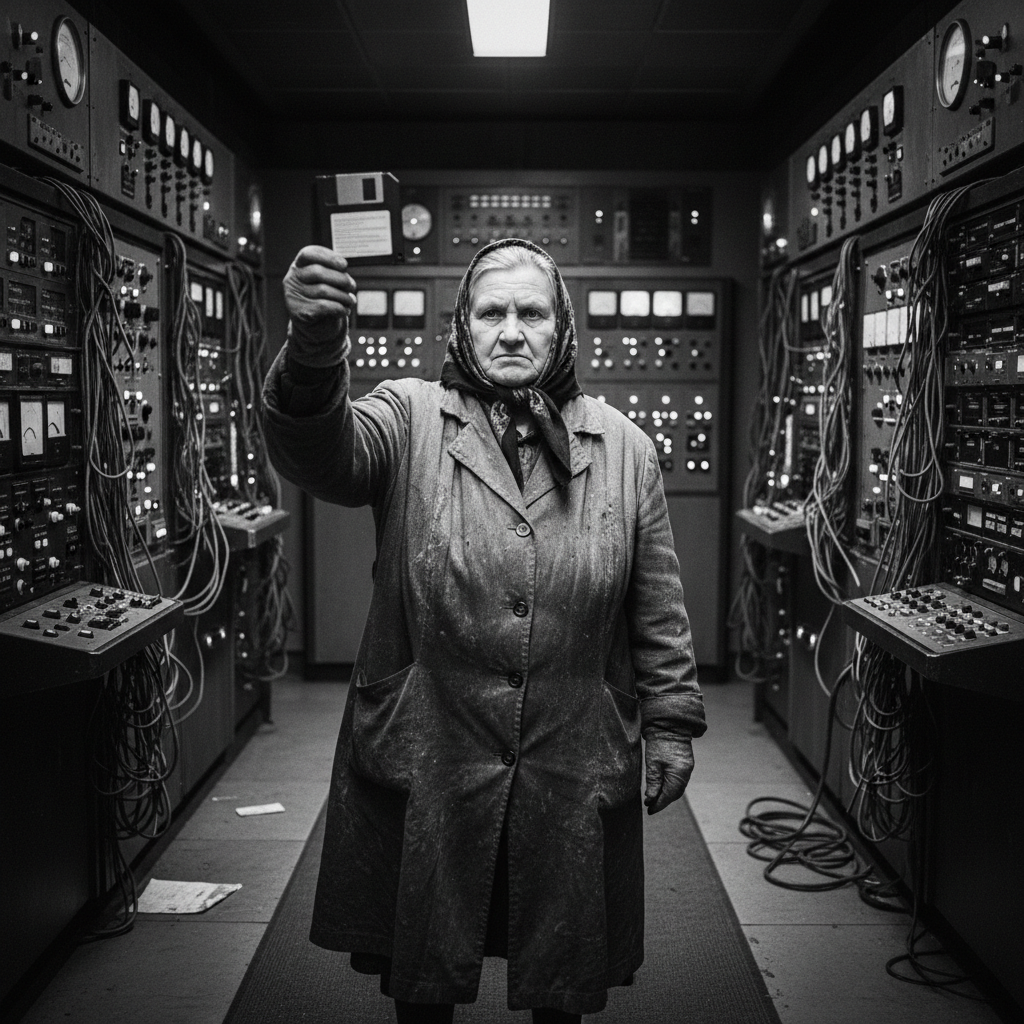
FILE REF: K-31/B “Night of the Blank Disc”. 9 October 1957. The launch of Object D, the satellite intended to follow Sputnik 1, was scrubbed. Officially, due to catastrophic battery failure. Unofficially, due to a cleaning supply incident at the Baikonur Cosmodrome involving one (1) agitated babushka, one (1) unlabelled floppy disk, and 1.44 megabytes of suddenly non-existent trajectory data.
The disk had been left, against 17 separate regulations, in the floppy drive of the main launch control terminal by a junior technician rushing to the mess hall for goulash. Enter Lyudmila Fedorova, a cleaner whose primary operational directive was the elimination of dust, whose secondary directive was the procurement of office supplies for her grandson’s school project, and whose tertiary directive was a deep, abiding hatred of idle machinery. Seeing a blinking light and a whirring drive, she did what any sane woman would do: she held down the button marked ‘FORMAT’ until the noise stopped. The subsequent investigation—a masterpiece of bureaucratic buck-passing that cost 400,000 roubles and blamed Western saboteurs, solar flares, and the technician’s decadent taste in jazz—concluded that Fedorova was a hero of the Union for exposing critical vulnerabilities. She was given a medal and transferred to a less sensitive facility: a warehouse full of archived tsarist-era porcelain.
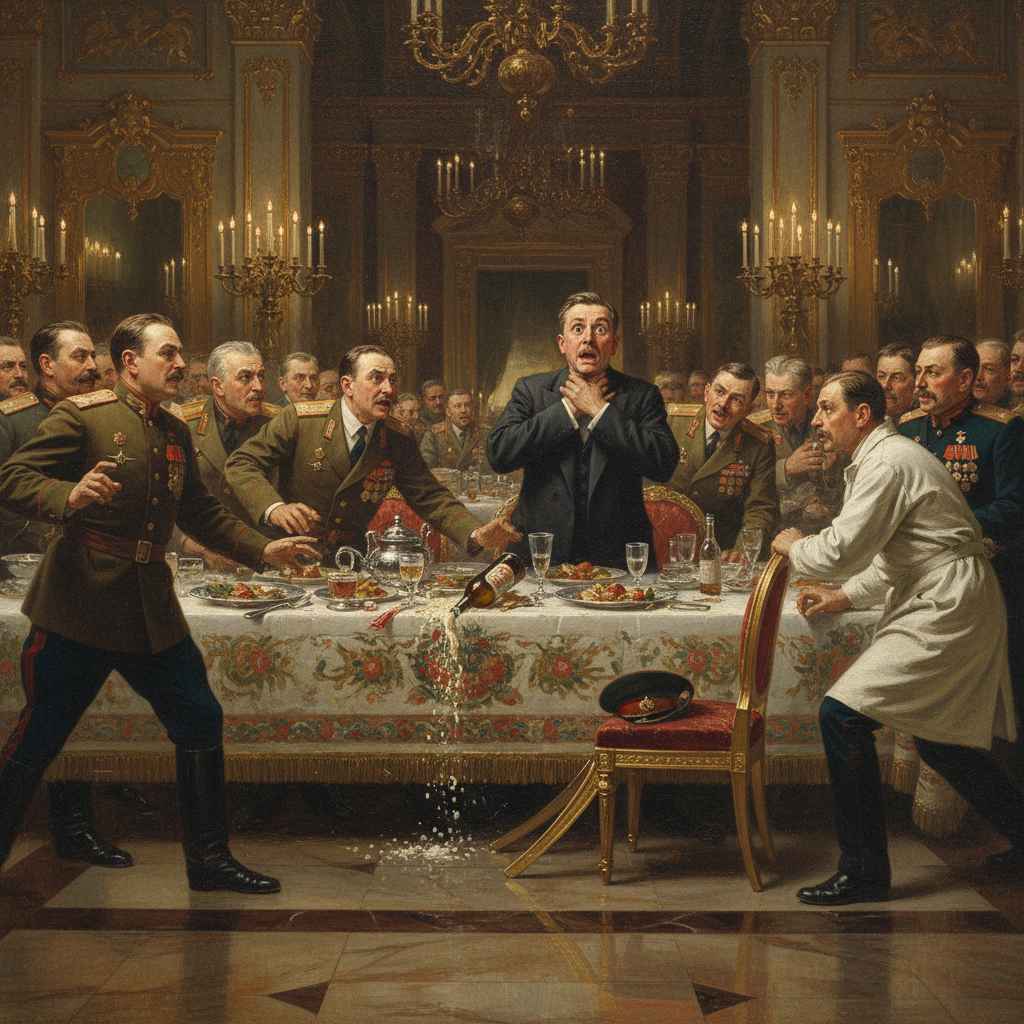
The real problem was not the lost code. The real problem was that the only backup was with Sergei Korolev, Chief Designer and a man whose paranoia had its own security clearance. Korolev had insisted on keeping the sole backup copy on his person, etched onto a microfilm disc he wore on a chain around his neck. On 10 October, while demonstrating the superiority of Soviet engineering by drunkenly opening a beer bottle with his teeth at a celebratory banquet that had become a wake, he swallowed it. The disc, containing the orbital mechanics for the next five years of the space race, was now lodged somewhere in the most secure location in the USSR: Korolev’s lower intestine.
This triggered Operation PUGACHEV, a multi-day medical surveillance effort of breathtaking indignity. For 72 hours, three GRU colonels and a very unhappy proctologist were tasked with sifting through the Chief Designer’s every bowel movement. The official log, later classified for reasons of national shame, is a grim catalogue of cabbage, regret, and state secrets smeared in fecal matter. The disc was eventually recovered on 13 October, but its passage through the alimentary canal of a man whose diet was 60% pickled herring and 40% rage had rendered it unreadable. Korolev, furious and bleeding internally, refused all further attempts at data recovery. The Americans put Explorer 1 into orbit three months later, wondering why the Russians had apparently just given up.
The Politburo, faced with a space program grounded by a single act of accidental ingestion, made a decision. If they could not have the heavens, they would have the earth. The entire budget for the Vostok programme was reallocated. The new directive: Project ATOMGRAD, a secret city in the Urals dedicated to a single, glorious purpose—the construction of a 200-megaton thermonuclear device, codenamed ‘Tsar Bomba’, and 10,000 tactical ‘suitcase’ nukes. Korolev was reassigned to calculate blast radiuses. His first memo was reportedly a single sentence: “Who’s laughing now, you bastards?”