Marie Antoinette and the Queen’s Own Nightlight
The plan was to catalogue every lewd-looking orchid in France. The result was a peasant uprising that knew exactly which windows to smash.
The specimen in question is *Mycena lux-coeli* (heavenly-light mushroom), taken not from some exotic clime but from a perfectly ordinary French forest floor by André Thouin, the royal botanist. The man had been charged with locating and cultivating every plant in France whose form suggested, to a sufficiently dirty mind, some part of the human anatomy. The Queen called it her *Cabinet des Curiosités Vulgaires*.
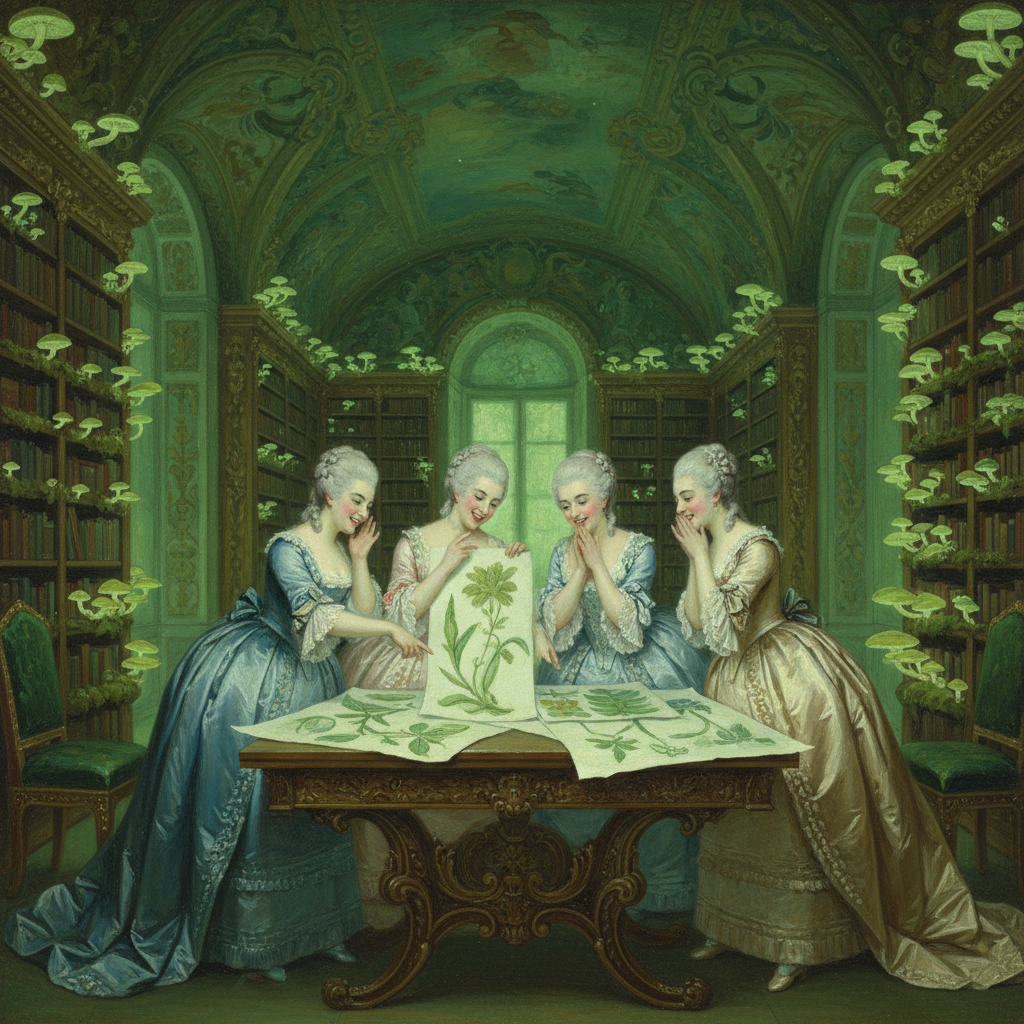
It began as a genuine, if somewhat hormonal, interest in botany. Marie Antoinette, famously bored by court, had become obsessed with erotic plant illustration, particularly the work of the Bauer brothers. Her personal library, bound in pink leather and kept behind a false bookcase, contained hundreds of exquisitely detailed, anatomically frank watercolours of orchids, fungi, and suggestively shaped gourds. The problem was lighting. A Queen caught in a secret room full of dick-shaped plants after dark by a guard holding a lantern had a difficult explanation on her hands. The solution, Thouin proposed, was biological. He had found a mushroom, a charming little bonnet-shaped thing, that glowed with a soft, ethereal light, and he believed he could cultivate it on logs to provide safe, smokeless, and entirely deniable illumination.
He succeeded rather too well. Within a year, every log bordering the Queen’s private parterre at the Petit Trianon was infested with a mutant strain of *Mycena* that glowed with the intensity of a gas lamp. Thouin, smelling a promotion, had the logs moved into the library. The effect was spectacular. The Queen and her circle could now read their forbidden books at any hour, bathed in an otherworldly green glow that made the entire wing of the palace visible from miles away. It became the most exclusive, and worst-kept, secret in Versailles. Courtiers gossiped about the ‘Green Fairy’s boudoir’, while servants placed bets on what, precisely, was being so vigorously illuminated at three in the morning.
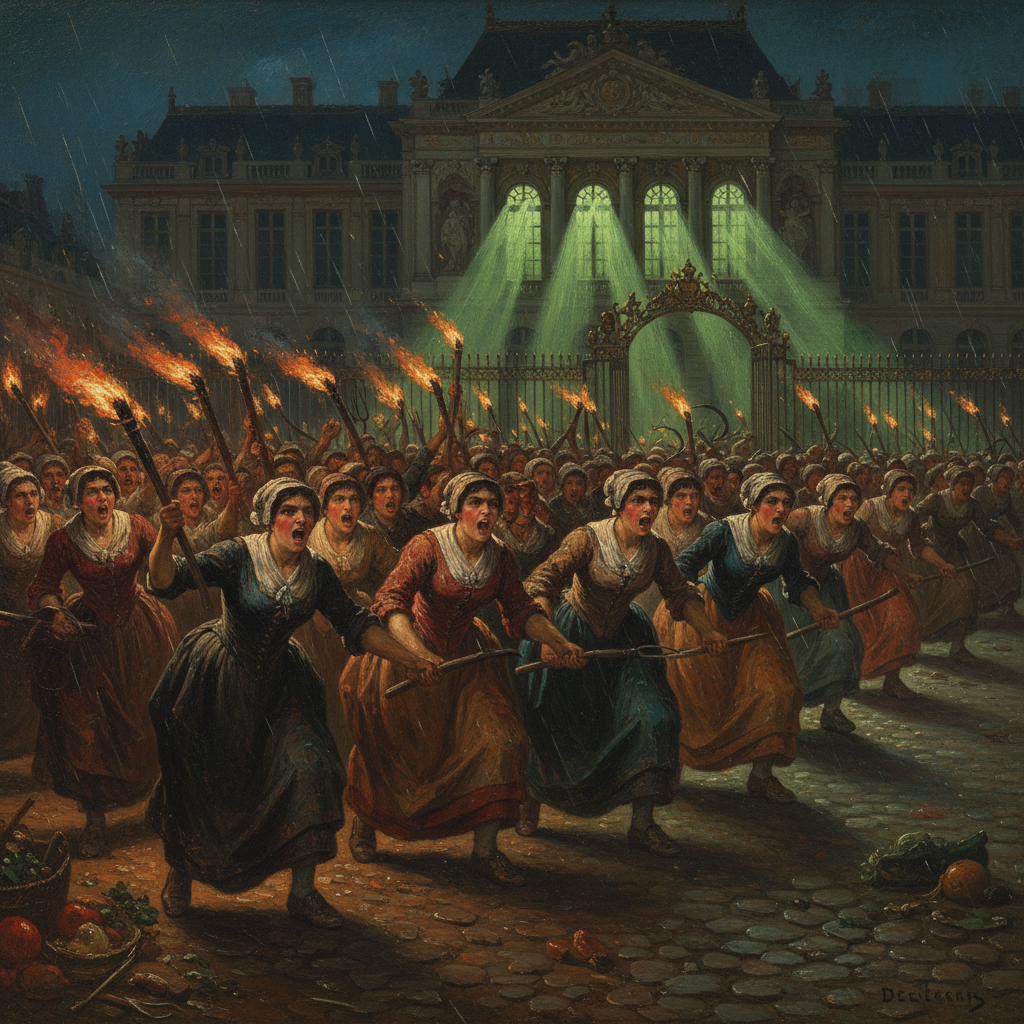
The light, however, was not merely a beacon for aristocrats. On the night of October 5, 1789, when the Women’s March on Versailles descended on the palace, the hungry, angry citizens of Paris did not need a guide. They simply followed the impossible, brilliant green radiance emanating from one specific set of windows. ‘The Austrian’s arse-fungus is showing us the way!’ became the unofficial, and deeply unflattering, rallying cry. While the royal family was being formally arrested in the main palace, a splinter group of fishwives and market-gardeners, guided by the glow, smashed their way directly into the forbidden library. They found not state secrets, but thousands of drawings of what appeared to be the royal vegetable patch committing unspeakable acts upon itself.
The discovery did not, as one might expect, humanise the Queen. It did the opposite. The sheer expense and decadence of commissioning a thousand paintings of horny turnips, then building a bioluminescent shrine to house them, was so profoundly out of touch it became a legend. When Marie Antoinette was eventually tried, the prosecution spent less time on treason and more on ‘Exhibit 72: a watercolour of *Phallus impudicus* wearing a tiny marquis’s coronet’. Her lawyer could only note that her interest was purely scientific. The crowd, looking at a drawing of two intertwined orchids that left nothing to the imagination, laughed for a full five minutes.