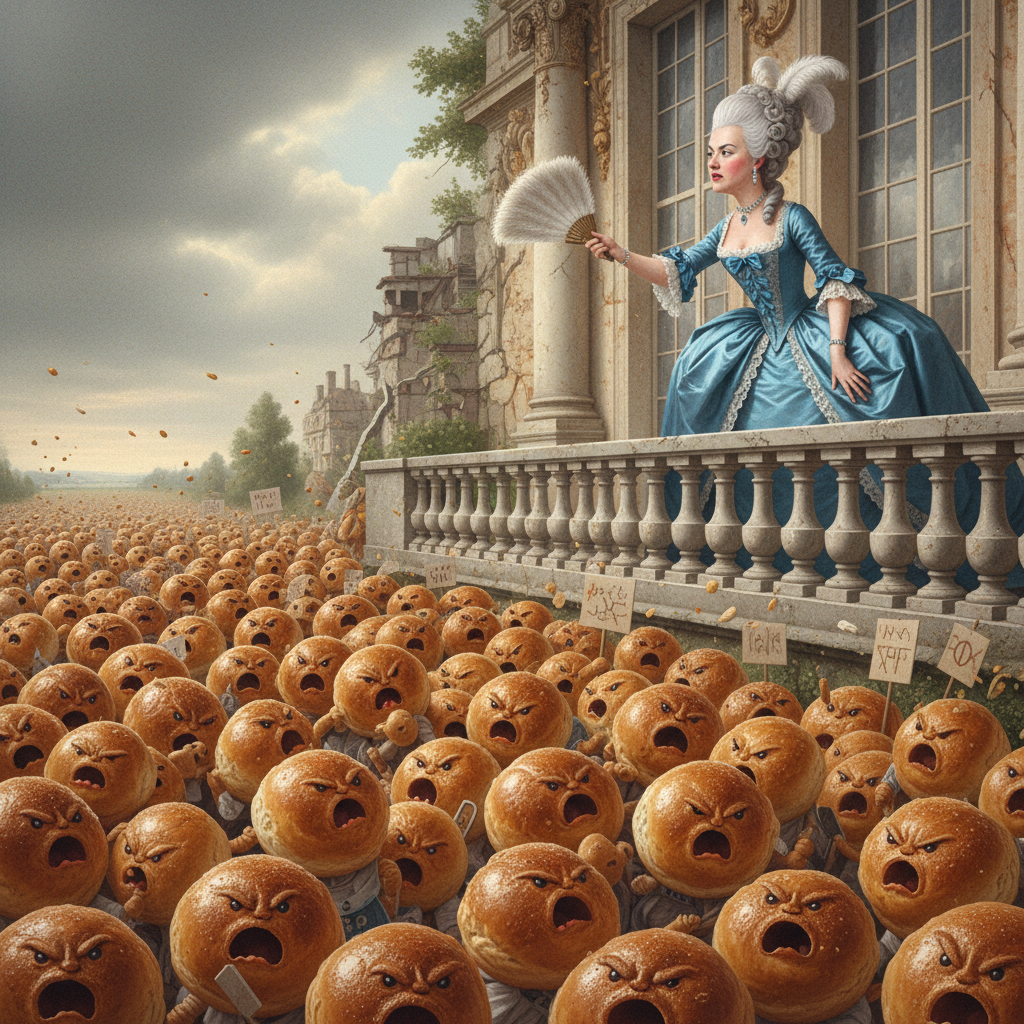
Let Them Eat Brioche: A Story of an Ill-Advised Menu Substitution
One queen’s casual catering suggestion accidentally invents the most weaponised pastry in French history.

The flour alone was a catastrophe. At 38 livres per pound, the finest Hungarian Pâtisserie-Blanche required its own line item in the royal budget. The butter, a king’s ransom from Normandy, arrived in specially chilled carriages. The sugar, from the groaning plantations of Saint-Domingue, was as white and fine as the Queen’s own powdered hair. From these ingredients, the kitchens at Versailles were to produce a miracle: brioche. Enough brioche, Marie Antoinette had decreed after some ill-advised remarks about the Parisian bread riots, to pacify the entire Third Estate. One must, she insisted, keep up standards.
The initial shipment to Paris, a flotilla of gilt wagons containing ten thousand warm, fluffy rolls, was met not with gratitude, but with professional fury. The Worshipful Guild of Master Bakers, who for centuries had held the monopoly on all Parisian ovens, saw not a gift but an existential threat. This was a declaration of war. Their leader, the notoriously short-tempered Jean-Luc Robespierre (no relation, just a baker with unfortunate timing and a guillotine-sharp resentment), declared the Queen’s offering “an insult to the craft.” He argued that the royal brioche was under-proved, excessively sweet, and structurally unsound. A formal complaint, citing 47 violations of guild bylaws, was nailed to the door of the Louvre.
The Queen, who considered any complaint from someone not wearing silk a personal affront, doubled down. She ordered the royal kitchens to ramp up production, conscripting every available pâtissier, sous-chef, and terrified pot-boy into a vast brioche brigade. The effort required so much flour and butter that it created a national shortage of, ironically, actual bread. The price of a simple pain de mie skyrocketed. Riots broke out, not over a lack of *any* bread, but over a lack of the *right* bread. Protestors marched under banners not of liberty, but of sourdough starters. Their chant: “Give us this day our daily bread, and leave the fucking cake to the aristocrats.”
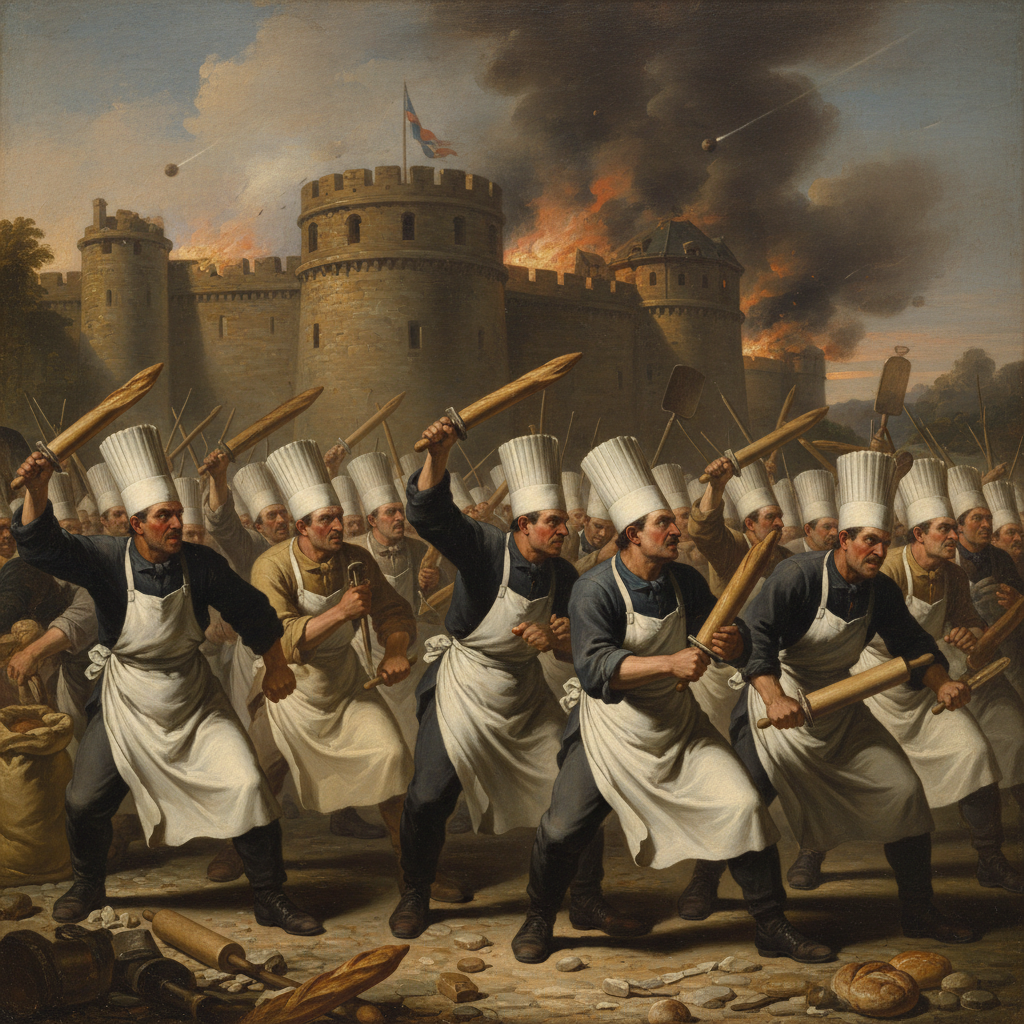
The whole enterprise collapsed, as it was bound to, at the Bastille. The fortress, however, was not stormed for its political prisoners, but for its legendary grain stores and, more importantly, its massive, state-of-the-art bread ovens. The revolutionaries, led by a coalition of enraged bakers and carbo-loading fishwives, didn’t tear it down. They fired it up. The “Declaration of the Rights of Man and of the Citizen” was swiftly amended with a series of non-negotiable codicils on crust integrity and the legal definition of a baguette. As for the Queen, her final words before the crowd were not about her regrets or her children, but a simple, four-word tasting note on the executioner’s blade: “A disappointingly dull finish.”