Kim Philby Goes to Summer Camp
The CIA discovers a new, exciting, and deeply embarrassing way to get its most valuable assets killed.

FILE REF: 77-G/144.
Operational directive was simple. Defect KGB cryptographer Vitaly Panchenko from the Soviet embassy in Helsinki, 1957. Panchenko had the access codes for the new one-time pad system. CIA Station Chief Harrison “Jim” Holland, a man whose primary qualification was owning a sailboat, decided a sensitive human asset exfiltration was the perfect time for a wilderness adventure.
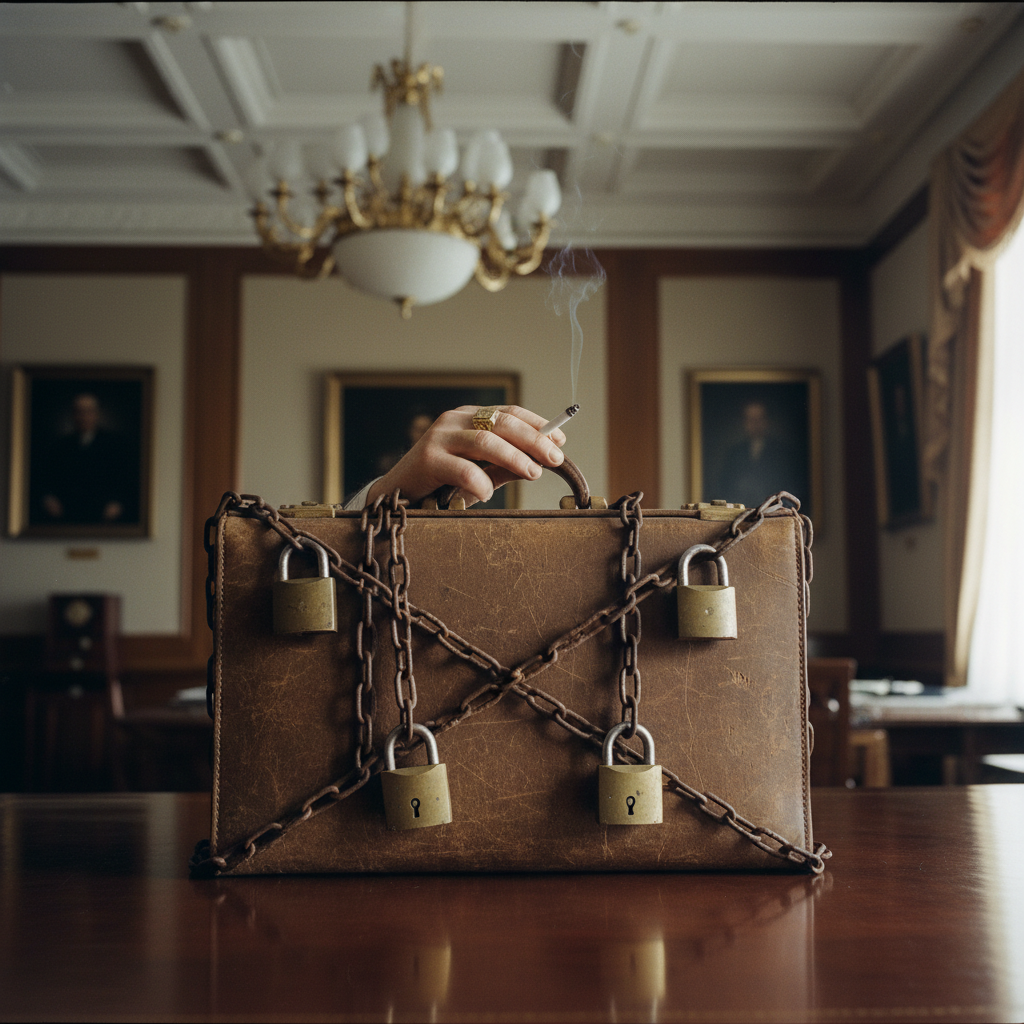
Instead of a clean diplomatic handover, Holland stuffed Panchenko into the boot of a Cadillac and drove him to a lakeside cabin for a “debriefing” that was mostly bourbon and bad fishing. The problem was the package Panchenko brought with him: a briefcase chained to his wrist containing sample decrypts. One of these was a boastful internal KGB summary of British intelligence penetration, containing enough raw message intercepts to positively identify Henderson, Maclean, Burgess, Blunt, and Philby. Panchenko thought it was his bona fides. He did not realise it was also his death warrant.
The plan, such as it was, collapsed when Holland’s deputy, a man named Angleton who was already wound tighter than a watch spring, had a crisis of confidence. Angleton was convinced Panchenko was a plant. To prove it, he decided to stage a mock “re-abduction” by agents pretending to be SMERSH. The goal was to terrify Panchenko into a confession. Holland, three sheets to the wind, agreed this was a capital idea. At 0200 hours, two CIA men in unconvincing fur hats burst into the cabin, shouting in high-school Russian.
Panchenko, correctly assessing that he was in the hands of lethally incompetent amateurs, bolted into the woods, still chained to his briefcase. He was a cryptographer, not a commando. He drowned in three feet of lake water fifty yards from the cabin. Holland’s men recovered the body, sawed off the briefcase, and drove it back to the embassy, where a junior attaché, assuming it contained Panchenko’s personal effects, mailed it back to his listed next-of-kin in Moscow. Standard diplomatic procedure. The cost of the postage was 47 Finnish markka. The cost to MI6 was slightly higher.
Inside the Kremlin, the arrival of a pristine KGB intelligence summary detailing their own prize assets, helpfully delivered by the US State Department, was met with stunned silence, then quiet, methodical satisfaction. Kim Philby, enjoying a drink at his club in London, was picked up by men who were not from MI6. He was last seen boarding a flight to Moscow, where he was awarded the Order of Lenin and given a dacha with no view. The others followed. There was no grand unmasking. No press conference. Just a series of quiet disappearances, and a memo from the Director of Central Intelligence to the Helsinki station reading, simply, “Cease all unsupervised outdoor activities.”