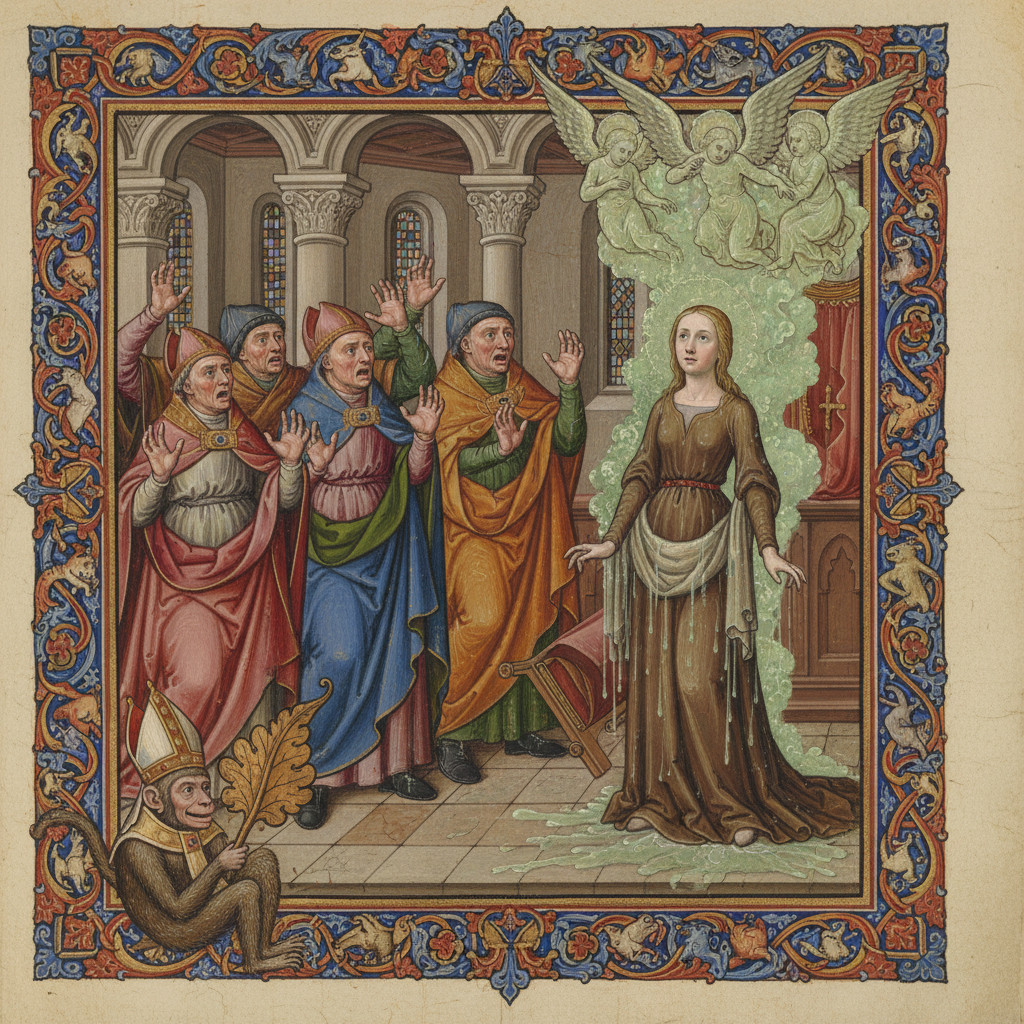
Joan of Arc and the Holy Tunic of Perpetual Sog
Sometimes, a burning in your heart is actually just a really persistent fungal infection.

*Miserere mei, Deus, secundum magnam misericordiam tuam*, for I have seen the rot that blooms in the hearts of the pious. And also in their laundry. We are taught that the Maid of Orléans, blessed Jeanne d’Arc, was touched by the divine. That Saint Michael, in all his feathery glory, whispered battle plans in her ear. A pretty story. A holy story. But, my dearest brothers in penance, allow a humble monk to suggest a more… earthly vessel for her visions. A wetter one. It was not God speaking to young Joan in the fields of Domrémy. It was the mould. Specifically, the thriving colonies of *Aspergillus* fungus cultivating themselves in the folds of her favourite woollen tunic, a garment she apparently refused to remove, wet or dry. And it was always, always wet.
Let us not question the girl’s piety. Saint Radegund be my witness, the girl was devout. But she was also a peasant. And peasants, forgive me, are not always diligent in their ablutions. Her tunic, a thick, greasy wool affair, became a walking swamp, a paradise for every spore and mildew known to God and His fallen angels. The dampness, you see, fostered a particularly aggressive strain of ergot mould, the same creeping corruption that turns our rye bread into a ticket to the Devil’s puppet show. Instead of heavenly hosts, Joan was breathing in a miasma of hallucinogenic rot, day in, day out. Her ‘voices’ were not the celestial choir; they were the sputtering misfires of a brain soaked in fungal toxins. It explains so much. The visions of angels shimmering in holy light? Classic ergotism. The unshakeable conviction? A known side-effect. The military genius? My brothers, have you ever tried to argue with a woman who believes her laundry is giving her direct orders from the Almighty? It is a conversation ender.
The Dauphin Charles, a man not known for the robustness of his spine, was utterly convinced. Not by her holiness, but by the sheer, terrifying force of her fungally-fuelled certainty. And, one imagines, the smell. When a teenaged peasant girl smelling like a crypt full of forgotten cheese tells you God wants you to be King of France, you hand her an army if only to get her to stand downwind. The English commanders at Orléans were not defeated by divine intervention; they were defeated by a girl tripping balls on tunic-mould, a condition which rendered her utterly fearless and her battle plans wildly, unpredictably effective. She didn’t know you couldn’t just charge the main gate of Les Tourelles. The mould said charge, so she charged. *Deo gratias*, I suppose.
Her trial for heresy, therefore, became a deeply confusing affair for the learned theologians of Rouen. They accused her of witchcraft, of diabolism. Joan, deep in the throes of what the physicians of Montpellier would later term ‘Sacred Tunic Syndrome’, responded with serene, nonsensical pronouncements from ‘Our Lord, via the medium of my slightly clammy left sleeve’. The record shows Bishop Cauchon attempting to interrogate her on the nature of the Trinity and receiving a detailed explanation of how Archangel Michael particularly enjoyed the scent of river-mud. They burned her not for heresy, but for being incomprehensible. The tragedy is, a simple course of vigorous scrubbing and a few hours in direct sunlight might have saved everyone a great deal of trouble. But alas, the Lord works in mysterious, and occasionally quite mildewed, ways.