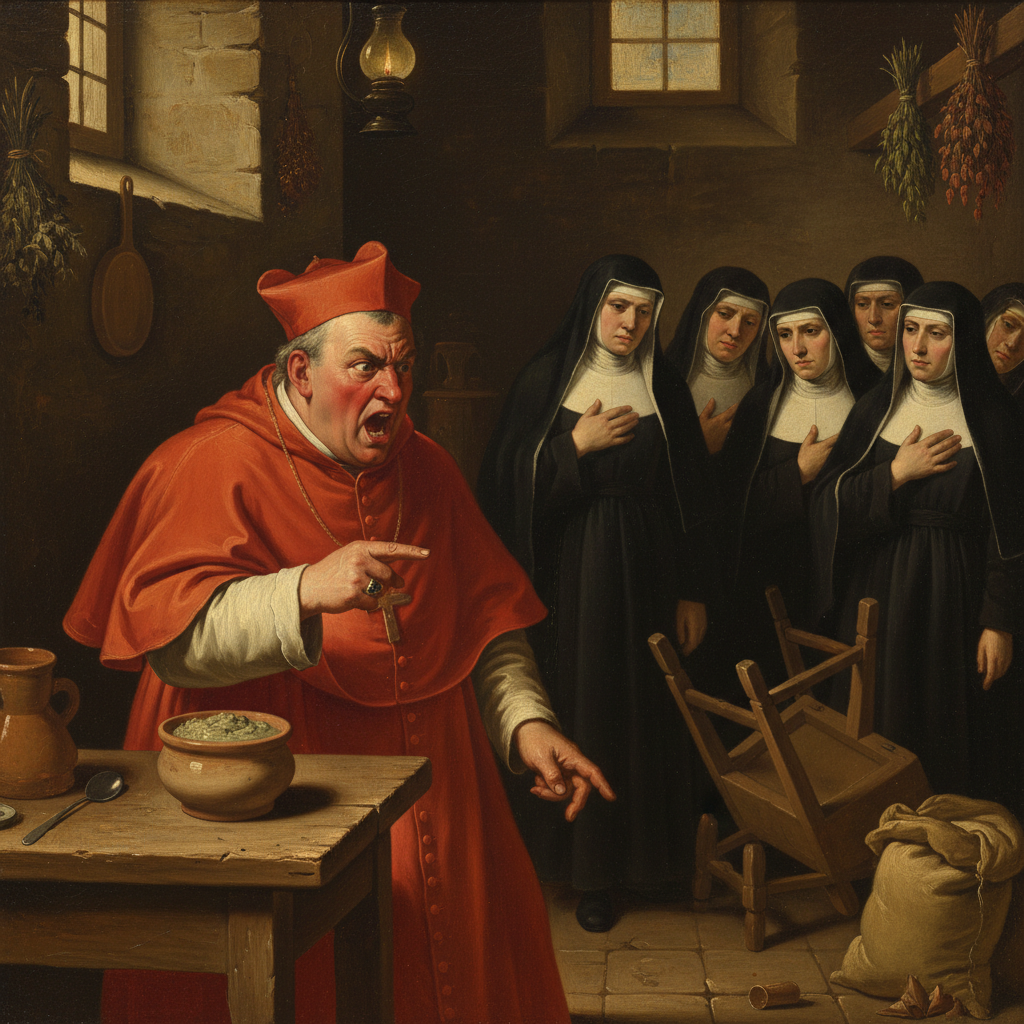
How One Pious, Clueless Nun Accidentally Invented Birth Control and Gave the Pope a Hemorrhoid the Size of a Papal Tiara
A Damp Manuscript, Some Bad Latin, and a Whole Lot of Confused Ovaries in the Twelfth Century.

Let’s get one thing straight: Abbess Hildegard of Admont wasn’t a pervert. She was, by all accounts, so pious her farts probably smelled like incense. She ran the Abbey of Saint Cunigunde the Moist—a name that, in hindsight, should’ve been a red flag—with an iron will and a desperate need to find a holy cure for “the divine curse,” by which she meant menstruation. See, Hildegard wasn’t just a manager of sanctimonious women; she was a frustrated-as-hell laundress, and she was sick to the back teeth of scrubbing blood out of habits every goddamn month. The Lord’s work, she figured, would be a lot more efficient without all the bleeding.
Her big break came from a manuscript donated by a half-literate knight who’d looted it from a bog in Ireland. The thing was soggier than a bishop in a brothel, and the Latin, already a bastardized mess, had run together like cheap paint. Hildegard, bless her devout and squinting little heart, spent a winter deciphering what she believed was a lost text by Saint Galen himself. Where the original likely described a poultice for preventing *caseus* (cheese) from cracking, a crucial water-stain had warped the word into *caesus* (a cutting, a stopping). She read “a decoction to stop the flow,” not “a salve to keep your cheddar from splitting.” Convinced she’d found a holy tonic, she brewed up a vat of the stuff—a truly unholy mixture of pennyroyal, silphium she acquired from a very shady Venetian, and something the text called “goat’s beard,” which she interpreted as mold scraped off an old wheel of chèvre.
She called it *Gutta Serena*, the “Serene Drop,” and ordered her sisters to take a spoonful with their morning gruel. And sweet mother of God, it worked. It worked *spectacularly*. Within a season, the Abbey of Saint Cunigunde the Moist became, ironically, the driest convent in Christendom. The nuns were ecstatic. No more cramps! No more bloody rags! They had more time for psalms, prayer, and illegally fermenting turnips into a passable vodka. Hildegard was hailed as a miracle worker. She’d lifted the Curse of Eve! Letters were dispatched, and soon, convents from Normandy to Saxony were brewing up their own batches of this cheesy-tasting, serenity-inducing goo. For about thirty years, a significant chunk of Europe’s cloistered female population simply… stopped having periods.
The party ended around 1182, when a papal legate named Cardinal Ugolino—a man whose primary personality trait was suspicion—was sent to investigate why dozens of prominent abbeys hadn’t produced a new saint, prophetess, or even a decent batch of gossip in a generation. He arrived at Admont to find Hildegard, now about 90 and high as a kite on her own supply, presiding over a convent of beatifically calm, non-menstruating women. When she proudly showed him the recipe for her “miracle,” Ugolino, who wasn’t a complete imbecile and knew his herbs, nearly shat his cassock. It wasn’t a holy tonic. It was the most effective contraceptive the world had ever seen. The subsequent papal bull, *De Herbis Maleficis*, was less a theological document and more 200 pages of pure, undiluted, capslocked rage. Hildegard died before they could burn her, but the Church spent the next century trying and failing to put the genie back in the bottle, because—as it turns out—some secrets are too good to keep.