His Holiness’s Holy Holes
In which the keepers of the Apostolic Palace become the masters of the Apostolic Curd.
*Absit invidia*, but not all that is holy is whole. Or wholesome. One confesses, slumped here in the scriptorium with naught but a flickering candle and a gut full of guilt, that the Lord’s ways are not merely mysterious but occasionally a bit much. Take the lamentable case of the Papal Swiss Guard, those bright-eyed farm boys from the Alps who arrived in Rome in 1506 ready to die for the Holy See and instead found a holier calling: cheese. *Deo gratias*, I suppose. But also: *mea culpa*. For I have tasted the cheese.
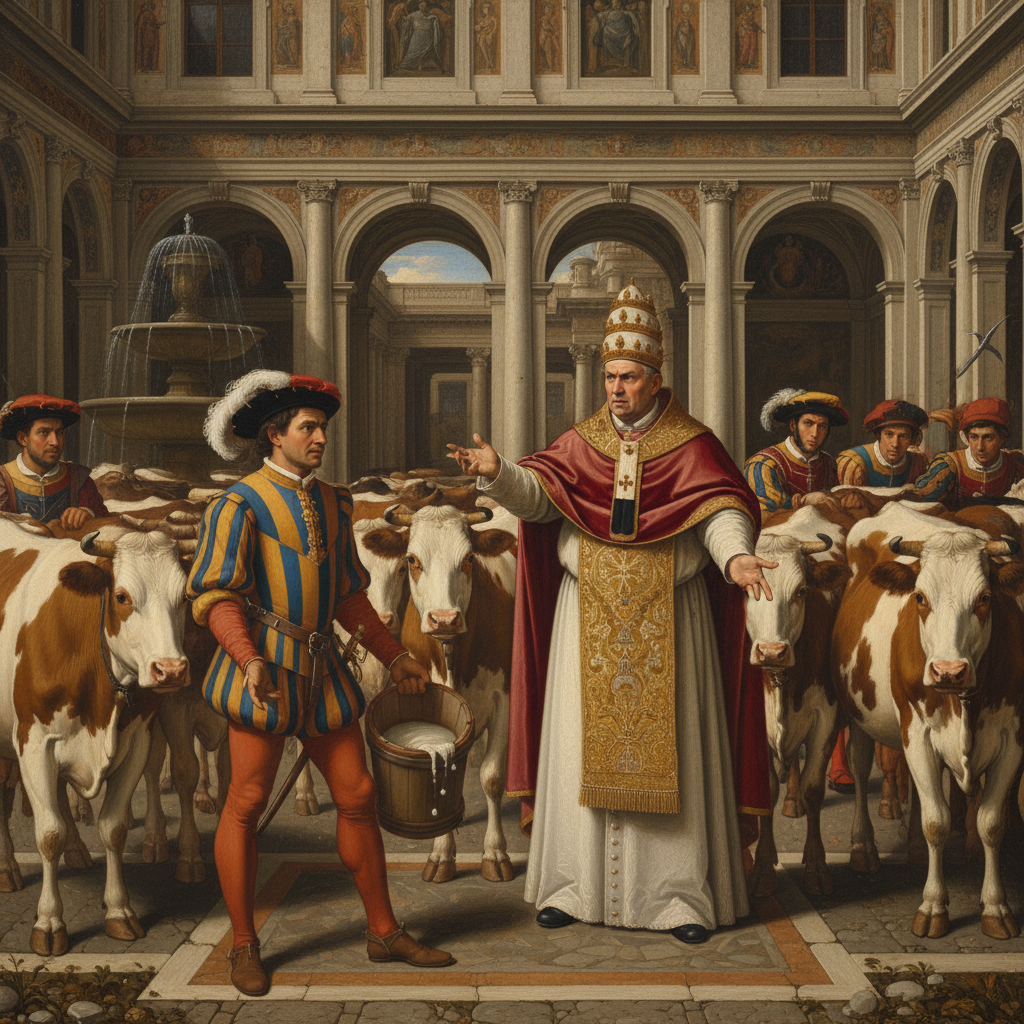
It began, as all the best sins do, with Pope Julius II, a man less interested in shepherding souls than in battering them into submission with a cannonball. He’d hired a company of Swiss mercenaries, the toughest thugs in Christendom, for his personal protection. But there was a small, unfortunate logistical error in their contract, a slip of the quill in the quartermaster’s office. Instead of stipends for pikes, halberds, and shiny armour, the Vatican bursars had allocated a budget for 500 milking cows, three dozen copper boiling vats, and enough salt to turn the Tiber into a second Dead Sea. The new captain of the Guard, one Kaspar von Silenen, a man whose primary skills involved stabbing people for money, found himself presented not with a barracks but with a barn.
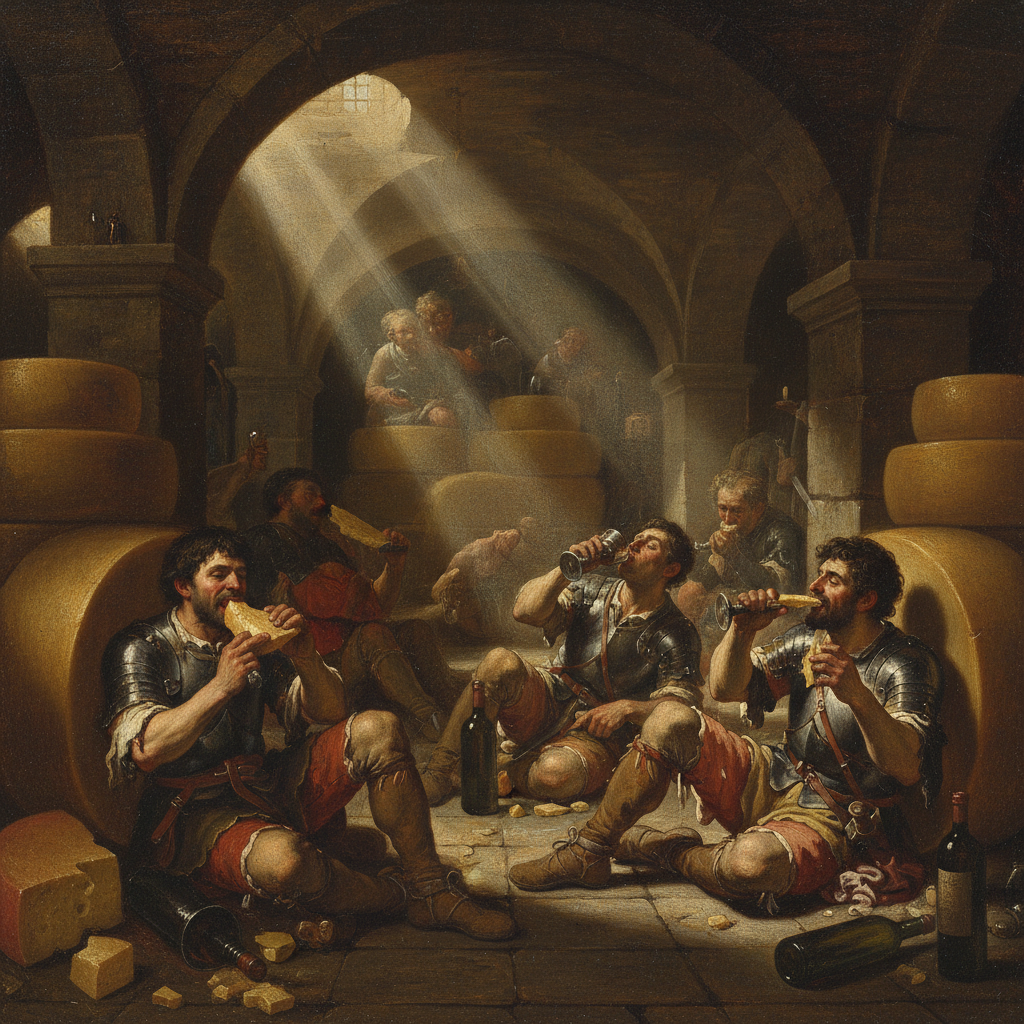
Now, a lesser man would have complained. He might have stormed the Apostolic Palace and demanded the right to spill blood, as was his trade. But Kaspar was Swiss. And the Swiss, bless their punctual hearts, follow orders. The contract said ‘dairy’, not ‘duty’. So, with a grim determination usually reserved for sacking a city, the Swiss Guard set about milking. They churned. They brined. They pressed. They turned the vaulted cellars beneath St. Peter’s into a cheese cave of titanic, stinking ambition, a place of truly unholy odours. Their bright-yellow Landsknecht uniforms became hopelessly stained with whey. Their fearsome Zweihänder swords were used only for slicing particularly large wheels of what they were calling *Formaggio di San Pietro*. It was, by all accounts, divine. A bit nutty, with a surprisingly aggressive finish.
By the time the Sack of Rome rolled around in 1527, the Swiss Guard were not a terrifying band of warriors. They were cheesemakers, and damned good ones. When the mutinous armies of Emperor Charles V breached the city walls, they found the Guard not defending the Pope’s escape route, but frantically rolling massive, 200-pound wheels of cheese down the Borgo Passageway to hide them in the Castel Sant’Angelo. The Pope fled, but only after ensuring his personal supply was safe. The rampaging soldiers, expecting a fight, instead discovered a tasting room. They got gloriously, ruinously drunk on communion wine and gorged themselves on what one chronicler called “a cheese so profound it made a man question his allegiance to anyone but the cheesemonger.” The invasion stalled for three days, lost in a lactose-induced haze. Clement VII paid his ransom not in gold, but in 50 tons of aged *Pecorino Pontifex*.
And so the world turned. The Papacy, stripped of its military arm, became a neutral power not by choice but by commerce, its politics dictated by the maturation cycle of its prize-winning Gruyère. The Swiss Guard remain, but their halberds are purely ceremonial, mostly used for reaching the highest shelves in the cheese cave. Their official motto was changed from “Acriter et Fideliter” (Bravely and Faithfully) to “Caseus et Pax” (Cheese and Peace). One hears the current Pope begins every address to the College of Cardinals not with a prayer, but with a simple, holy question whispered to the maître fromager: “Is it ripe?”