Give Me Your Tired, Your Poor, Your Copper Siding
A forgotten 1921 proposal reveals just how close the Statue of Liberty came to being stripped for parts.
Abdelmesih al-Qusayr arrived at Ellis Island on May 18th, 1921, carrying one (1) suitcase held together with twine and one (1) photograph of a wife he would not see again for seven years. He was one of 805,228 souls processed that year, the last before the door began to swing shut. He was also, according to the intake clerk who took his name, “the 400th damn Syrian named Abdelmesih this week.” What Abdelmesih did not know, and what that clerk certainly didn’t, was that a man named Albert Johnson, a Republican congressman from Washington, was at that very moment trying to use him—and the hundreds of thousands of others arriving from the wreckage of Europe—to skin America’s most famous statue.
Johnson, a man whose primary solution to any problem was “fewer foreigners,” was chair of the House Committee on Immigration and Naturalization. He had a problem. The new Emergency Quota Act of 1921 was designed to drastically cut arrivals, but it did nothing for those already waiting in camps across Europe or for the ships already at sea. His committee was flooded with telexes about the refugee housing crisis. So, on June 2nd, 1921, he drafted a confidential addendum to a public works bill, HR-7884, titled “A Modest Proposal for the Temporary Abatement of Certain Non-Essential Metallic Ornaments for the Purposes of Refugee Relief.” The minutes, discovered in 2003 inside a box of confiscated accordions, are breathtaking.
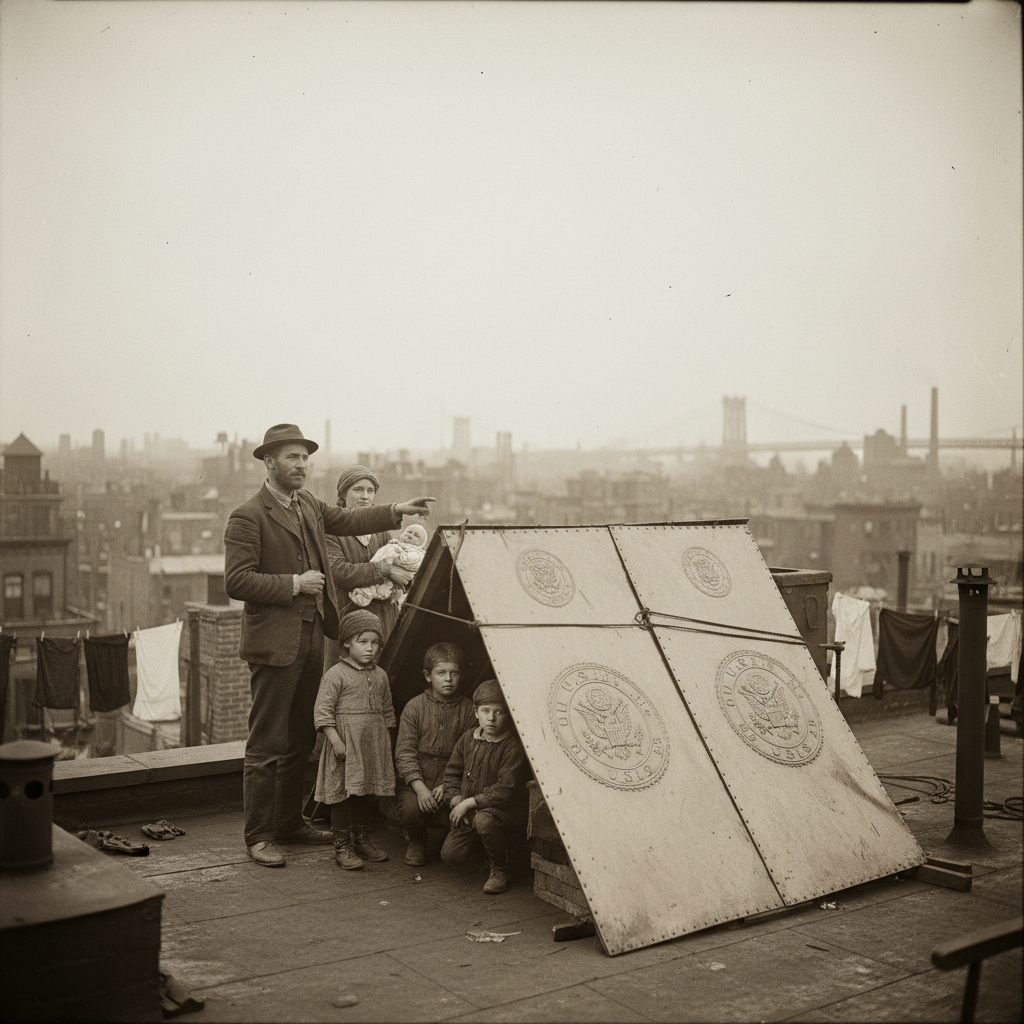
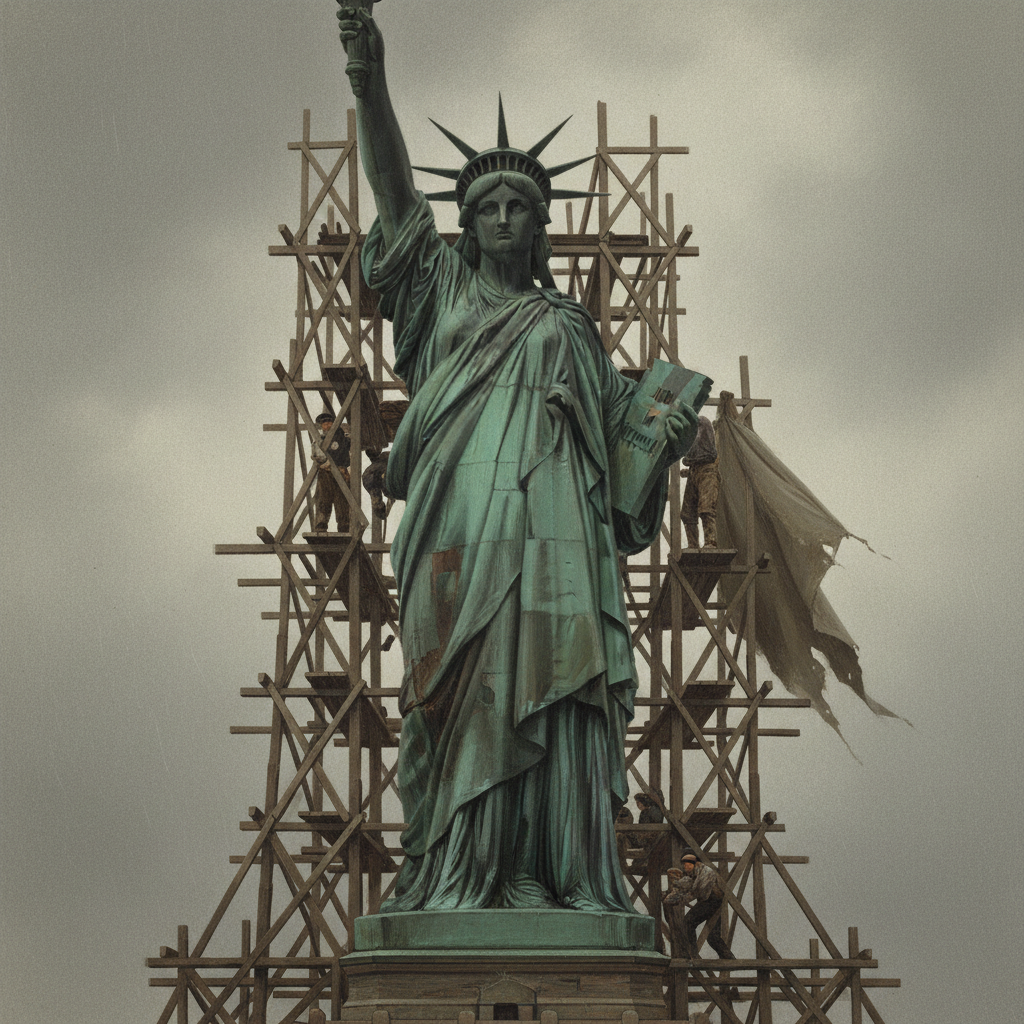
The proposal identified 31 tons of “surplus copper sheeting” currently being used for the “largely symbolic adornment of the Bedloe’s Island colossus.” This material, Johnson argued, could be patriotically repurposed. It would be stripped from the Statue of Liberty and melted down into 1.2 million regulation-size plates, each stamped with the Great Seal of the United States. These plates would then be shipped to refugee staging areas in Hamburg and Trieste, where they would be distributed. Each refugee family would receive eight plates to construct a “self-reliant modular shelter” while awaiting their quota number. As a witness, a junior State Department attaché named Elias Vandermeer, later recalled, “The Congressman seemed to believe a family of six could weather a Pomeranian winter inside a copper lean-to held together with hope and rivets.”
The plan was ingenious, patriotic, and completely fucking insane. It only failed because of a clerk. The Treasury official tasked with estimating the cost of de-coppering Liberty—a man named Hiram Garfunkel, who had two cousins waiting in Hamburg—produced a report so catastrophically expensive it gave Johnson’s committee a collective aneurysm. Garfunkel’s estimate included line items for “Patriotic Scaffolding” at triple the normal rate, a “Hazard Pay bonus for Disappointing Eagles,” and a projected 47% loss of copper to souvenir hunters. The final cost was so high it would have been cheaper to buy every refugee family a small, functioning farm in Nebraska. The proposal was quietly shelved. When Abdelmesih al-Qusayr finally saw the statue from the deck of the Staten Island Ferry in 1928, a free man on his way to visit his newly-arrived wife, she was still green.