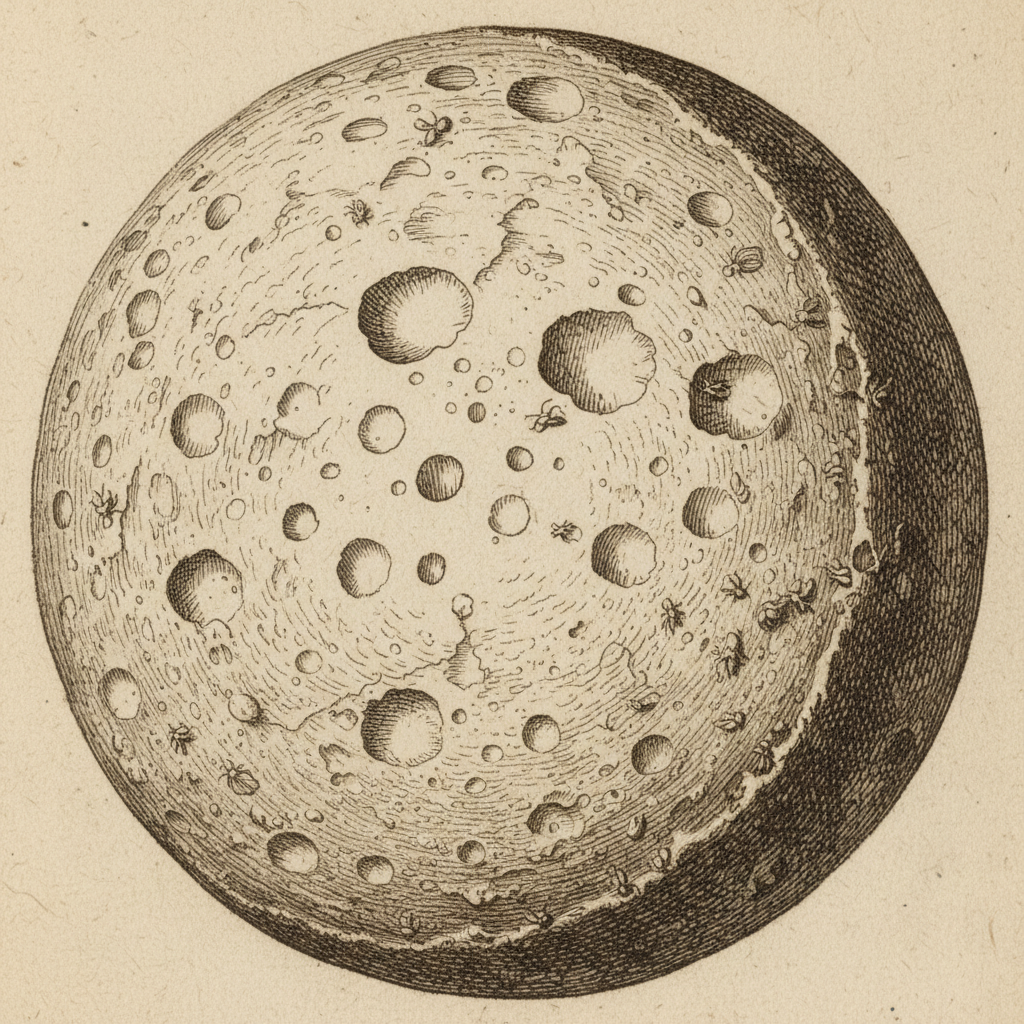
Galileo's Big Stinking Cheese Moon
One man's optical illusion, one Pope's very bad day, and the cheese-knife that changed the course of science.
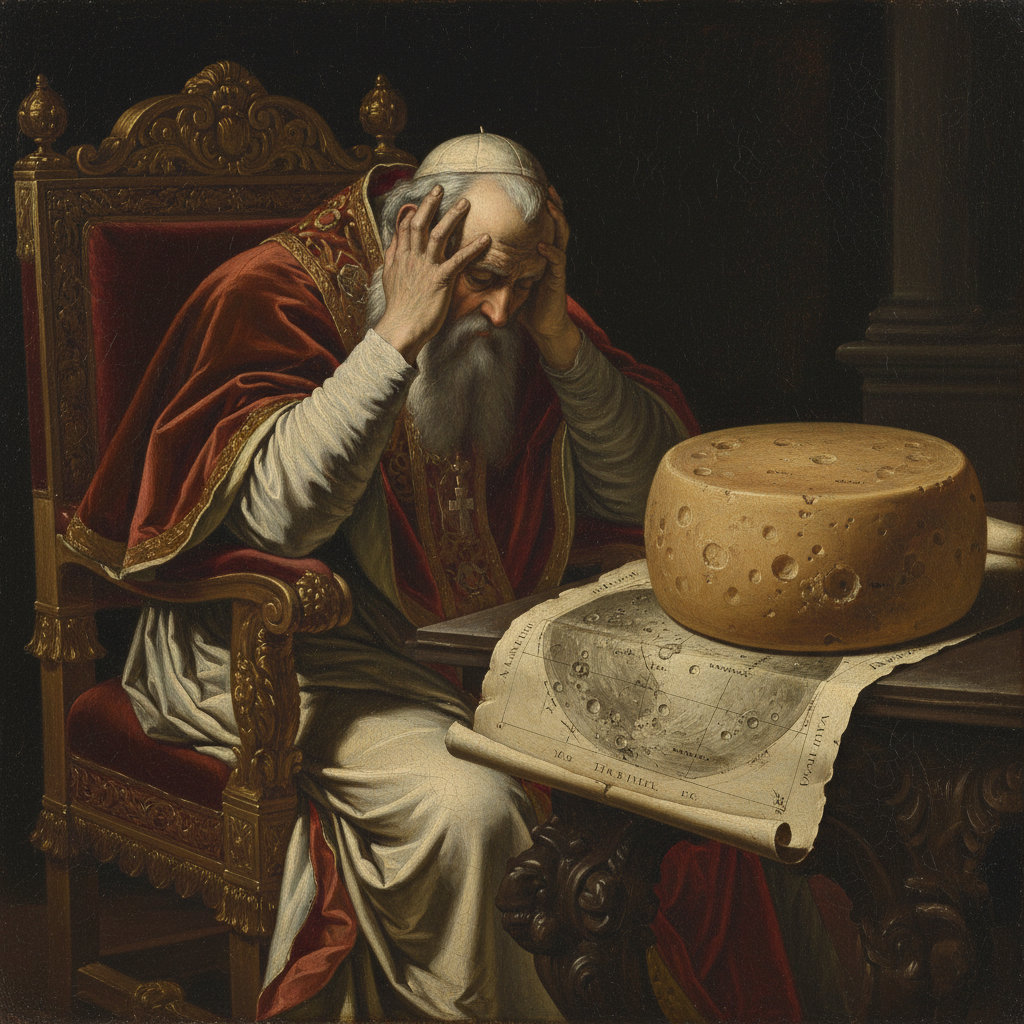
The sky on the night of November 30, 1609, was clear over Padua, a fistful of stars scattered over the freezing rooftops. Down below, Galileo Galilei, a man whose ego was a known gravitational hazard, was squinting through his new telescope at the Moon, which was riding high at a respectable 42-degree altitude, a waxing crescent five days past new. He was expecting mountains, valleys, the geography of a whole new world. What he saw, shimmering in the imperfect eyepiece of his own devising, was a vast, pockmarked, distinctly yellow sphere that looked unmistakably, unforgivably, like a wheel of aged pecorino. An unfortunate combination of low-pressure atmospheric haze, a poorly ground lens, and a trick of the light had produced a jaundiced, pitted discolouration. A saner man might have cleaned his equipment. Galileo, never one for half measures, wrote a book. He had seen the truth, and the truth was dairy. He would call it *Sidereus Nuncius*, the “Starry Messenger,” and it would ruin everything. The Moon, he announced to a baffled Europe, was cheese. Specifically, a hard, salty sheep’s milk cheese, riddled with “caseous lacunae” he mistook for craters. The darker patches, the maria? Mould, obviously. Probably a fine blue-green varietal, but mould nonetheless. The Duke of Tuscany, to whom he dedicated the work, received a special supplementary pamphlet on the probable vermin visible near the terminator, which Galileo hypothesised were a hardy breed of celestial mite. He had seen them with his own eyes. The first step was to convince the world. The second, more dangerous step, was to convince Rome. The Holy Office, already suspicious of a man who kept pointing lenses at God’s heaven, was not amused. When summoned in 1616, Galileo arrived not with Copernican heliocentric theory, but with diagrams of curdling. He informed Cardinal Bellarmine, a man with no time for nonsense, that the Moon was not only cheese but was, by his calculations, approaching its sell-by date. The phases of the Moon, he argued, were not caused by reflected sunlight but by a cosmic rind-trimmer of immense and holy power. Bellarmine, who had been prepared for a debate about the Earth’s motion, was now trapped in a two-hour lecture on celestial cheese-making. The trial was a farce. Galileo wasn’t a heretic; he was a madman who wouldn’t stop talking about the Moon’s fat content. The Church couldn’t condemn him for heresy when he wasn’t committing any — his theory was just monumentally, cosmically stupid. Instead, they took the only available option: in 1633, Pope Urban VIII, rubbing his temples with what aides described as “a fury so pure it was almost divine,” issued a papal bull, *De Caseo Lunari* (“On the Cheese of the Moon”), declaring lunar dairy a non-negotiable article of faith. Refusing to believe the Moon was cheese was now, officially, a heresy. The Pope, forced to die on the most idiotic hill in Christendom, spent the rest of his reign fending off theological inquiries about whether the cheese was consecrated and if it could be consumed on Fridays. It was a new low for science and a very strange new high for theology. Astronomy became the domain of cheesemongers. Kepler wasted three years trying to calculate the curd-to-whey ratio of the lunar maria. Observatories were redesigned with built-in cheese cellars. As for Galileo, he died under house arrest, a celebrated prophet of the Great Celestial Dairy, scribbling his final work, *Dialogue Concerning the Two Chief Cheese Systems*. He’d won, technically. He spent his final nights staring up at the bright, beautiful, stinking ball of cheese that had made him famous, occasionally shouting tasting notes out the window at passing cats.