Galileo Blinks
One man’s failed Mars observation, a whole lot of bad theology, and the Pope having the last laugh.
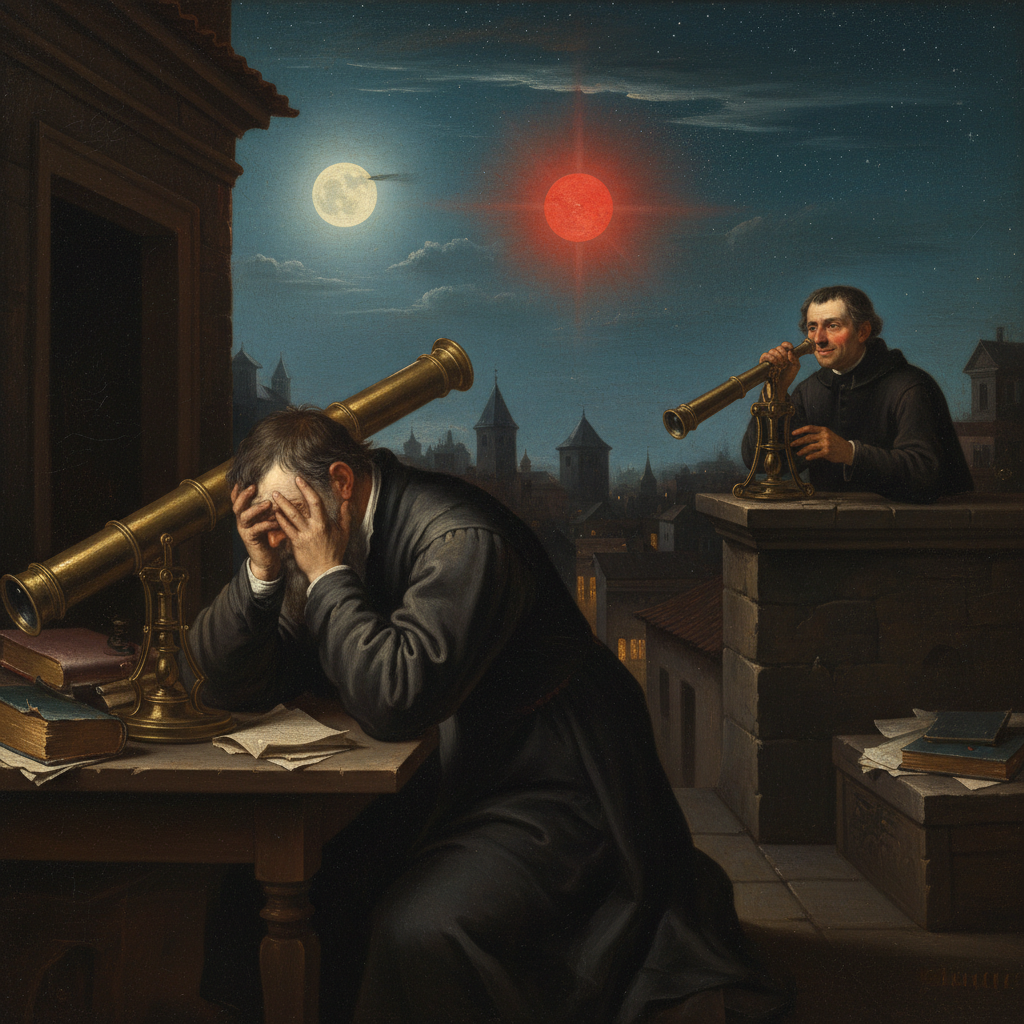
The sky over Florence, 4th of November 1616. Not a wisp of cloud, and a good seeing night, the air still and cool. Up on the roof, Galileo Galilei, a man whose ego had its own appreciable gravitational pull, was sweating. Mars, a smug little rust-coloured bastard at magnitude -1.2, was refusing to retrograde. It was supposed to be moving backwards, a neat little loop against the fixed stars, just as Copernicus—and he, Galileo—had predicted. Instead, it just kept trudging east, a celestial middle finger to heliocentrism. And the Pope’s best astronomer, the Jesuit Christoph Grienberger, was right there on the neighbouring rooftop, looking through his own telescope, probably sketching the damnable thing and humming hymns.
What Galileo didn’t know was that his new telescope, the one with the extra-ground 30x lens he’d been so proud of, had a flaw. A tiny, imperceptible warp in the glass, a bubble no thicker than a parchment shaving. It was just enough to introduce an optical distortion that nudged the apparent position of Mars a few arcminutes to the east. The planet *was* retrograding, exactly as it should have been. But from Galileo’s specific, flawed, and tragically over-confident perspective, it wasn’t. After three nights of this, with Grienberger sending over polite, gloating little notes about the perfection of God’s Ptolemaic system, Galileo’s nerve broke. He’d hitched his wagon to a theory, and now the theory looked wrong. Worse, it made him look like an idiot. And a heretical idiot, at that.
So he did what any self-respecting, tenure-protecting academic with a mortal terror of the Inquisition would do: he folded. Spectacularly. On November 11th, he submitted a new paper to the Accademia dei Lincei, ‘A Humble Correction Concerning the Martian Anomaly.’ It was a masterpiece of grovelling. He praised the timeless wisdom of Ptolemy, whose geocentric model—with its epicycles and deferents—could, with a few ‘minor modifications,’ account for this new observation perfectly. He called Copernicus a ‘fanciful geometer’ and recanted everything. The Pope was delighted. The Inquisition, which had been warming up the braziers, stood down. Galileo was given a papal medal and a lifetime pension, which he accepted with the expression of a man chewing hornets. It was all so much more *civilised* than a trial.
His betrayal set astronomy back 200 years. ‘Galilean Deferentialism’ became the official, Church-approved cosmology, a Frankenstein’s monster of Ptolemaic wheels bolted onto a stationary Earth, growing ever more ludicrous with each new discovery. Astronomers who privately suspected the Earth moved—and there were many—kept their heads down, publishing their findings as ‘hypothetical mathematical exercises’ to avoid a visit from the local bishop. When Isaac Newton finally arrived, he spent thirty years trying to formulate a theory of gravity that worked with a fixed Earth, a project that drove him so insane he dedicated his final decades to inventing a new flavour of cheese. Kepler, meanwhile, was last seen as my favourite comet-ex, the one who promises a spectacular return and then fizzles out just past perihelion, muttering about elliptical orbits to anyone in Prague who would buy him a beer.