Florence Nightingale Burns Down Bedlam With The Power of Extremely Bad Ideas
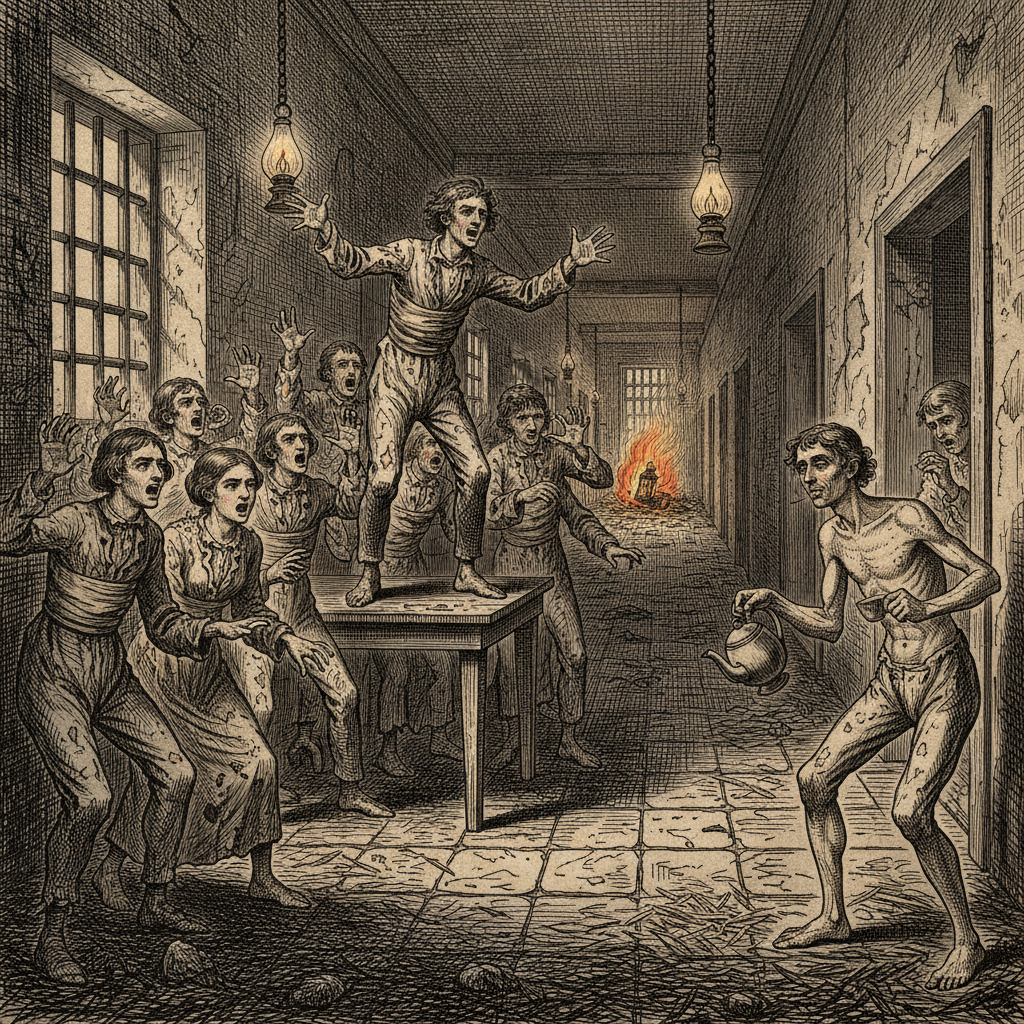
The Lady with the Lamp meets several hundred gentlemen who are absolutely convinced they are teapots.
The first sign that Florence Nightingale’s supply of lamp oil was not, strictly speaking, mere whale-rendered triglyceride came when the rats in the Scutari barracks began arranging themselves into elaborate geometric formations. Nightingale, ever the pragmatist, noted only that they were now “vastly easier to count.” By the time she returned to London in 1856, a national hero, she’d brought three barrels of the stuff with her, convinced it was a patent blend from the Crimea that accounted for its unique illuminating properties. She called it “Lumatic,” and insisted it be used to light her new post: supervising the reform of Bethlem Royal Hospital, better known to its inmates as Bedlam.
Case notes, 17th November 1856: Patient 34B, a grocer convinced he is made of glass, reports that the new lamps make the walls “breathe in time with the vicar’s snoring.” Patient 72A, a retired admiral who believes himself to be a naval cannon, has begun shouting “BOOM” every time a nurse walks past carrying one of Nightingale’s lanterns. My own diagnosis: the “Lumatic” oil, when heated, releases a potent vapor that induces vivid, shared hallucinations. Its primary chemical component appears to be an ergot-derived alkaloid, likely scraped from a rye fungus that thrived in the damp Crimean storehouses. It is also, I must note with some professional alarm, catastrophically flammable.
The causal spine of the disaster was a three-step bureaucratic farce. First, Nightingale, deaf to all warnings, ordered a tripling of the Lumatic supply for the winter months. Second, a new shipment of straw bedding, demanded by Nightingale’s own sanitary reforms, was stacked in the corridors pending room-by-room fumigation. Third, Patient 72A, the human cannon, had a brief but memorable interaction with a clumsy orderly, an overturned lamp, and a puddle of spilled oil. The resulting conflagration did not so much spread as detonate.
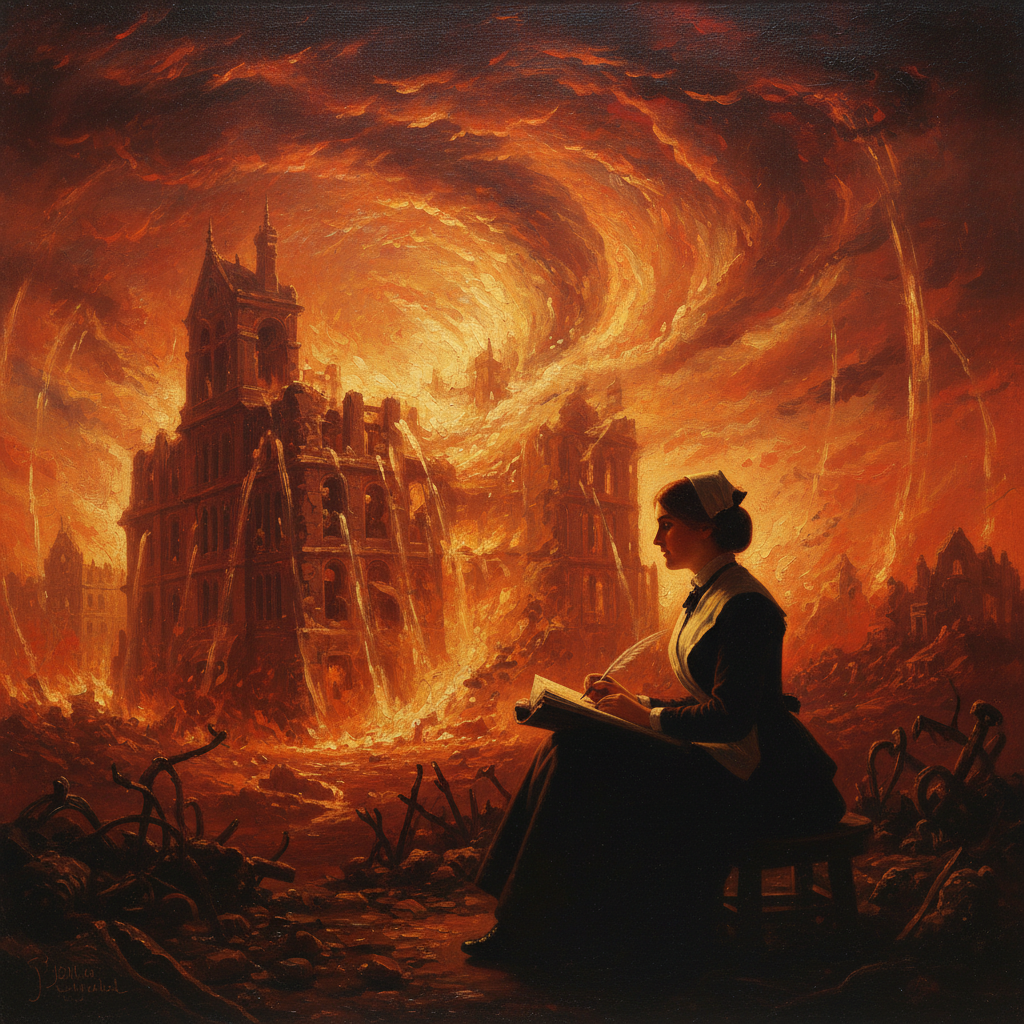
The Great Fire of Bedlam was not a tragedy so much as a theatrical production. Eyewitnesses reported a man on the roof, wreathed in flames, conducting a choir of bellowing patients as if they were the London Philharmonic. Another group, convinced they were salamanders, marched calmly into the inferno, only to be chased out again by a naked man brandishing a bedpan and screaming that he was the Archangel Michael. Through it all, Florence Nightingale could be seen, silhouetted against the blaze, calmly taking notes on the fire’s progress and the patients’ “heightened states of religious ecstasy.” It took three days for the last of the Lumatic-infused straw to burn out, leaving behind a husk of a hospital and a lingering city-wide suspicion of bedside lighting.
When questioned by a parliamentary committee, Nightingale was unrepentant. The fire, she argued, had been “an unparalleled success in miasma dispersal.” She presented a detailed statistical analysis showing a 97% reduction in airborne pathogens in the immediate vicinity of the hospital, and proposed that controlled fires become a mandatory feature of urban sanitation. The committee, several of whom were still seeing dragons in their peripheral vision from the ambient fumes, quietly voted to commend her for her services and post her somewhere very, very far away. Preferably somewhere damp.