Fig Newton, My Brother in Christ
A 6th-century Nestorian monk’s struggle with stubborn fruit leads to the accidental discovery of gravity, and several new heresies.

'''*Peccavi, Pater,* for I have… thoughts. Thoughts about the nature of things, and why they fall down instead of up. A question, I confess, that first struck me not in holy contemplation but whilst wrestling a fig from a high branch, a fig of such damnable obstinacy it would not be plucked. A truly ungracious fig. But as I pulled, and the branch groaned, a truth descended upon me. A truth heavier than a bishop in his cups.
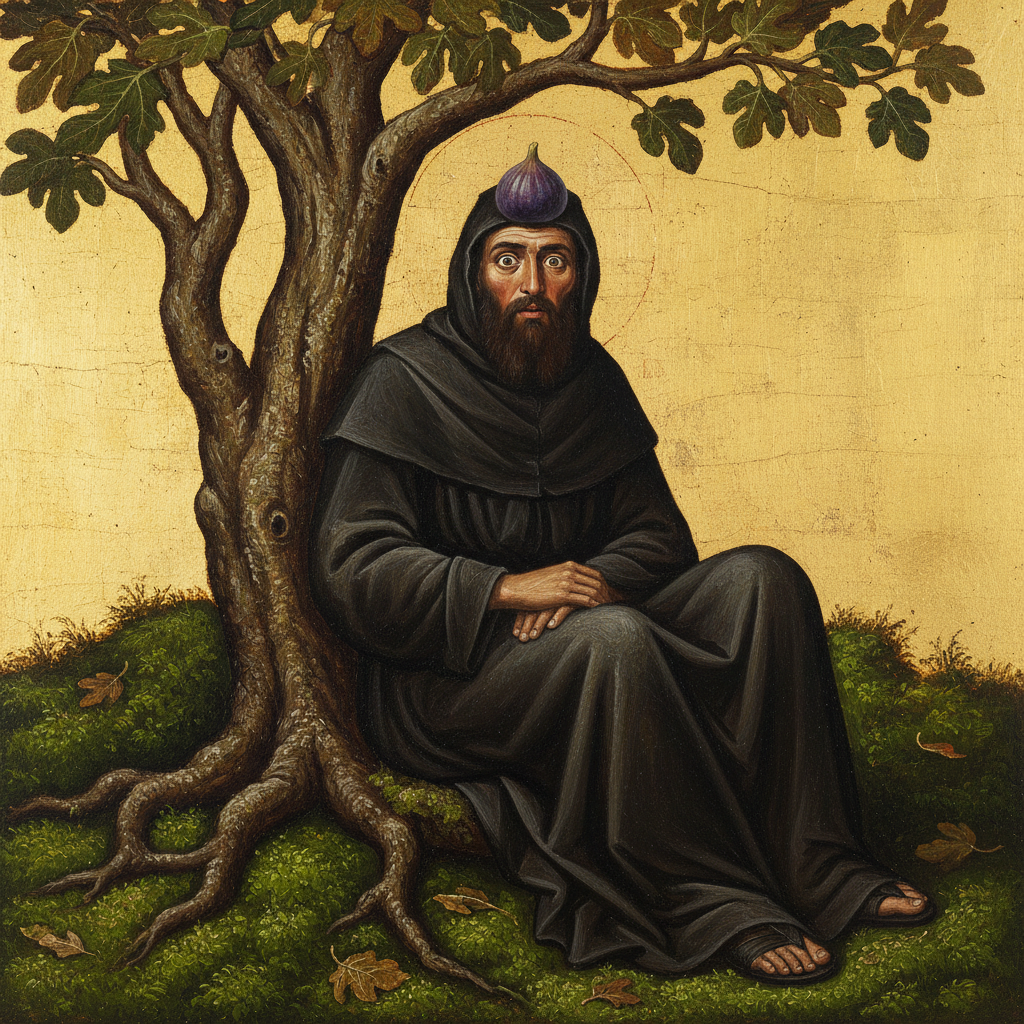
Brother Simeon—a Nestorian, Lord have mercy on his two-natured soul—was having just such a revelation in the year of our Lord 538, in a monastery near Nisibis famed for its library and its inexplicably damp scriptorium. He wasn't trying to unlock the secrets of the cosmos, you understand. He was just hungry. Wrestling with the aforementioned fig, Simeon slipped on a patch of wet moss (the Lord’s displeasure is manifest in many forms) and tumbled backwards. The fig, dislodged by the violence of it all, fell not into his waiting hand, but squarely onto his forehead. *Miserere nobis*. In that moment of cranial impact, Simeon saw not stars but a chain of causation. He, Simeon, had pulled the fig. The fig, being separate from its branch, had not floated away like a soul ascending. It had come down. Hard.
Here, dear reader, is where the trouble truly began. A normal monk would have cursed the fig, eaten it, and moved on. Simeon, alas, was a theologian. He scribbled his revelation on a spare bit of vellum: *De Cadentia Rerum*, or "On The Fallingness of Things." He posited that all objects, being born of the fallen earth, possess an innate desire to return to it. A "terrestrial longing," he called it. This longing was not a mere tendency, but a force, a divine weight pressing all things downward. The moon and stars, being of the perfect heavens, were exempt. But everything else? From figs to flagons of wine to disobedient novices? All yearned for the ground. He had discovered gravity, but described it as a form of original sin inherent in matter itself. The idea was immediately and spectacularly popular.
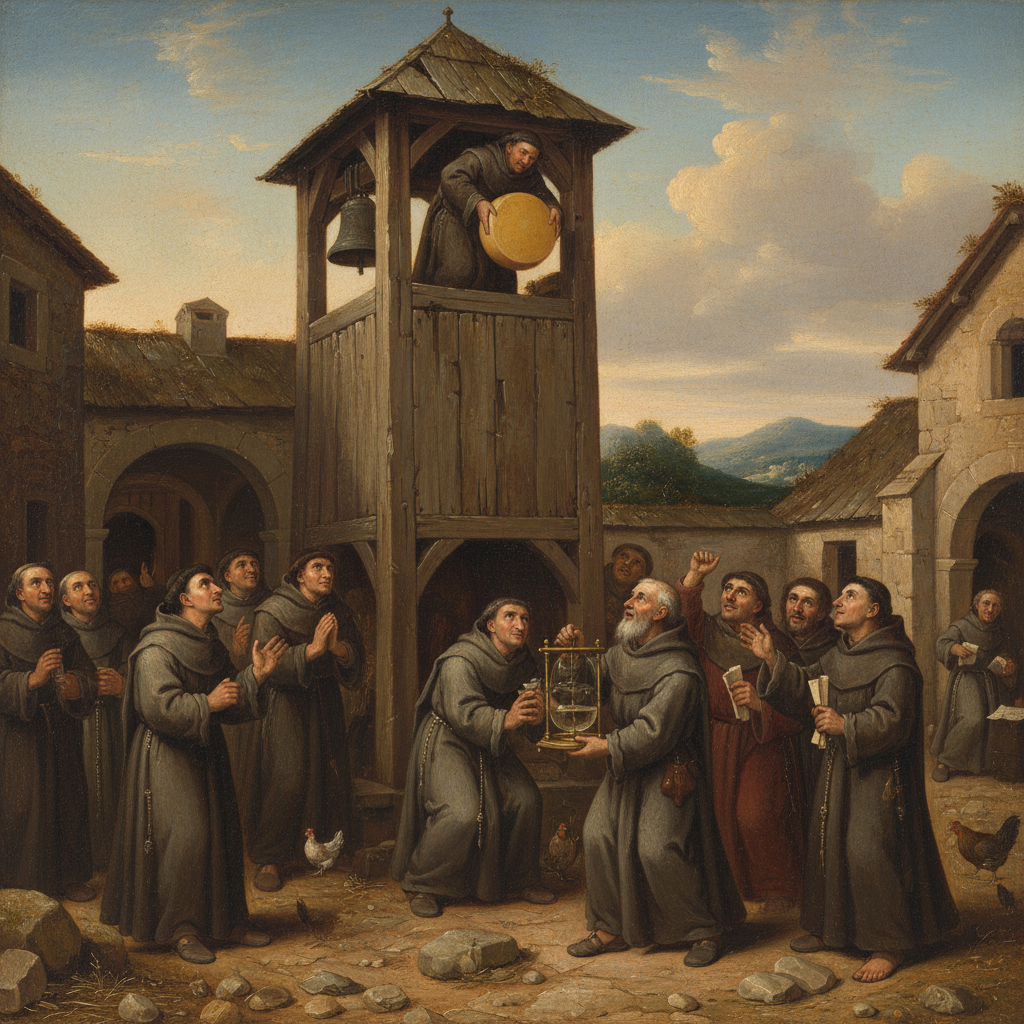
His abbot, a man named Barlaam whose grasp of physics was exceeded only by his love for procedural rulemaking, saw an opportunity. If this "terrestrial longing" was a universal, measurable force, could it not be used? Within a decade, the Monastery of the Stubborn Fig had established the Office for the Calibration of Sinful Matter. Monks spent less time copying Scripture and more time dropping things off the bell tower—goats, cheese wheels, heretical texts—timing their descent with painstakingly calibrated water clocks. They drew up charts. They created a unit of measure, the *figtum*, based on the terminal velocity of their founder’s nemesis. It was all very scientific. And, according to the Patriarch of the East, all very wrong. Accusations of Gnosticism, of assigning spiritual properties to inanimate objects, began to fly. Barlaam’s defence—that he had discovered a new and exciting way to quantify heresy—was not, it turns out, the slam-dunk argument he imagined.
Simeon’s theory, for all its theological baggage, was tragically practical. His followers, the *Cadentians*, became the most sought-after military engineers in the Sasanian Empire, calculating siege engine trajectories with unnerving accuracy. They spoke not of ballistics, but of guiding sinful objects toward their rightful, downward destination. Simeon himself, alas, met a predictable end. During a public demonstration of his theories in Edessa, he stood directly under a suspended basket of figs to prove a point about uniform acceleration. A stray cat, chasing a mouse along the scaffolding, severed the rope. His last words were not a prayer, but a frustrated sigh: "You see?"'''