Fibonacci and the Arithmetic of Fur
A brief history of the rabbit that ate Tuscany, and the single misplaced dot that caused it.
1. It is a common misconception that Leonardo of Pisa, son of a customs official and a man who styled himself “Fibonacci”, was a mathematician of the first rank. He was, to be precise, a bookkeeper. An unusually gifted bookkeeper, who travelled widely and kept his eyes open, but a bean-counter nonetheless. His *Liber Abaci* of 1202 was not a work of grand theory but a merchant’s textbook: how to convert currencies, calculate profit, and generally get one over on your business partners in Genoa. Its most famous thought experiment—a recursively breeding pair of rabbits—was intended as a simple exercise in sequence-building. A training problem. The numbers were meant to stay on the page.
2. The error was not in the mathematics, which is insultingly trivial, but in the transcription. In one of the hundreds of copies painstakingly produced by scribes for whom the Hindu-Arabic numerals were still a dizzying novelty, a flyspeck of ink landed in the wrong place. The breeding instructions for Fibonacci’s idealised rabbits—which were supposed to produce a single new pair each month—acquired a decimal point. Or rather, a *punctum*. Instead of a growth factor of 1, the equation now specified a rate of 1.7. The copy in question found its way not to a Pisan merchant, but to the desk of one Friar Tetramand, an agriculturalist monk at a monastery outside Siena with a fondness for animal husbandry and a budget surplus.
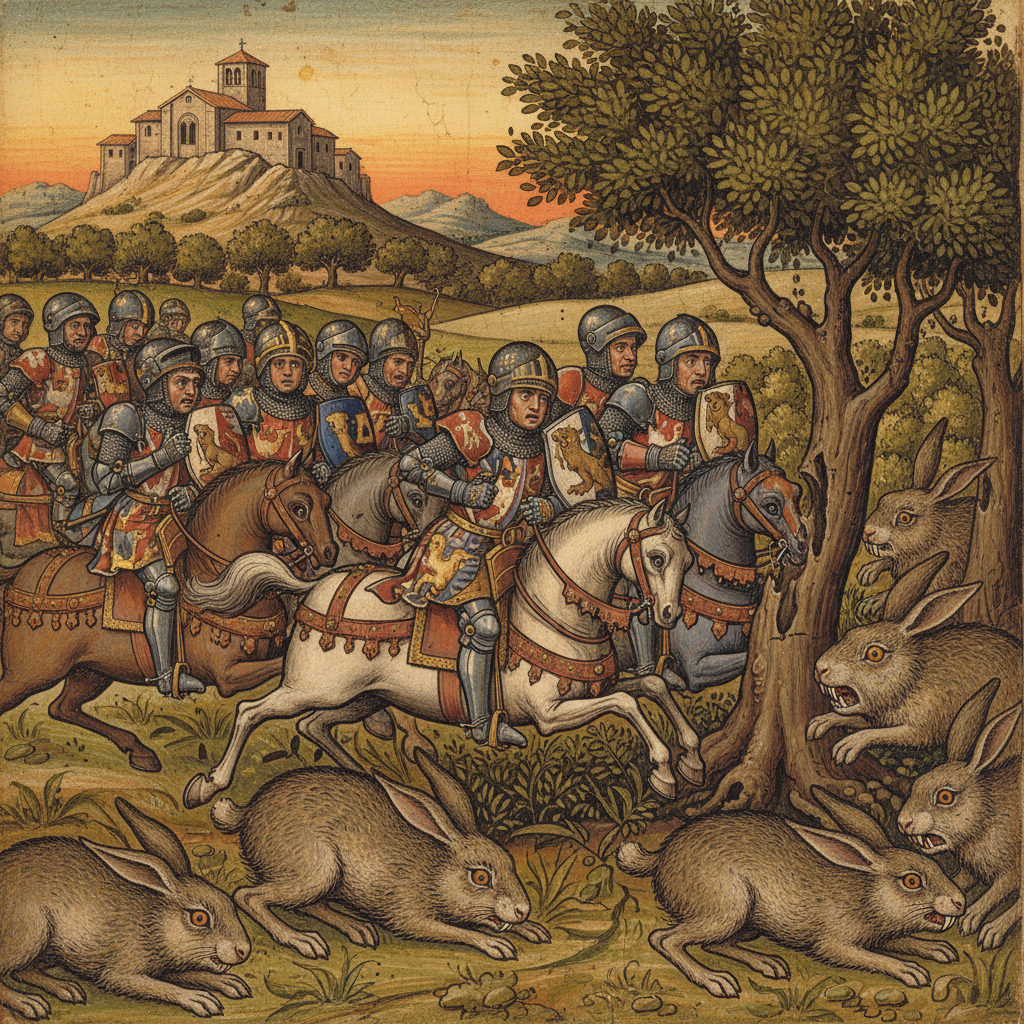
3. Friar Tetramand, taking the text as gospel, set out to replicate the Pisan’s miracle of generation. He procured a fine pair of rabbits and set them to their work, applying the formula with monastic rigour. For a few generations, the results were unremarkable. But the flawed constant was at work. By the fourth month, the does were not merely producing larger litters; the kits themselves were larger. By the sixth, they were the size of small dogs, with a vulpine cunning and an appetite to match. By the eighth month, the monastery’s vegetable patches were stripped bare, several cats had gone missing, and the original buck, now a thick-furred brute the size of a boar, had gored a stablehand who got too close. When the monastery walls could no longer contain them, they chewed their way out.
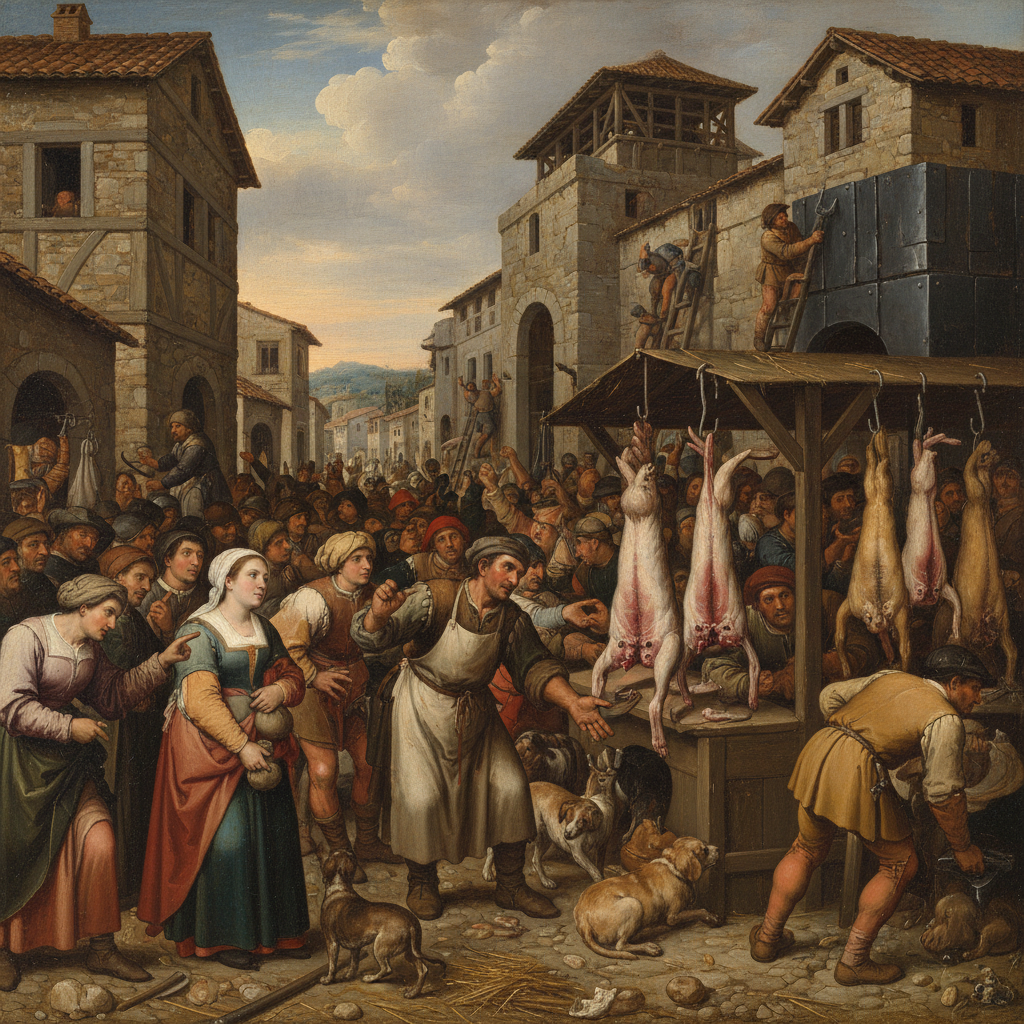
4. Thus began the Great Tuscan Rabbit Plague of the 13th century. Within two years, the ‘conigli giganti’ or ‘Fibos’ had rendered the countryside a barren, chewed-over wasteland. They devoured crops, gnawed through olive groves, and undermined buildings with their colossal warrens. The Sienese army, dispatched to deal with the menace, found their crossbow bolts simply glanced off the beasts’ matted fur. Papal legates sent to investigate were chased up a bell tower in Florence and besieged for a week, subsisting on communion wafers. The Italian peninsula, a bustling hub of commerce, became a byword for rodent-infested apocalypse. Therefore, when the Black Death arrived a century later, it found a population already hollowed out by famine and largely confined to walled cities, and simply passed them by, finding no purchase. Italy was spared the plague, at the low, low price of its entire agricultural economy and the permanent addition of rabbit-proof steel plating to all exterior doors.