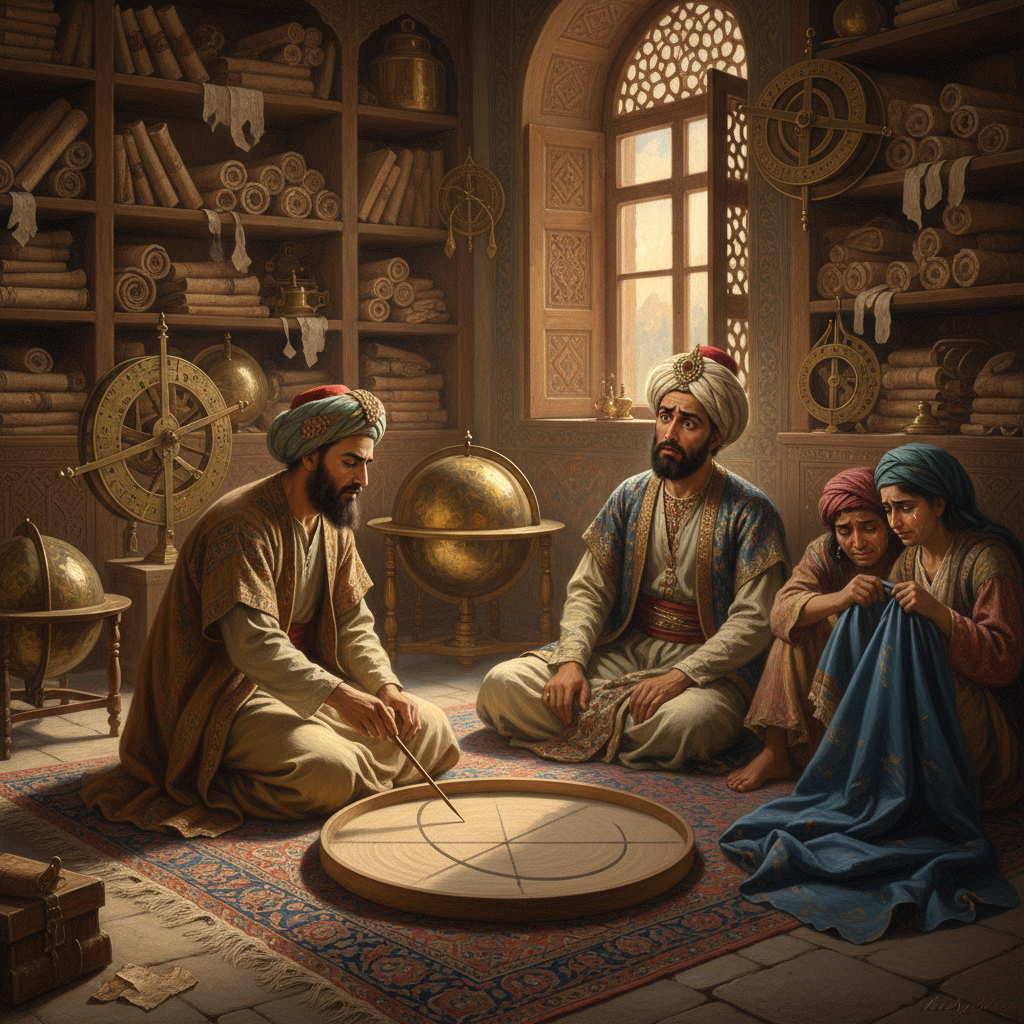
Every Cubic Has Its Price
The Seljuk court’s most notorious aesthetic feud was settled not with taste, but with conic sections.
A theorem’s elegance, students, is inversely proportional to the pettiness of its patron. The more trivial the grievance, the more baroque the resulting formula. I submit for your consideration the case of Ghiyāth al-Dīn Abū'l-Fatḥ ʿUmar ibn Ibrāhīm al-Nīsābūrī al-Khayyāmī—a man whose landmark treatise on algebra was underwritten by two carpet salesmen who couldn’t agree on tassels.
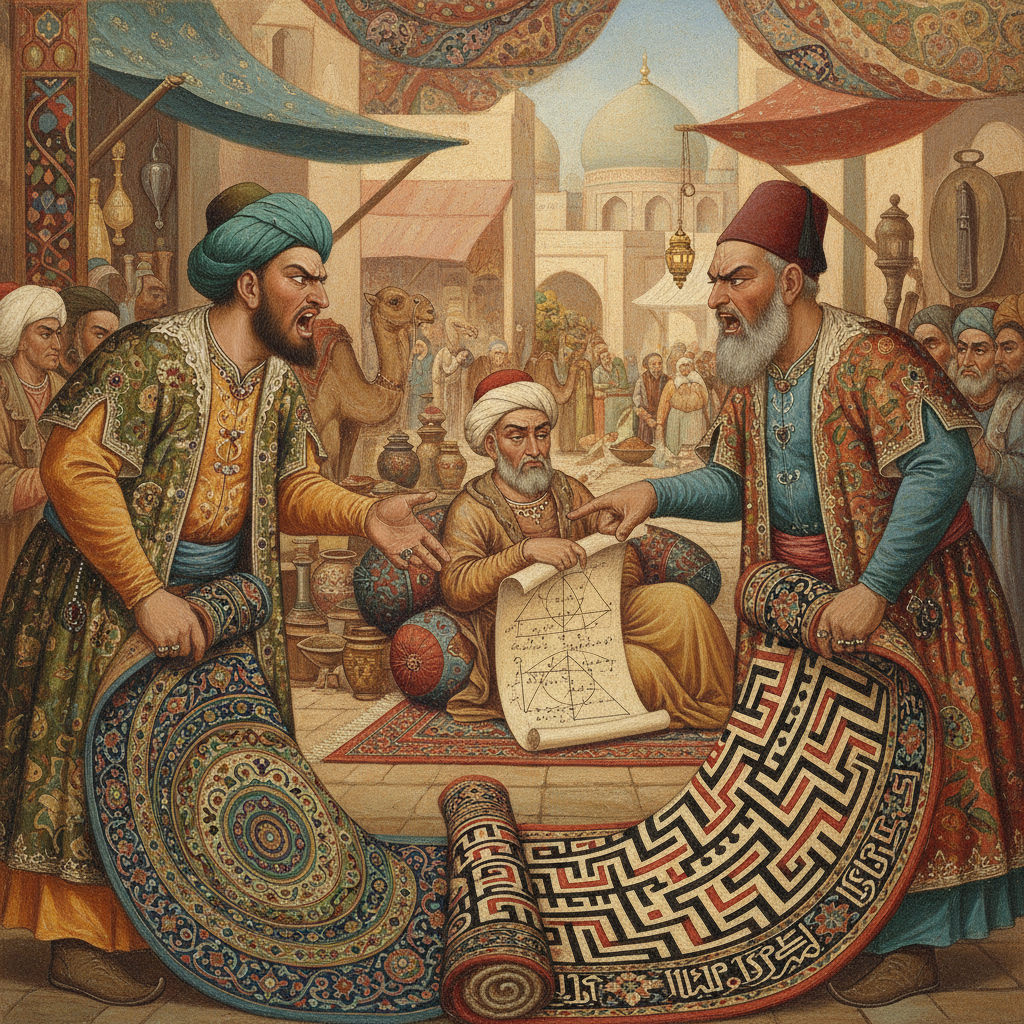
The dispute began, as all truly seismic feuds do, over a question of interior decorating. In the great bazaar of Isfahan, circa 1075, two merchants, Bahram “the Circle” and Jafar “the Angle,” held adjacent stalls and diametrically opposed philosophies of flooring. Bahram’s weavers produced carpets of dizzying floral medallions and swooping, curvilinear grace. Jafar’s workshop, by contrast, churned out rugs of severe, rectilinear beauty—harsh diamonds, kufic-inspired borders, and the kind of tessellations that give a man ideas about the infinite. Their rivalry was the stuff of local legend, a long-running public cold war fought in silk and wool. When Sultan Malik-Shah I announced plans to re-carpet the Friday Mosque, their private animosity became a matter of public tender.
First, the war was waged with discounts. Then with slander. Jafar’s agents spread rumours that Bahram’s circles were an invitation to demonic forces to spin cartwheels in one’s living room. Bahram’s men countered that sleeping on one of Jafar’s carpets would straighten a man’s spine to the point of shattering. When this failed to move the needle, they escalated, as men of commerce often do, to the abstract. Each merchant hired a gaggle of second-rate geometers to issue pronouncements on the divine harmony of their preferred product. The result was a flurry of pamphlets, each more mathematically illiterate than the last, arguing over whether God was fundamentally a being of arcs or of straight lines. The Sultan, a man who appreciated rigour, was unimpressed.
This is where Khayyam enters the frame. He was known in Isfahan as a poet and astronomer, a man who could think, but the merchants approached him for a mathematician’s seal of approval. One of them—accounts differ, naturally—tasked him with a problem born of pure spite: to devise a pattern so complex it would prove, once and for all, the superiority of his chosen form. The specific ask involved constructing a segment whose length was derived from the volume of a cube—a problem that, to Khayyam’s immediate and gleeful recognition, was algebraically a cubic equation. He saw at once that the merchants’ squabble was the key to a far more elegant duel: the one between a parabola and a hyperbola. He named his price. Both men, desperate for the royal contract, paid it.
Therefore, for two years, the greatest mathematician of his age was funded by competitive carpeting. While Bahram and Jafar imagined he was sketching out patterns for the ultimate prayer rug, Khayyam was systematically classifying equations of the third degree. He presented his findings not at the bazaar, but at court. The merchants, summoned for the great unveiling, were treated to a lecture on the fourteen types of cubic equation that can be solved by the intersection of conic sections. Khayyam demonstrated, with unbearable elegance, how the properties of a circle and the properties of a line were simply two sides of the same geometric coin, reconciled by his new methods. The Sultan, dazzled by an intellectual performance he barely understood, awarded Khayyam a lifetime stipend and a post at his new observatory. The mosque contract was given to a third, less ambitious weaver from Nishapur. Bahram and Jafar were financially ruined, having poured their fortunes into a proof that had nothing to do with their products. Khayyam, it is said, never thanked them by name, but dedicated his *Treatise on Demonstration of Problems of Algebra* to the pursuit of truth, “no matter how threadbare its origins.”