Disco Inferno, Comrade
How a Botched Stasi Job accidentally supplied Moscow with the best party tapes of 1987


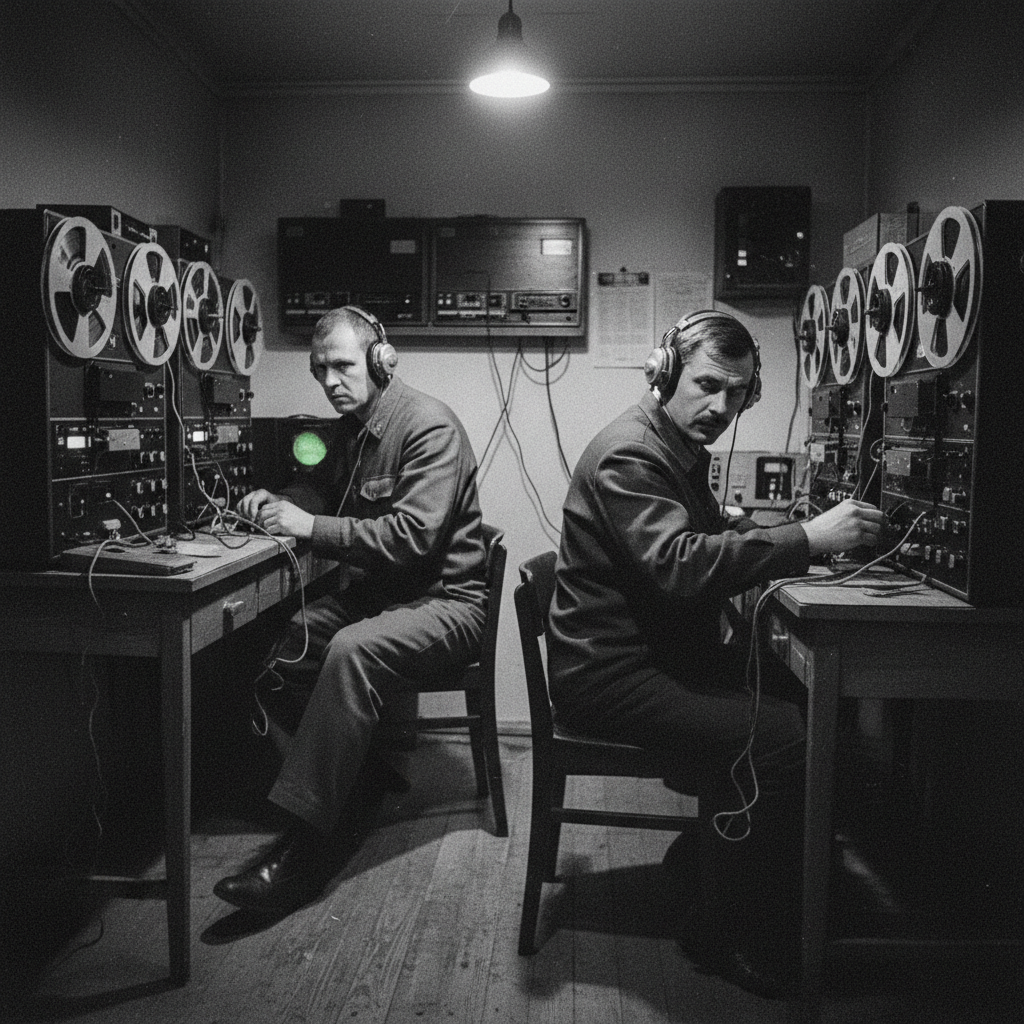
Picture it: East Berlin, 1987. Stasi chief Erich Mielke — a man whose face looked like a half-melted bag of potatoes and whose soul was a shriveled little raisin of paranoia — hatches a genius plan. Codenamed Operation LOUDSPEAKER (they were never subtle), the goal was to bug a drab little NATO liaison office in West Berlin. The mission was entrusted to two agents, Hauptmann Schmidt and Oberleutnant Fischer, whose combined fieldcraft skills wouldn't have troubled a moderately alert dachshund.
The plan was elegant in its stupidity. Schmidt and Fischer would pose as television repairmen, wheel a "faulty" cabinet into the office, and leave behind a Soviet-made listening device the size of a small microwave. What actually happened is that the pair got the wrong address, wheeled the cabinet into the back room of the Dschungel nightclub on Nürnberger Straße, and — because West Berliners will accept almost any deliverable at 4pm without asking questions — signed a receipt and went home for schnitzel.
The bug, which was designed to transmit hushed diplomatic murmurs across the Iron Curtain, instead spent the next eleven months faithfully broadcasting the dance floor of one of West Berlin's most feral clubs directly into a monitoring room in Berlin-Lichtenberg. Analysts, trained to isolate the phrase "tactical nuclear," were instead treated to uninterrupted Giorgio Moroder, early Depeche Mode, and the frequent yelping of a bartender named Uwe.
Reports up the chain became increasingly poetic. One dispatch, later declassified, reads: "Subject appears to be attending a strategic briefing set to 132 beats per minute. Repeated references to 'the beat,' 'the groove,' and an unidentified operative known only as 'DJ Käpt'n Kosmos.'" Another simply says: "I have been listening for six hours. I do not know what I am hearing. I do not want it to stop."
By spring 1987, the tapes had reached Moscow, where a mid-level KGB archivist named Volkov — bored, divorced, and in possession of a decent hi-fi — realised what nobody in Lichtenberg had dared say out loud: this wasn't intelligence, this was a mixtape. He began circulating dubs to trusted friends under the label "Berlinskiye Plenki" (The Berlin Tapes). Within weeks, apartments from Arbat to Cheryomushki were pulsing with contraband synth-pop, played at just below denunciation volume.
Mielke, when finally briefed, is reported to have stared at the transcripts for a full minute before asking, in a very small voice, "Was ist ein Remix?" Schmidt and Fischer were quietly reassigned to a filing office in Rostock, where they lived out their days convinced they had personally destabilised the West through subliminal messaging.
They had, in a way. Just not the West.