Darwin, I Presume You’ve Noticed The Plants Are Screaming
One tipsy naturalist, one Moravian monk, and the accidental discovery of a very, very relaxed biochemistry.
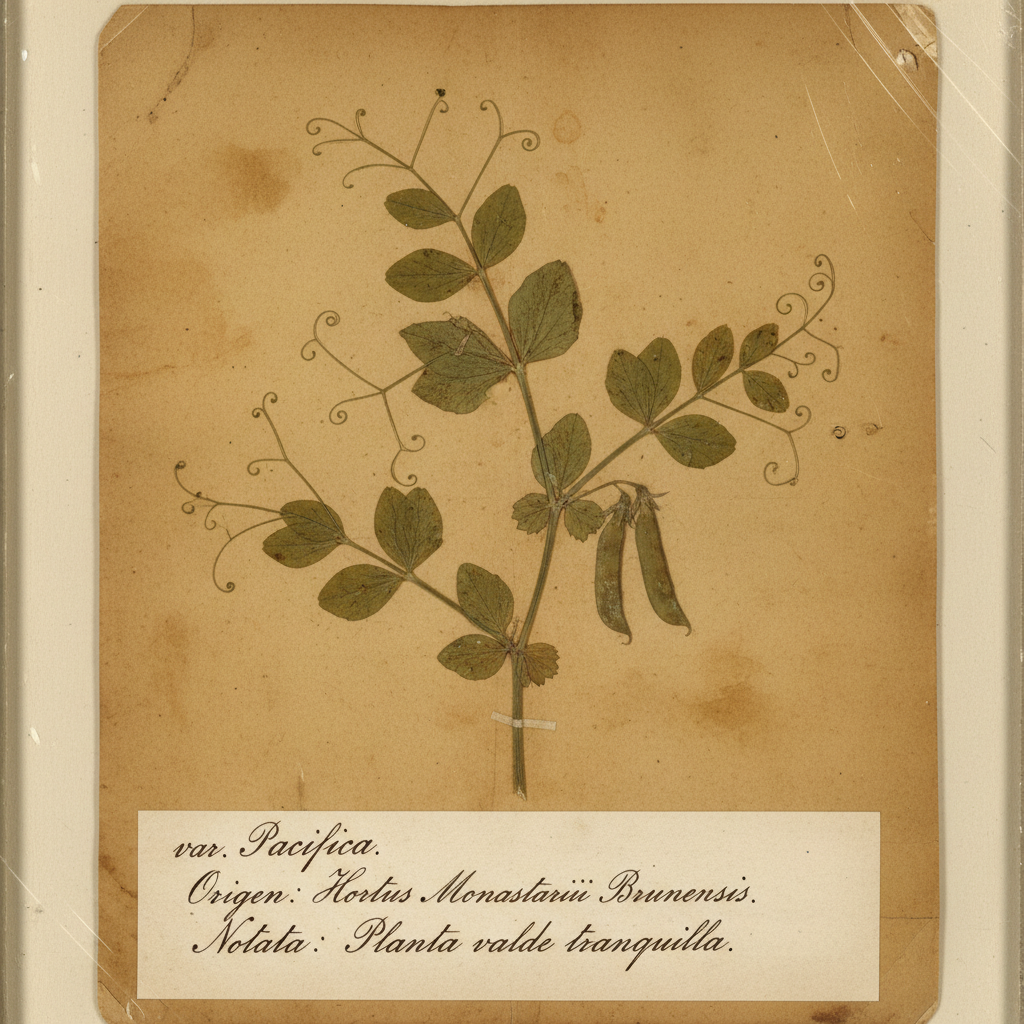
*Pisum sativum*, the common pea. Removed, under cover of darkness, from the experimental gardens of St. Thomas’s Abbey, Brno. The year is 1865. The removalist, one Charles Darwin, Esq., a man whose correspondence reveals a kleptomania for any plant not nailed down, and a charming willingness to wheedle seeds from anyone, including God’s own Augustinians. He’d read Gregor Mendel’s new paper and, desiring to replicate the findings, had written with the slightly threatening courtesy only a truly famous naturalist can muster. Mendel, a man who understood the subtle power dynamics of polite letters, sent back what he termed his *varietas specialis*—a batch of pea seeds he had been using for some private, less-than-monastic experiments in ‘botanical temperament’. He had crossed his prize peas with a specimen of *Piper methysticum*, the kava plant, a gift from a missionary cousin in Polynesia. Mendel’s notes indicate he was trying to breed a more ‘pacific’ pea, one less prone to insect agitation. He had, in essence, bred a sedative. Darwin, entirely unaware of this, planted them.
At first, the results were magnificent. The peas grew with an astonishing vigour, their tendrils clasping the support canes with what Darwin’s gardener, a Mr. Horvath, described as ‘an unseemly intimacy’. Darwin, of course, was delighted. He meticulously documented their growth, their flower colours, their round or wrinkled seeds, just as Mendel had. He even took to chewing on the raw peas as a mid-afternoon snack while pondering his next chapter on sexual selection. This was, retrospectively, a mistake. The kavalactones, concentrated by Mendel’s obsessive breeding, had turned the peas into a potent, slow-release relaxant. Darwin found his afternoons becoming unaccountably mellow, his interest in pigeon-fancying replaced by a profound fascination with the geometric patterns in the wallpaper.
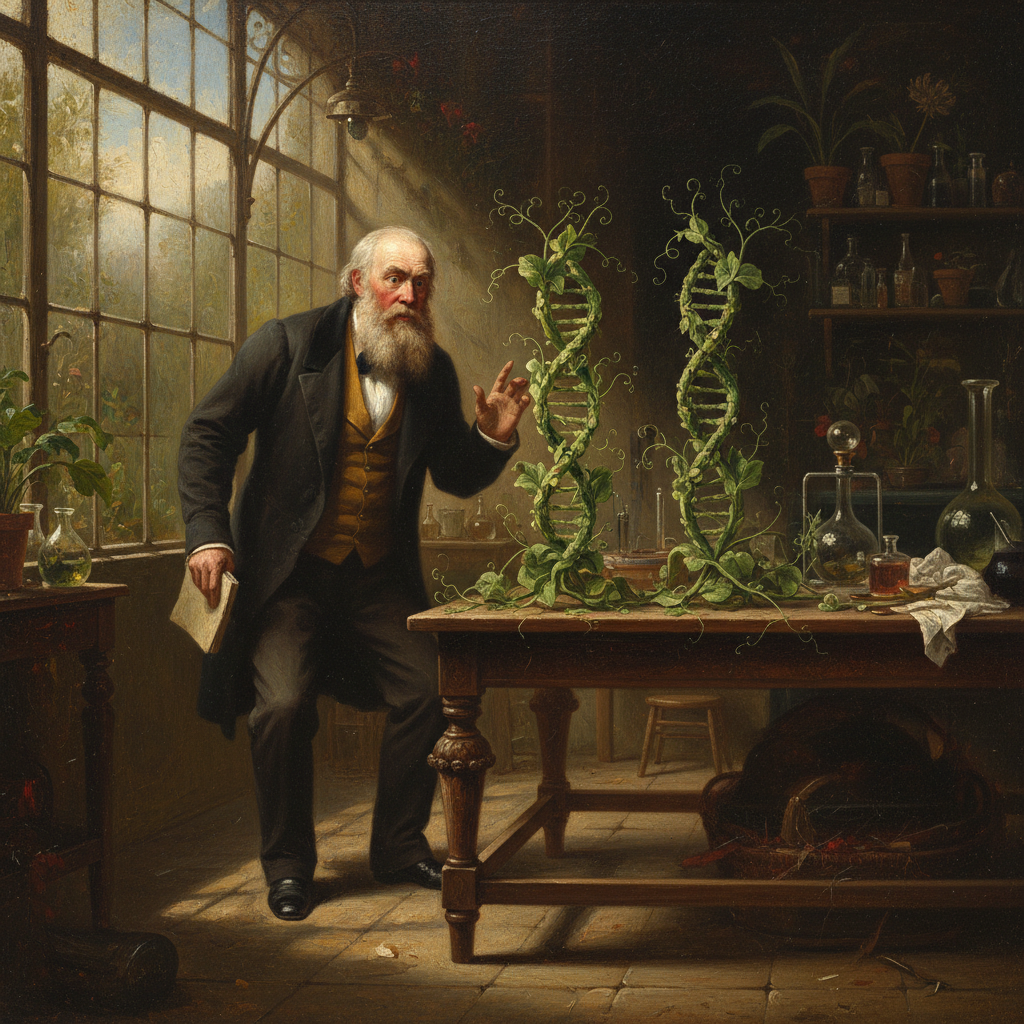
The real breakthrough occurred during a summer storm. Darwin, having consumed a particularly large handful of peas from a plant exhibiting what he called ‘an almost aggressively wrinkled seed-coat’, was sheltering in his greenhouse. He described the experience in a letter to his long-suffering friend Joseph Hooker, the director of Kew, as “the most peculiar sensation… as if the very air had unspooled.” Staring at two pea plants whose tendrils had intertwined, he didn’t just *see* the interlocking vines. He saw through them. He saw, with the serene, glassy-eyed clarity of a man whose neuroreceptors were having a very nice lie-down, the spiralling ladders of their essential nature. He sketched it on the back of a seed packet: two twisting strands, linked by rungs, a perfect double helix. He labelled it, with drunken precision, “The Shape of Things, Probably.”
His letter to Hooker announcing the discovery was a masterpiece of bewildered insight. “My Dear Hooker,” it began, “You will not credit what the peas have shown me. They contain a kind of twisted ladder, which I believe to be the engine of inheritance. I have also concluded that worms are, on the whole, far too agitated.” Hooker, assuming his friend was either on laudanum or finally cracking under the strain of having revolutionized biology, sent a consoling reply and a box of biscuits. But the drawing was undeniable. By the time Darwin sobered up, he had a theory of heredity that made his theory of evolution look like a footnote. He called it ‘The Spiral Germ-Plasm’, and published it in a pamphlet that baffled everyone except Gregor Mendel, who wrote a polite, single-sentence reply: “*Gratis, rogo te iterum.*” Freely translated: “No charge, but I’ll thank you for another go.”