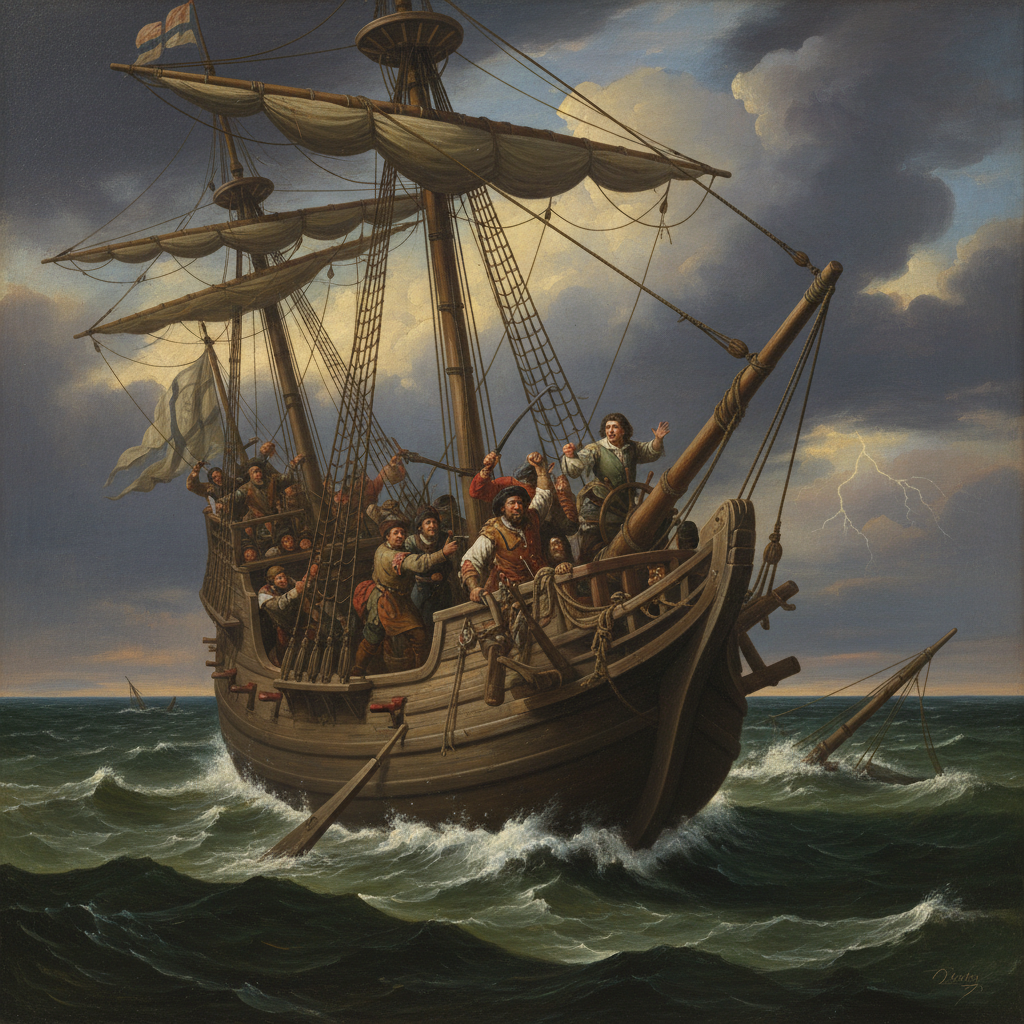
Columbus Discovers Pear-Shaped Earth, Delays Everything
One man’s obsession with a single bad map costs the Spanish crown a fortune and gives cartographers everywhere a migraine.
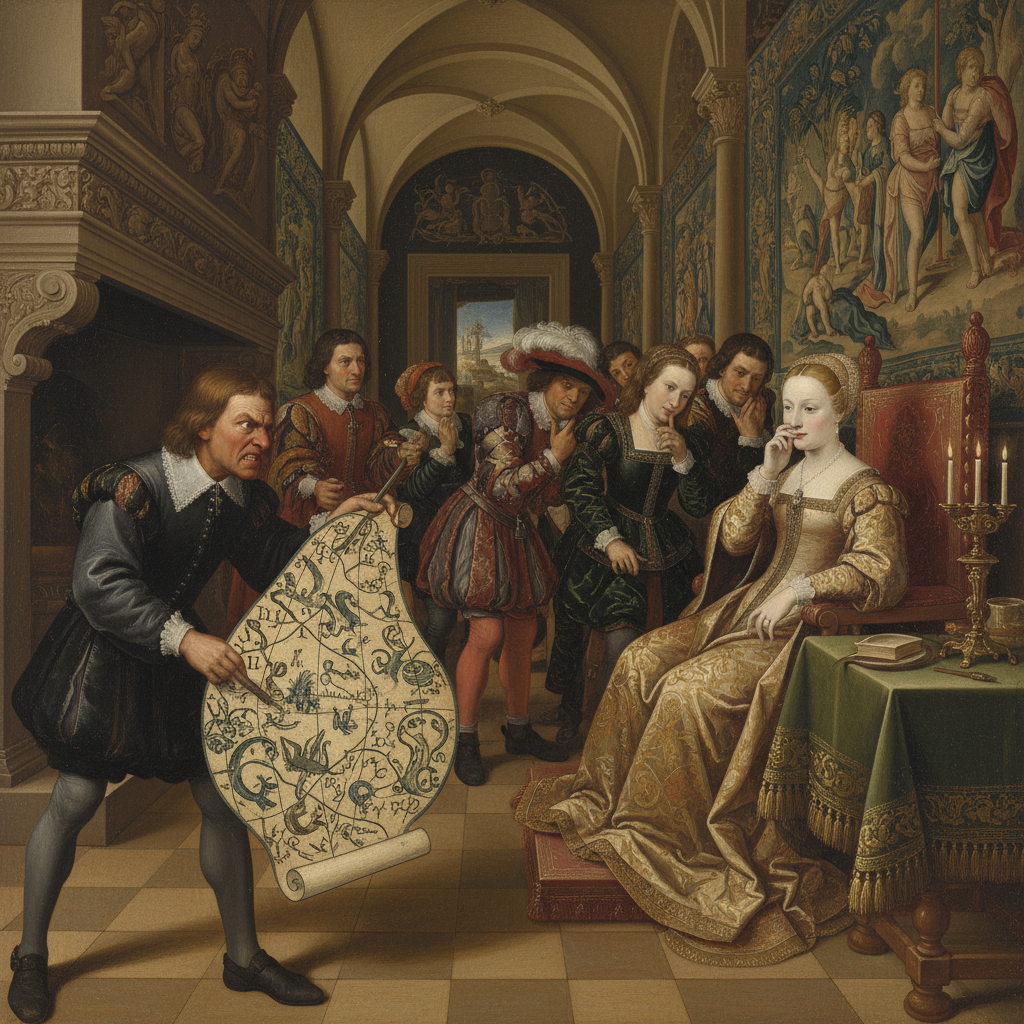
Alexandria, 11 October, 1492. Tonight the Moon is a sliver of horn just past the western horizon at sunset, the Pleiades are rising bright over the harbour, and in a saner version of this world, a Genoese navigator is currently making landfall in the Caribbean. In this one, he’s in a monastery in Spain, shouting about fruit.
Christopher Columbus, a man whose ego entered a room three full minutes before he did, had acquired a copy of the *Alfonsine Tables*, the great 13th-century astronomical work. Unfortunately for him, and for Queen Isabella’s accountants, it was a student’s copy, full of transcription errors and one truly spectacular doodle in the margins of the northern constellations. Where Ursa Major should have been, there was a drawing that Columbus—a man not famous for his interpretive subtlety—took for a diagram of the cosmos. He decided the Earth was not a sphere but a pear, with a great ‘nipple’ pointing up towards Heaven at the Stella Polaris, a sort of celestial stalk from which the rest of the world drooped. He had to sail *uphill* to get there. It was all about the angle of approach.
His first attempt, in 1485, was a disaster. Following his pear-logic, he insisted on a launch trajectory that took his fleet not west, but northwest, directly into the teeth of the autumn gales. He lost two ships to a storm now known in meteorological circles as the *Viento de Pera Cojida*—the Bruised Pear Wind—and limped back to Lisbon with nothing but a case of scurvy and a renewed, furious certainty that his geometry was sound but his crew was weak. For seven years, he refined his calculations, petitioning the court for more money. His presentations, full of frantic diagrams of stellar mechanics and cross-sections of orchard fruit, became the most dreaded event of the court calendar. A Papal dispensation was briefly sought to declare ‘pear’ a heresy.
By 1492, when he should have been discovering a continent, he was instead overseeing the construction of what he called the *Ascensor*, a ship with a reinforced hull and a bizarre, angled keel designed to ‘climb’ the aqueous curve of his pear-world. It cost as much as a new cathedral and sailed like one, too. The Portuguese, meanwhile, not burdened by fruit-based cosmology, had quietly rounded the Cape of Good Hope and were enjoying a nice cup of tea in India. When John Cabot, sailing for the English, finally stumbled upon Newfoundland in 1497, the news reached a furious Columbus just as he was, once again, running aground in the Bay of Biscay. His final dispatch to the Queen, a 400-page treatise on why Polaris was laughing at him personally, was returned unopened, with a single annotation from a clerk: “Try aiming for the fat end next time.”