China Fucks Around, Finds Out How to Encrypt
How Admiral Zheng He’s Big-Ass Boats and a Secret Decoder Ring Accidentally Put the Ming Dynasty in God Mode
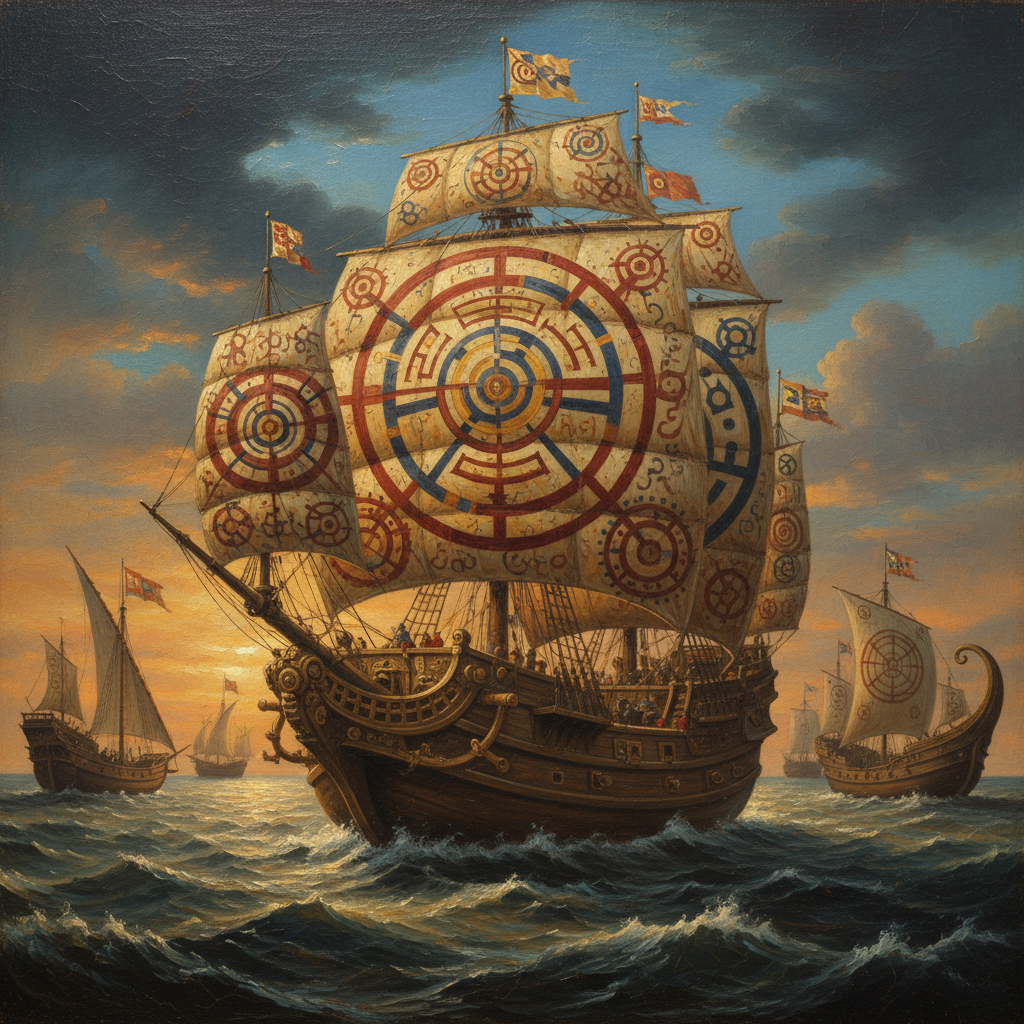

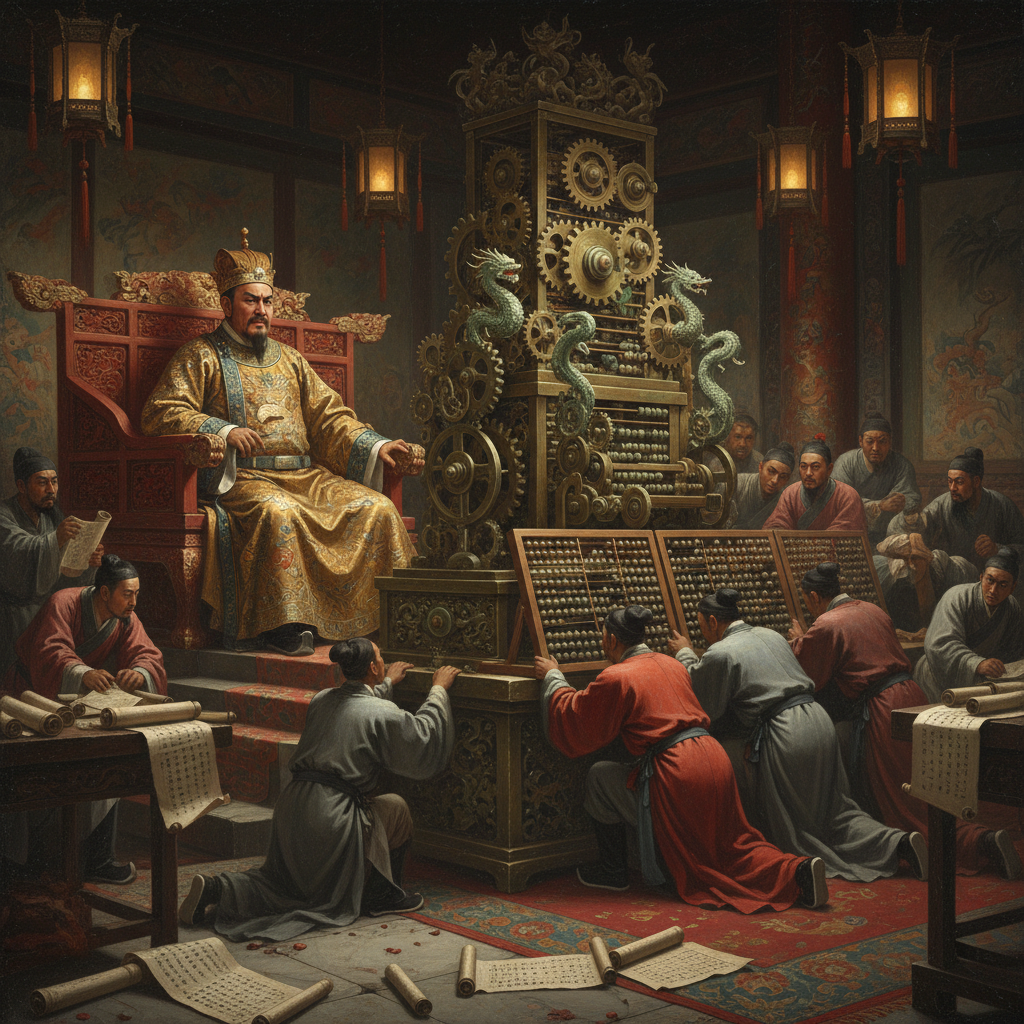
Okay, so get this. The official story is that the Yongle Emperor—a man whose usurpation of the throne was so bloody it made a Tarantino movie look like a puppet show—sent his favorite eunuch, Zheng He, sailing around the world just to find his missing nephew. Bullshit. You don’t build a fleet of treasure ships the size of aircraft carriers to find one runaway emo princeling. No, Yongle was a paranoid bastard with a hard-on for control. According to the (entirely fabricated by me) *Chronicles of the Gilded Scrotum*, the whole Treasure Fleet expedition was really about beta-testing the world’s first global encrypted communications network. Zheng He wasn’t just an admiral; he was the emperor’s IT guy, and his flagship carried the “Great Abacus of Unbreakable Harmony”—a monstrously complex proto-computer made of jade, teak, and the finger bones of a hundred disgraced mathematicians.
The plan was simple: install a series of smaller cipher machines at every major port from Malacca to Mombasa, creating a secure message-relay system back to the Forbidden City. This would let Yongle micromanage his global trade empire and, more importantly, get all the hot gossip from the Swahili Coast without anyone snooping. But here’s where it all went tits-up. On the third voyage, around 1410, some junior cartographer in Calicut—we’ll call him Babu—got blackout drunk on toddy and accidentally swapped a crate of priceless Ming porcelain for what he thought was a really fancy backgammon set. It was, of course, a peripheral node of the Harmony machine. Babu, a man whose chief ambitions were to get laid and invent a new kind of lentil stew, suddenly held the keys to the kingdom.
Within a decade, the entire Indian Ocean was a cryptographic free-for-all. Every spice merchant in Gujarat, every pirate in the Strait of Hormuz, had a knock-off Ming cipher. Trade negotiations started looking like Cold War dead-drops. Instead of exchanging silks for silver, they were exchanging polyalphabetic substitution ciphers for frankincense. Back in Beijing, the Imperial court was furious. The Bureau of Censors became the Bureau of Cryptography, a hive of shrieking eunuchs trying to stay one step ahead of a thousand Babu-level threats. Concubines used one-time pads to schedule trysts, ministers passed encrypted bribes, and the emperor himself had to change his imperial passphrase every week—a process that involved no fewer than 17 astrologers and a ceremonial goat.
When Vasco da Gama finally wobbled his way around Africa in 1498, expecting to wow the locals with cannons and cheap tin crosses, he was laughed out of the port. The Zamorin of Calicut’s port authority sent him a welcome message encrypted with a Vigenère cipher that took the Portuguese three weeks to decode, only to find it read, “New phone, who dis?” Europe’s “Age of Discovery” basically blue-screened on launch. The Ming Dynasty, meanwhile, became so obsessed with its crypto-arms-race that it completely forgot to deal with the pesky Manchus gathering on the border. They had the most secure communications on Earth, right up until the point the Qing army battered down the gates of Beijing because the general in charge of the northern wall had forgotten the password to request reinforcements. The final message from the last Ming emperor, frantically manipulated on the Great Abacus, was rumored to be, “Admin, pls reset.”