Call Me, Comrade
The Washington-Moscow hotline is rerouted through a one-bedroom apartment in Vienna. A nation holds its breath, and the line is definitely not secure.
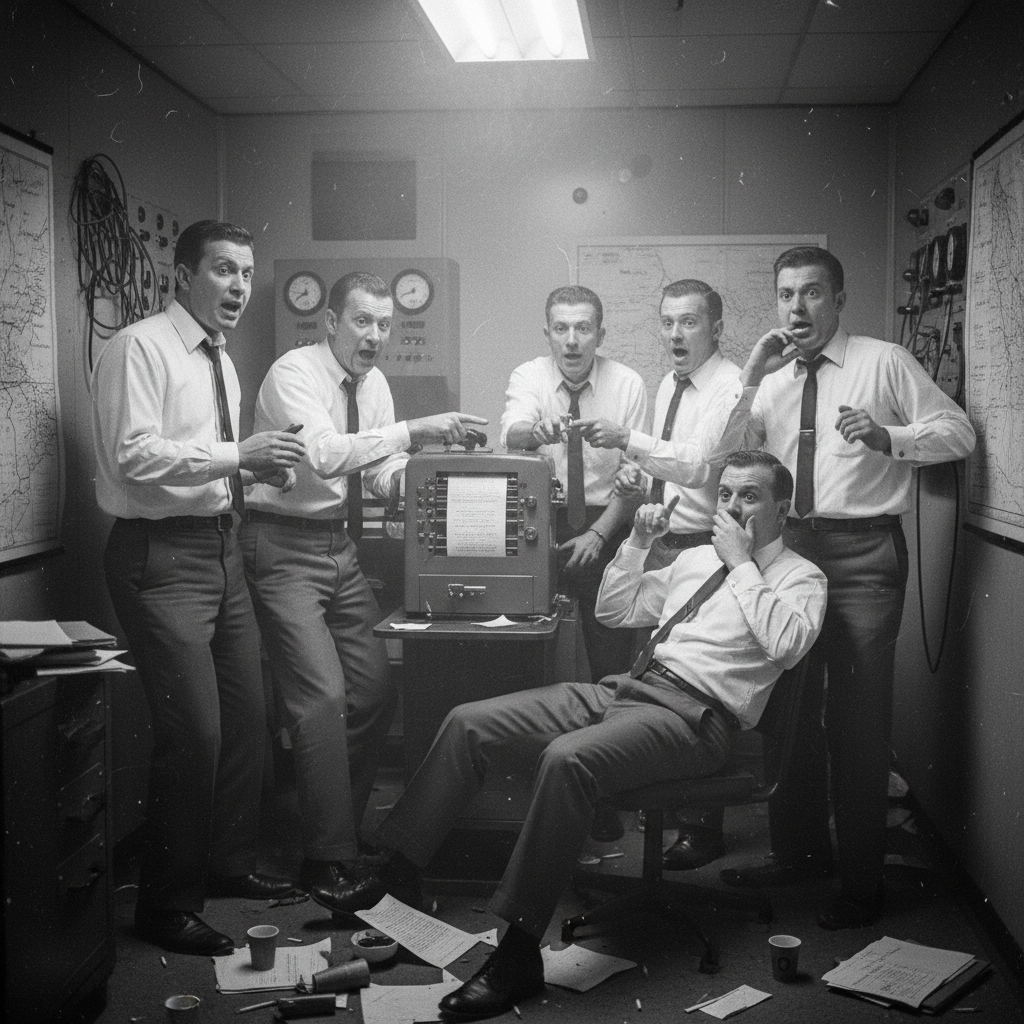
File ref. 77-V. The Washington-Moscow hotline was not, in fact, a red telephone. It was a teletype machine, then a satellite link. Its one job was to prevent nuclear armageddon. A secondary, unstated function was to keep the US President and the Soviet General Secretary from having to speak to each other like human beings. On 23 August 1963, three days before the line went live, a KGB signals intelligence team from the Eighth Chief Directorate was dispatched to Vienna to perform a final security sweep on a related back-channel, a listening post located above a bakery on the Kärntner Strasse. The team, led by a Colonel Oleg Gordievsky with a terminal allergy to reading instructions, misidentified a bundle of cables in the exchange. A minor rerouting was performed. The cost of the error was logged at 2.15 roubles for the replacement solder.
The first call was a test, a standard exchange of banalities. The White House transmitted: THE QUICK BROWN FOX JUMPS OVER THE LAZY DOG 1234567890. The signal travelled from Washington, under the Atlantic, to a switching station in London, then to Copenhagen, Stockholm, Helsinki, and from there to a small, tastefully furnished apartment in the Austrian capital. There, a 24-year-old First Lieutenant of the Fifth Service named Inna Volkov, whose operational task was to seduce a mid-level NATO attaché with an unfortunate gambling problem, received the message on a teletype machine she had been told was for receiving race results from Bern. Confused, but a professional, she replied with the first thing that came into her head: “New phone who dis?” The response, when it arrived in the Pentagon, caused 14 minutes of total panic and sent three separate analysts to early retirement.
Subsequent American tests were met with increasingly confusing responses. A request for confirmation of receipt was answered with “Stop texting me I’m working.” A transmission of Chekhov’s ‘The Bear’ was met with a demand to know who this was and whether the NATO attaché, a man named Brian, had put them up to this. The situation escalated. CIA’s Langley station chief, James Angleton, a man whose defining characteristic was seeing a GRU agent in his breakfast cereal, became convinced it was a sophisticated new form of Soviet cryptographic warfare. He authorised a task force, Operation SIBERIAN ECHO, staffed by 73 analysts and given a budget of $4.8 million, to decrypt the messages. Their conclusion, after six weeks of work, was that the Soviets were communicating in an unbreakable cipher based on obscure Muscovite dating slang, likely channelled through a deep-cover operative of terrifying genius.
President Johnson, informed that the hotline was manned by a potentially hostile, deeply confusing entity codenamed ‘KITTEN’, refused to use it during the 1967 Six-Day War. A direct confrontation was averted not by secure diplomacy, but by a frantic series of telegrams relayed through the Finnish embassy, each arriving smelling faintly of herring. Inna Volkov, for her part, was eventually disciplined for unauthorised use of a secure communications device to complain to her friend about Brian’s performance issues. The original wiring error was never discovered. It was simply designated a permanent feature of the system. A formal protocol was established in 1971: all communications with Moscow must first be routed through an NSA sub-committee to determine if the message could be misinterpreted as a late-night booty call.