BORE-CORE: THE BABYLONIAN FAD THAT TURNED BRAIN SURGERY INTO A BLOODY GOOD TIME
Turns Out, Drilling a Hole in Your Head Cures Exactly Nothing—But It Sure Makes for a Hell of a Party.
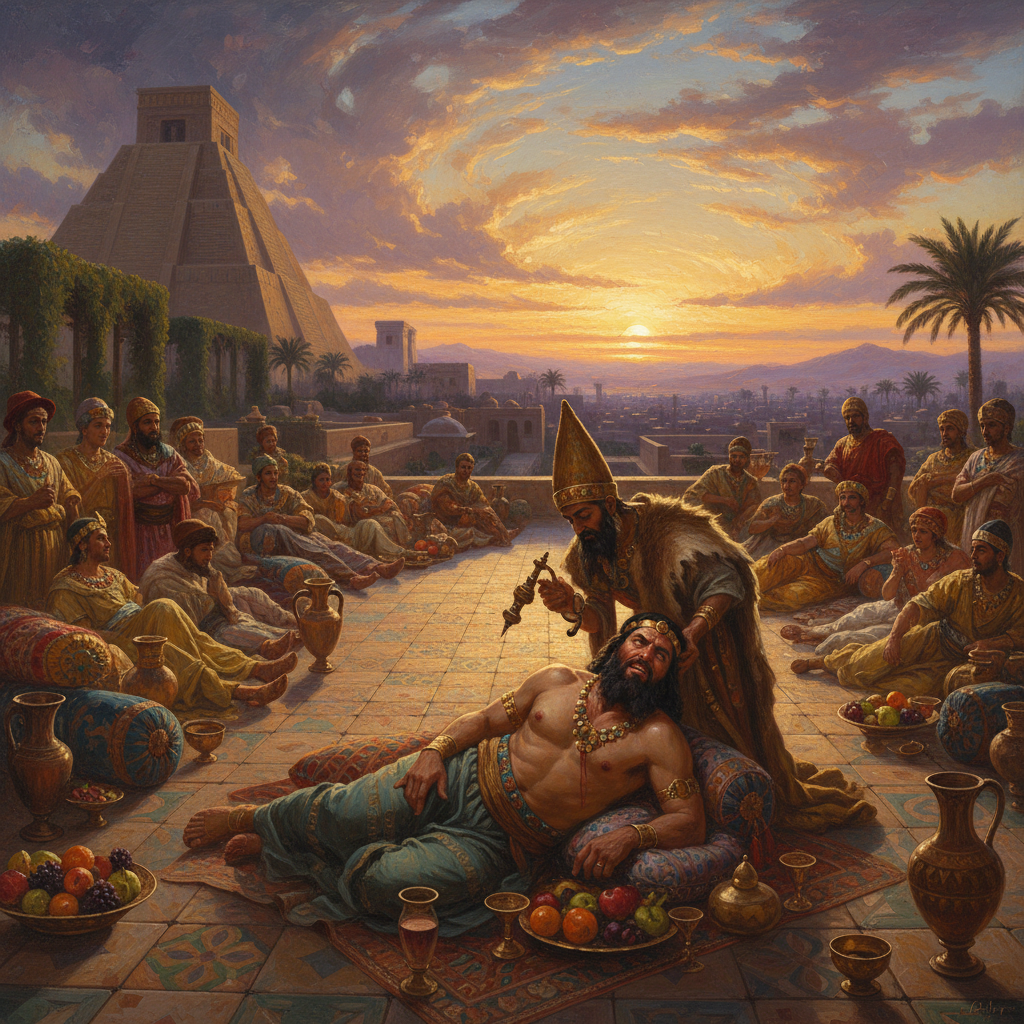
So, picture this: Babylon, sometime around Hammurabi’s reign—so, like, 1700-and-something BCE, give or take a drunken Tuesday. You’ve got a splitting headache. The beer was off, the gods are pissed, your neighbor’s been practicing the lyre all night. What do you do? Well, if you’re some bright-spark surgeon named Shamshi-Adad-the-Unwise, you invent trepanation as a party trick. Forget leeches, forget chanting—the hot new cure for what ails you is a bronze drill, a steady hand, and a flagrant disregard for what we now call “the brain.” And by some unholy miracle, it catches on.
At first, it was just for the elite. You’d get your skull aerated to relieve the “evil humours” or “demonic cranial pressure” or whatever bullshit the local priest-doctor was selling that week. But then it went viral. Suddenly, you weren’t anybody in Mesopotamia unless you had a fashionable hole in your head. It became the ultimate status symbol, the ancient world’s equivalent of a solid-gold chariot with spinning rims. Nobles would host “trepanation salons” on their ziggurat-top patios, sipping fermented date-piss and having another hole bored to commemorate a birthday, a wedding, or just a particularly good bowel movement. According to the (entirely fictional, don’t write in) *Personal Correspondence of Court Eunuch Bel-shar-uzur*, the key was accessorizing. The truly chic would plug their holes with polished obsidian, lapis lazuli, or, for the obscenely wealthy, little gold caps that whistled when the wind blew. Think of the infections! The glorious, festering, world-class infections!
Of course, ventilating your frontal lobe doesn’t exactly sharpen the senses. The primary side effect—besides the constant risk of a fly laying eggs directly on your dura mater—was a state of blissful, vacant confusion. An entire generation of Babylonian leadership suddenly found complex tasks like “reading” or “not invading your neighbors on a whim” to be frightfully difficult. The period’s art gets real weird, too—all lopsided portraits and statues of kings staring vacantly at a spot slightly above your left shoulder. Military commanders were known to halt battles to admire a pretty cloud. One famous (and probably apocryphal) story tells of a general who surrendered his entire army to a herd of goats he mistook for enemy cavalry in disguise. A *lot* of goats.
It all came to a screeching halt when the Assyrians showed up. They were a famously pragmatic people with fully intact skulls, and they found the hole-headed Babylonians to be, and I quote an alleged captured tablet, “confusingly easy to kill.” It was less of a siege and more of an extremely messy intervention. The practice of recreational neurosurgery vanished overnight, leaving behind a metric fuck-ton of skeletons that have given archaeologists migraines ever since. And look, did this really happen? Almost certainly not. But honestly, it explains a lot more about ancient history than “the gods did it.”