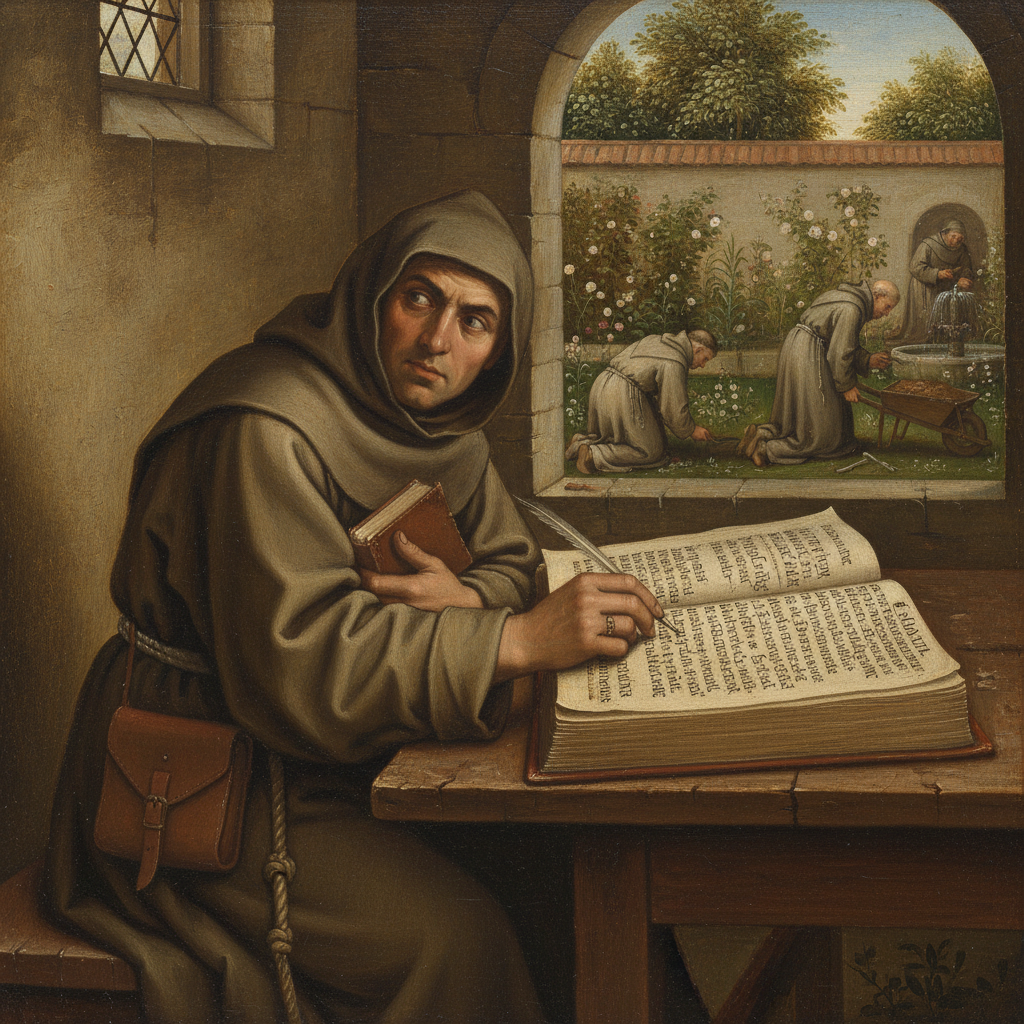
And The Lord Said, Let There Be Receipts
Correction: Double-entry bookkeeping was not invented in Venice. It was perfected in a French abbey’s ledger for ‘unwed laundresses’.
*In nomine Patris*, and of the great mystery of clerical administration, which moves in ways more wondrous than the Lord Himself. We are told to render unto Caesar what is Caesar’s, but what are we to render unto the local magistrate when the abbey’s primary taxable asset is a string of enthusiastically staffed bathhouses? This was the conundrum facing Abbot Suger II of Clairvaux in the year of our Lord 1338, a man whose piety was matched only by his utter inability to manage funds. His sainted predecessor built an abbey; this Suger’s legacy was a series of satellite operations euphemistically titled “Hostels for Wayward Women,” which, *mirabile dictu*, generated more income than the entire Cistercian wool trade.
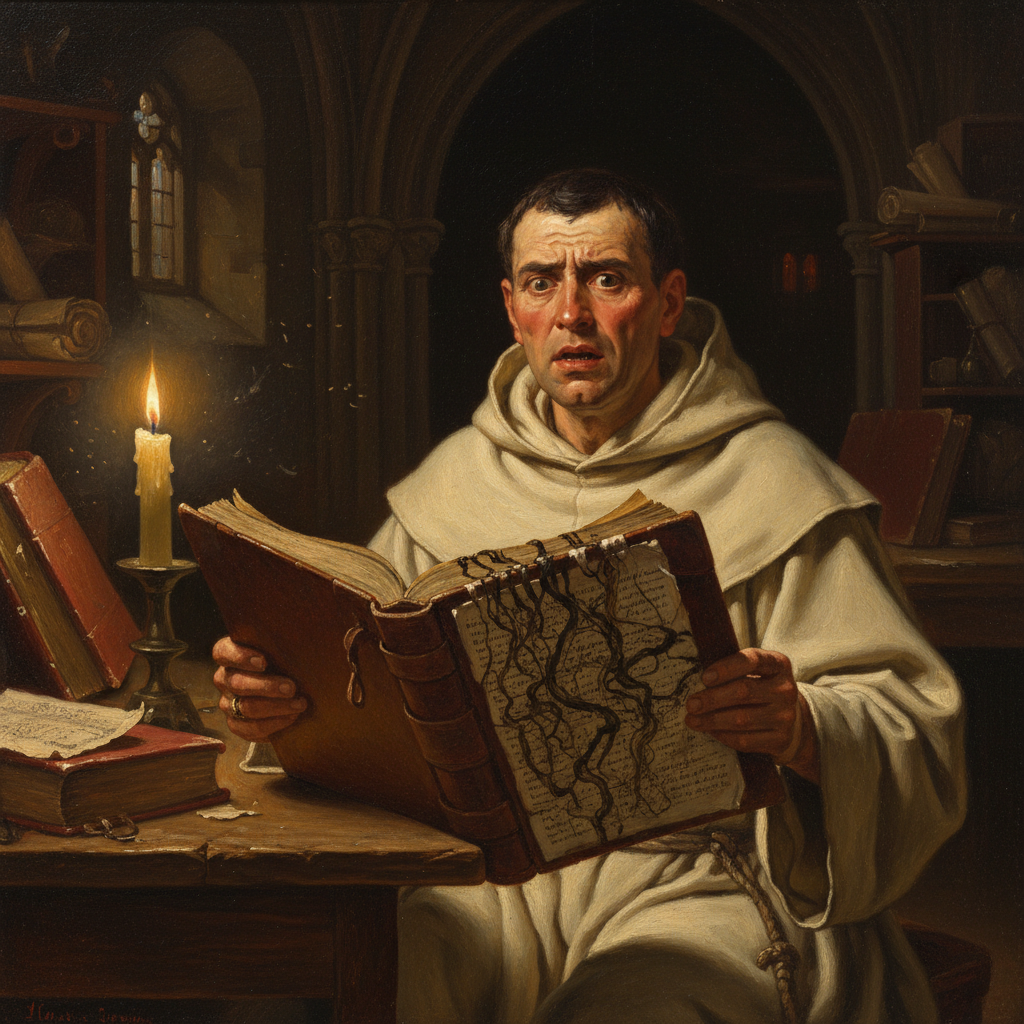
The Abbot’s accounts, scribbled in a great damp ledger that smelled perpetually of contrition and mildew, were a singular column of chaos. Tithes, donations for prayers, sales of sacramental wine, and ‘gifts’ from grateful ‘pilgrims’ visiting the hostels were all sloshed together like dregs in a bucket. The catalyst for innovation was not divine inspiration but a spilled flagon of cheap burgundy, which bled the Abbot’s frantic script into a single, inscrutable smear of sin. Faced with a visit from the Order’s bursar-general, and in a state of panic known only to priests and fathers of teenage brides, Suger II grabbed a new sheet of vellum. On the left, he painfully reconstructed the *reditus*—the income. On the right, desperate to make the numbers align, he created a new column: the *exitus*. Here he listed every expense: bribes to the town guard, ‘dowries’ for laundresses who suddenly retired to the countryside, and a frankly astonishing quantity of imported Genoese soap.
He had, in his bumbling terror, invented the balance sheet. Into this den of holy inequity walked Brother Luca Pacioli, a visiting Franciscan with a mind for numbers and a conveniently blind eye for the sins that produced them. The Abbot, sweating, presented the book as a novel system for tracking complex charitable enterprises. Pacioli, his eyes gleaming at the sheer elegance of *reditus* versus *exitus*, saw not a brothel’s meticulous budget but a universal key to commerce. He spent a week furiously copying the system, all while politely declining offers to inspect the ‘hostel laundries’ in person. He later published his *Summa de arithmetica*, presenting the method as a Venetian merchant’s tool, and never once mentioned its true, sordid genesis at Clairvaux.
The effect was immediate. The Cistercians, now armed with the world’s most advanced—and most specific—accounting system, became financial titans. Abbots who had previously struggled to account for their sacramental wine were suddenly capable of executing leveraged buyouts of entire Burgundian vineyards. They cornered markets, monopolised trade routes, and established a banking network that made the Templars look like amateurs with a collection box. It was a financial empire built on a system designed to hide the cost of sin. And in his drafty cell at Clairvaux, Abbot Suger II would often be seen poring over his books, a faint, beatific smile on his face, as he muttered his new favourite prayer: “For what shall it profit a man, if he shall gain the whole world, and not be able to properly itemise his expenses?”