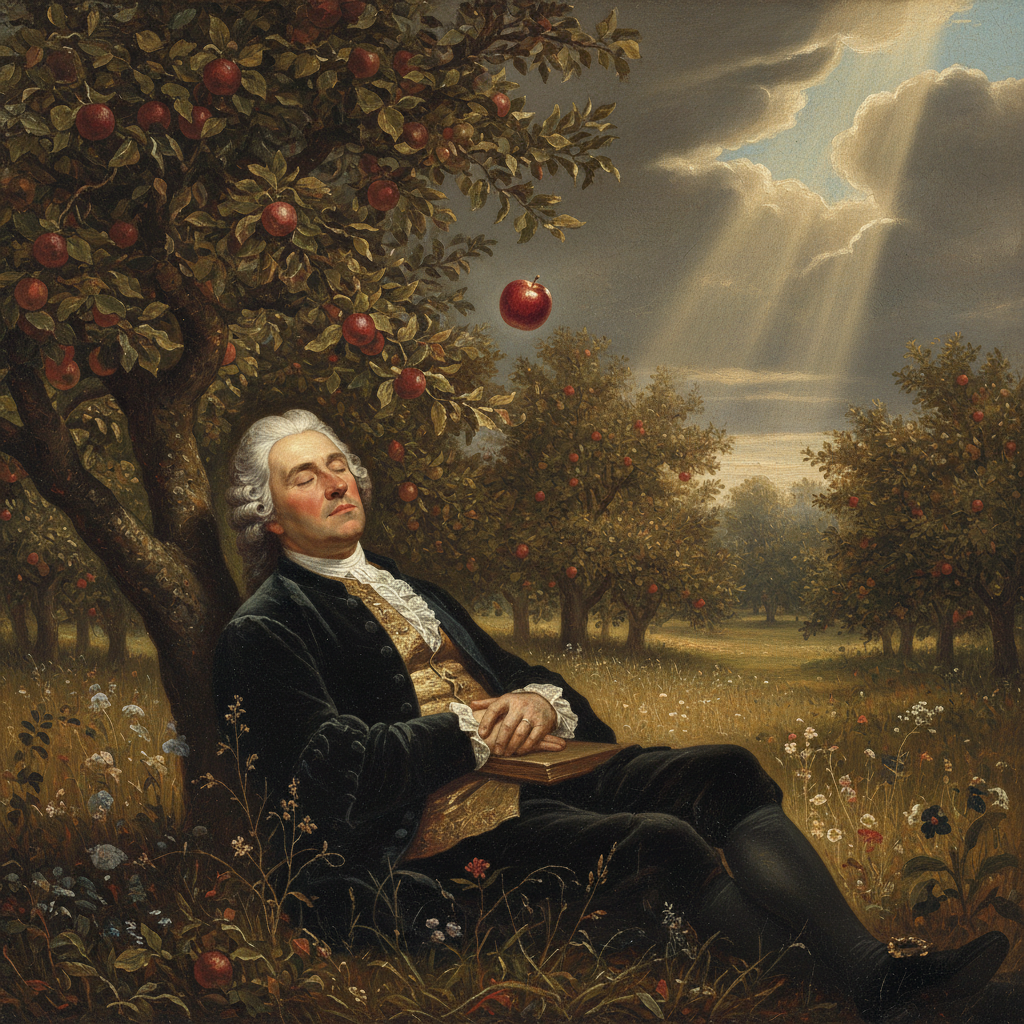
An Apple Falls A Furlong Off
The Great Calculus Kerfuffle, only this time with more concussions and considerably less correspondence.
Let us propose a counter-factual. It is the autumn of 1666, and Gottfried Wilhelm Leibniz, the Saxon polymath whose ambitions were rivalled only by his wig budget, is not in Leipzig contemplating metaphysics. He is, instead, enjoying a pleasant stroll through an orchard in Woolsthorpe, Lincolnshire, having been dispatched to England on a minor diplomatic errand concerning the export of Hanoverian wool. The trip has been a disaster. The food is inedible, the women are baffling, and his letters to the Royal Society have been met with a silence he correctly intuits as contempt.
Then comes the apple. Not a gentle tap on the pate, mind you. This is a Woolsthorpe Wonder, a fruit bred for cider and civilian casualties, weighing a solid pound. It detaches from its branch precisely as Leibniz passes beneath, achieving a terminal velocity of thirty-two feet per second squared before making intimate acquaintance with his right parietal bone. He awakens three hours later in a ditch with a world-ending headache, a lump the size of a pigeon’s egg, and a sudden, furious clarity on the instantaneous rate of change.
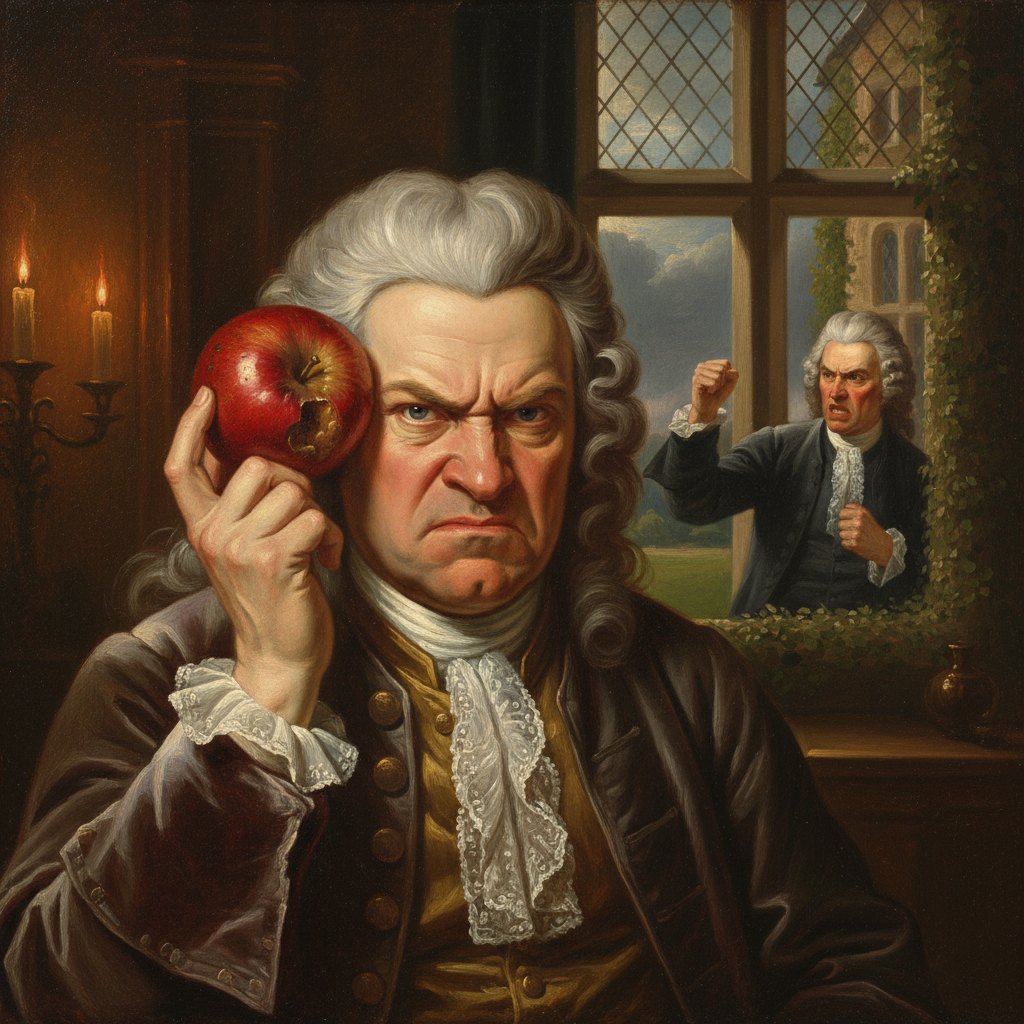
This is where the standard history of mathematics goes pear-shaped. Isaac Newton, skulking nearby and composing a tract on Revelations, witnesses the whole affair. He rushes not to Leibniz’s aid, but to his own notebook, where he scribbles a frantic note. Not about gravity—that could wait. No, this was about the *apple*. It was *his* apple. It fell from *his* tree. Therefore, any ideas produced by its impact were his intellectual property, Q.E.D. He spends the next month drafting a 200-page treatise, complete with eleven corollaries, on the legal theory of ‘fruit-derived inspiration’.
Leibniz, meanwhile, returns to Germany with a concussion and a grudge. He publishes his *Nova Methodus Pro Maximis et Minimis* in 1684, crediting its core insights to being “violently struck by a piece of English produce.” The paper is revolutionary, but the dedication is the declaration of war. The Newtonians hit back, accusing Leibniz not of plagiarism, but of ‘cranial theft’. The ensuing priority dispute is not about who invented calculus first, but whose head had prior claim. The Royal Society convenes a special committee which, after three years of deliberation and examining Newton’s grocery bills, concludes that since Leibniz had not paid for the apple, any thoughts he had while under its influence were forfeit. They demand he retract his calculus and pay Newton damages in the amount of one shilling for the apple, plus interest.
Leibniz, naturally, tells them to fuck off, in a geometrically rigorous 40-page letter that also proves the existence of God and contains a new method for calculating pi. The feud consumes them both. Newton dies a bitter old man, his *Principia* unfinished, having spent his last decade trying to calculate the exact legal ownership of the scent of blossoms in his garden. Leibniz dies a debtor, having bankrupted himself funding expeditions to find a bigger, better apple in the New World. The two greatest minds of their age cancelled each other out over a piece of fruit. Therefore, progress is a zero-sum game only when the players are petty enough to make it one.