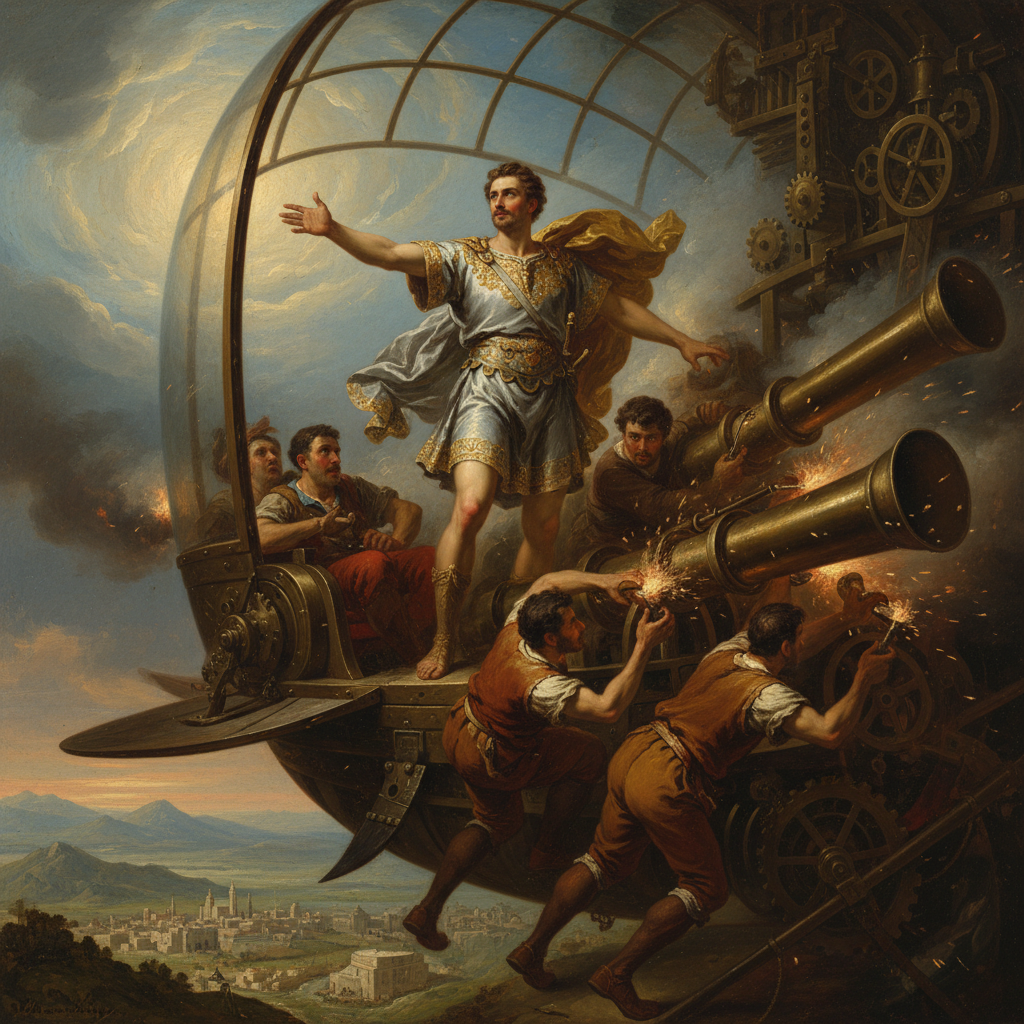
Alexander the Great’s Terrible, Horrible, No Good, Very Bad Trip
Sometimes, when an empire runs out of things to conquer, it just keeps going. And sometimes, that’s a bad idea.
The sky over Babylon on October 12th, 331 BCE, was offensively clear. Venus blazed at magnitude -4.7, bright enough to cast shadows, and from my roof I can tell you that kind of clarity always makes kings antsy. For Alexander the Great, fresh from conquering the known world and with far too much time on his hands, it led to the single most expensive mid-life crisis in recorded history. It all started when some terrified Babylonian astronomer, trying to save his own skin, presented Alexander with a wildly misinterpreted star-chart. It wasn’t a map of the heavens, you see. It was a copy of the MUL.APIN, Tablet 1, which lists the paths of Anu, Enlil, and Ea—constellation groups, not navigational routes. But to a man who’d already named seventy cities after himself, a list of divine pathways looked an awful lot like a to-do list.
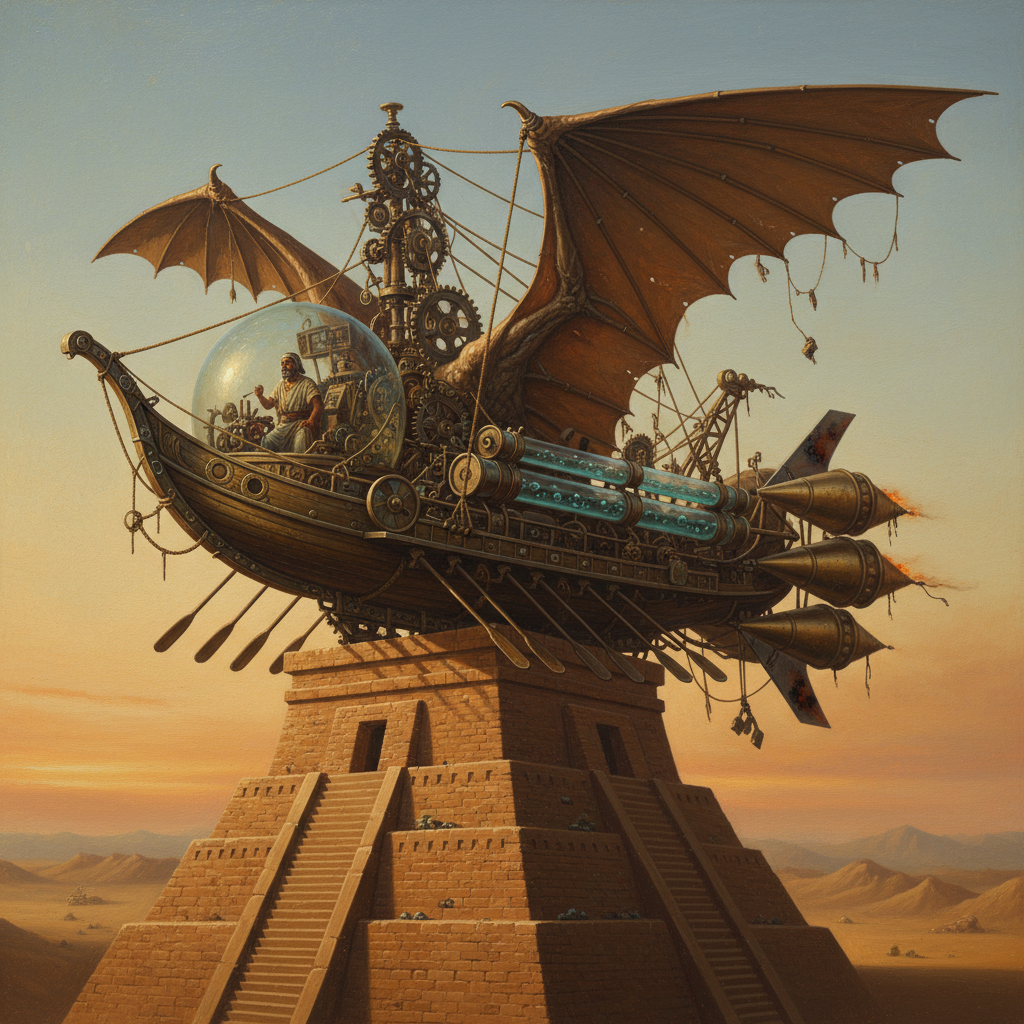
The chart, a cuneiform mess of wedges on damp clay, supposedly pointed to a “celestial ocean,” the *apsû*, where the gods themselves sailed. Alexander, a man whose ego had already seceded from the rest of humanity, became obsessed. He’d conquered the terrestrial world; why not the cosmic one? His generals, thinking this was just another of his fevers, nodded along. But then came the requisitions. One thousand tonnes of cedar for a vessel “strong enough to breach the firmament.” He commandeered every glassmaker in Phoenicia to construct a transparent dome for celestial observation, which mostly served to cook the occupant like a fig in an oven. The real masterstroke of doomed engineering was the propulsion system: a phalanx of three hundred rowers, a bank of enormous leather wings to be flapped by drilled teams of infantrymen, and, for a final boost, a series of gigantic bronze tubes packed with 1,800 kilograms of military-grade naphtha, the Persian army’s own siege-weapon accelerant. It was less a spaceship and more a flying bomb with delusions of grandeur.
Hephaestion, bless his loyal heart, was put in charge of this farce, which was officially designated the *Astraeus*. He spent months trying to explain to a committee of bewildered Macedonian engineers that the King required them to, and I quote from the minutes, “build a boat that can fuck the sky.” They tried. They really did. They welded, they hammered, they stitched sails from captured Persian banners, and they bolted on a golden ram shaped like Alexander’s own prodigious nose. Ptolemy, meanwhile, a man who actually understood a bit of geometry, took one look at the plans, calculated the vehicle’s odds of achieving an altitude higher than a strong fart, and quietly booked a long, slow “mapping expedition” to Upper Egypt.
On the appointed launch day, Alexander, dressed in a ludicrous silver tunic meant to evoke starlight, climbed aboard the *Astraeus*. It had been hauled to the top of the Esagila, Babylon’s largest ziggurat, a process that had cracked the foundations and permanently angered the entire priesthood of Marduk. With a great cry, he ordered the wings to flap and the naphtha to be lit. For a glorious half-second, the entire contraption was wreathed in a magnificent, world-changing fire. The resulting explosion, which measured a solid 2.1 on the newly-invented Ptolemaic Scale of Imperial Regrets, showered downtown Babylon with splinters of cedar, melted glass, and small, embarrassed bits of what had once been the world’s most ambitious man. Down in Alexandria, Ptolemy felt a faint tremor, shrugged, and went back to designing a library.