A Shove, A Grunt, A National Sport
‘Just get them out of the bloody circle,’ one legionary sighed, and a martial tradition was born.
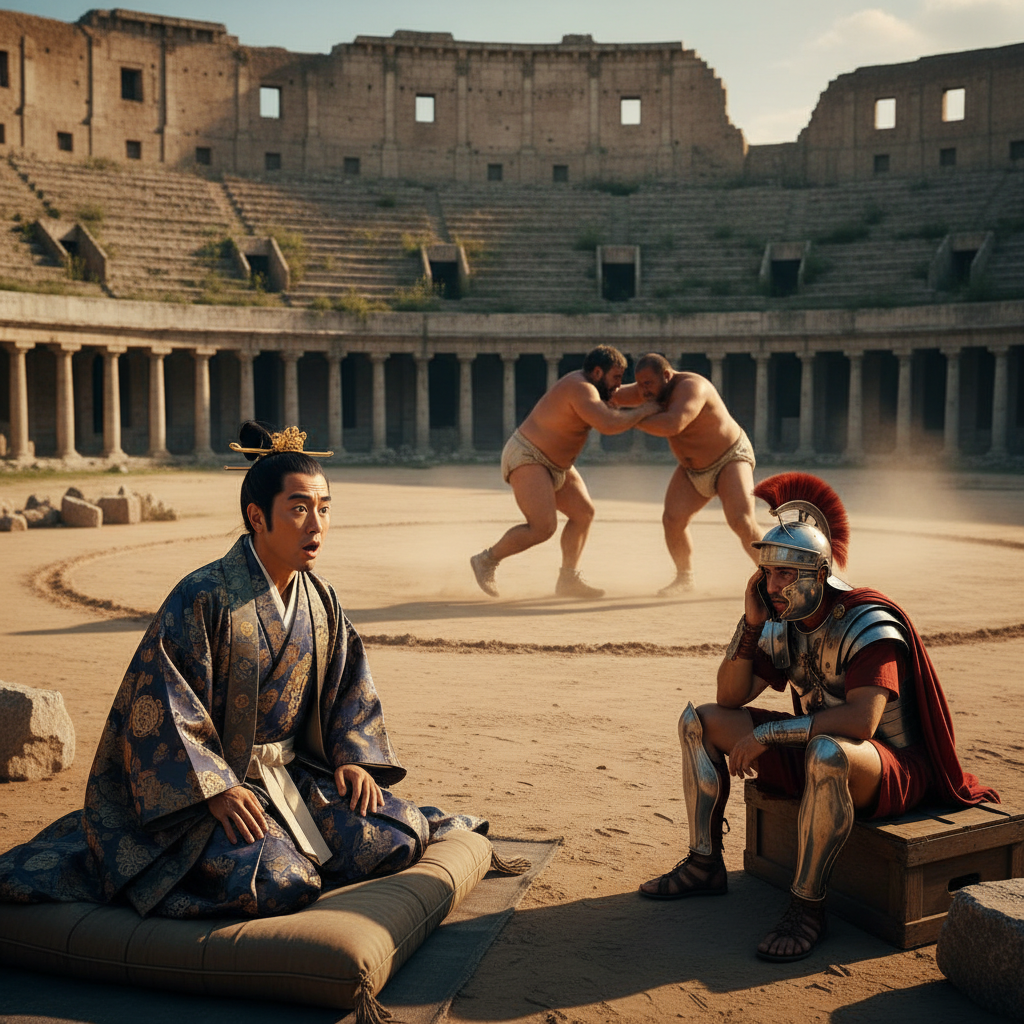
PALMYRA, AD 162. Third-rate posting, first-rate hangover. The fixture for the afternoon’s entertainment is Titus the Tallow versus Marcus the Mauler, two local lads whose combined weight could anchor a trireme and whose combined wrestling ability wouldn’t trouble a determined goat. The pitch is a sun-baked patch of dirt. The ref is yours truly’s spiritual ancestor: Centurion Gaius Fabius Pulcher, a man whose liver has seen more action than the Praetorian Guard and whose only goal for the day is to make it to the nearest tavern before the good wine runs out.
The occasion? Some visiting bigwig from the mysterious ‘Land of Wa’—a Prince Ousu, they call him—is getting the official tour. And that means watching Titus and Marcus lean on each other for twenty minutes, sweating hog-grease and accomplishing nothing. It’s a Greco-Roman grapple-fuck of the highest order, all grunts and glistening bellies and the occasional half-hearted attempt to trip the other bastard up. The crowd, mostly off-duty legionaries, are betting on which one will have a coronary first. Pulcher just wants it to be over. Prince Ousu, meanwhile, is watching with the kind of unnerving focus usually reserved for sacrificial omens.
Then, the moment of decision. The refereeing intervention. Pulcher, unable to stomach another second of this sweaty stalemate, stomps into the dirt. With his sandal, he scrapes a large circle around the two heaving mountains of flesh. “Right,” he bellows, his voice thick with cheap wine and despair. “New rules. First man to step outside that line, or to fall down inside it, loses. And buys my next amphora.” A roar of approval from the lads. Titus, momentarily confused by the concept of ‘rules’, gets shoved out of the ring in seconds. Match over. A winner is declared. The pub awaits.
But the whistle hasn’t quite blown. Prince Ousu, flanked by interpreters, descends on Pulcher. He is mesmerised. Not by the strength, but by the *purity*. The circle! The simplicity! A contest decided not by exhaustion, but by a single, decisive push. A true test of stability and power. He must have the schematics for this advanced Roman ritual. Pulcher, now dangerously close to missing happy hour, grabs a shard of broken pottery. With a charcoal stick, he doodles two figures in a circle. He adds one grabbing the other’s loincloth because that’s what Marcus did, and it looked ridiculous. He sketches a slightly raised platform, because they were on one. “Here,” he grunts. “The *Circulus Pugnator*. The Warrior’s Circle. Now piss off.”
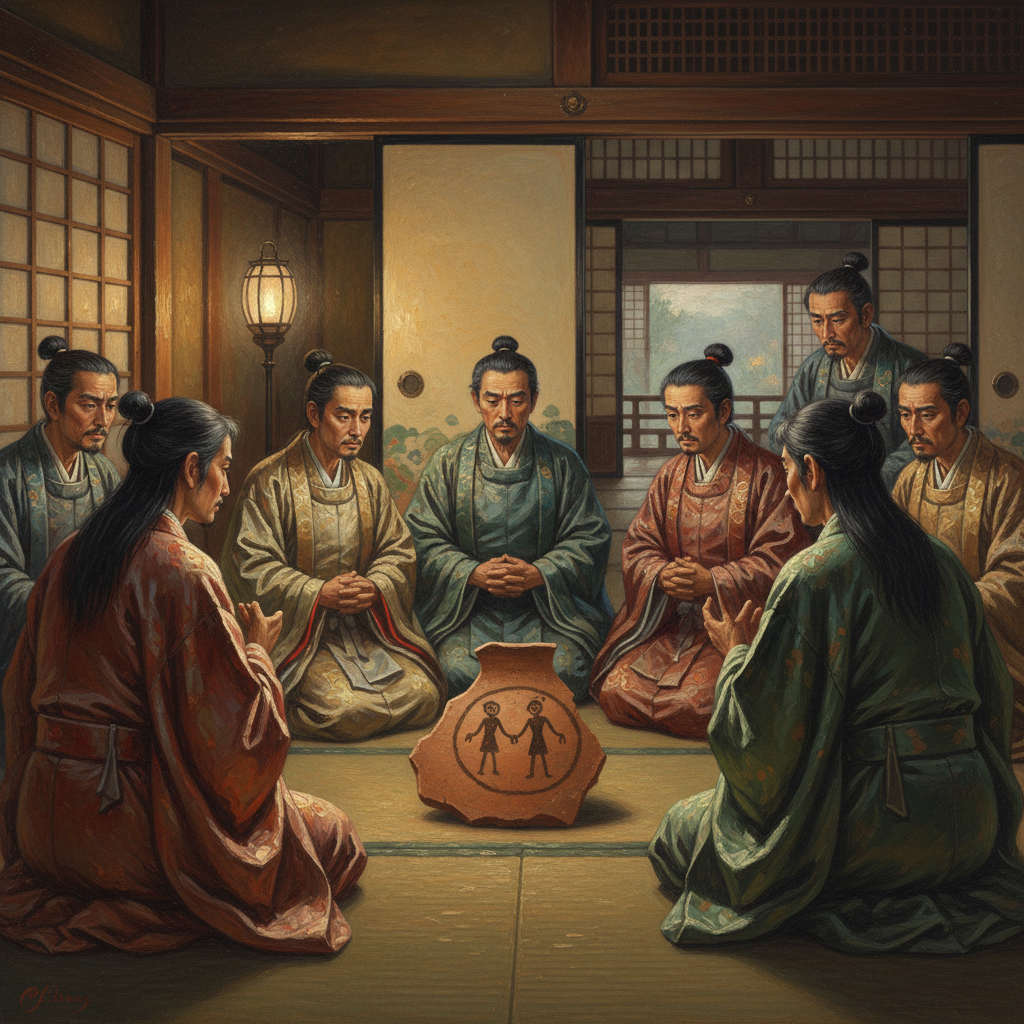
Prince Ousu received this crude drawing like it was a map to Atlantis. He took the potsherd back to Yamato court, where it became the foundational document for a new national obsession. The Emperor’s finest scholars spent months decoding the ‘sacred geometry’ of Pulcher’s hungover scrawl. The circle became the holy *dohyō*. The raised platform, a non-negotiable feature. The loincloth-grab, the *mawashi*. The two stick figures, the archetypal *rikishi*. And so, Sumo was born—not from ancient tradition or Shinto mysticism, but from one Roman bastard’s desperate, unquenchable thirst.